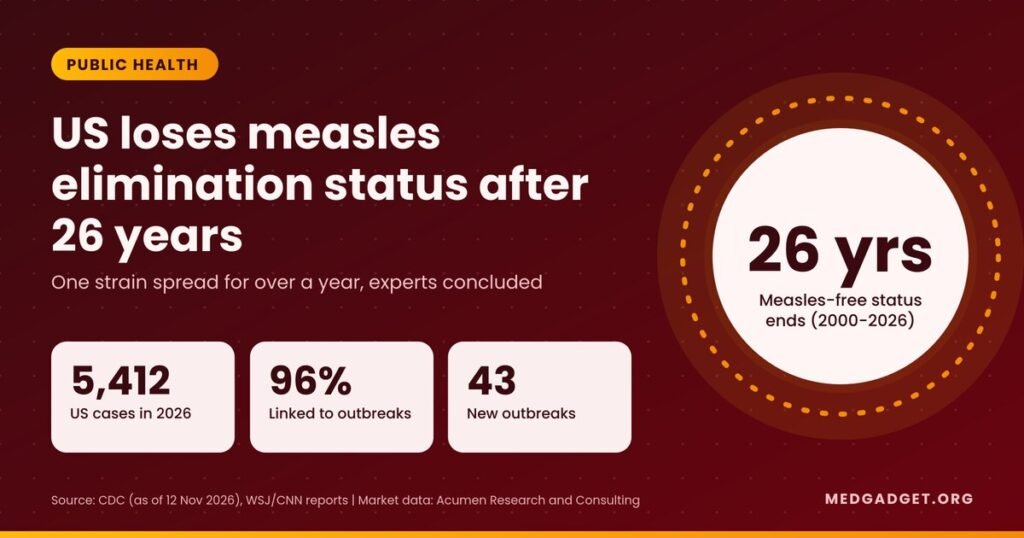

The US loses measles elimination status after 26 years: an independent expert commission that reports to the Pan American Health Organization (PAHO) has concluded that measles transmission in the United States has continued for more than a year, according to reports by The Wall Street Journal and CNN on 13 November 2026. The decision lands as the CDC counts 5,412 confirmed cases this year as of 12 November, the highest annual total since 1991, spread across 47 jurisdictions and 43 new outbreaks.
Key takeaways on US loses measles elimination status
- A PAHO-linked verification commission has judged that the US no longer meets the definition of measles elimination, which it had held since 2000. The finding was reported by the WSJ and confirmed to CNN by a source close to the process; we had not seen a formal PAHO statement at the time of writing.
- Elimination ends when one chain of the same virus strain circulates inside a country for 12 months or more. Genomic data from Utah showed one strain behind more than 95% of cases there between June 2025 and June 2026.
- CDC data show 5,412 cases in 2026, 96% of them linked to outbreaks, and six confirmed deaths. State health departments report at least 10 measles-associated deaths.
- Losing the status does not change who should be vaccinated. Two doses of MMR vaccine remain about 97% effective at preventing measles, according to the CDC.
- Canada lost its status in 2025. The US decision deepens a setback for the Americas, which PAHO had declared measles-free in 2016.
What the commission decided, and what is still unconfirmed
PAHO’s regional verification process reviewed US surveillance and laboratory data this week, a meeting we previewed in our explainer on what PAHO was deciding. Reports on Friday said the experts concluded the US could no longer be classed as having eliminated measles. Two details remain open: the exact wording PAHO will publish, and whether US health agencies will contest the evidence. Coverage we reviewed did not include a statement from the CDC or HHS on the decision itself.
The technical test is narrow. Countries are judged on whether a single lineage of measles virus keeps spreading person to person for at least a year. Virologists sequence samples from different outbreaks to check whether they are linked. Utah’s public health laboratory published a preprint in August showing one strain accounted for more than 95% of its cases as the outbreak moved from the southwest of the state into central Utah, producing more than 600 cases in a year. Long outbreaks in South Carolina, Pennsylvania, Wisconsin and New York added to the picture.
The 2026 numbers behind the decision
| Measure | Figure | Source |
|---|---|---|
| Confirmed US cases, 2026 | 5,412 (as of 12 Nov) | CDC |
| Jurisdictions reporting cases | 47 (plus 18 cases in international visitors) | CDC |
| New outbreaks in 2026 | 43 | CDC |
| Share of cases linked to outbreaks | 96% (5,216 cases) | CDC |
| Deaths confirmed by CDC | 6 | CDC |
| Deaths reported by states | At least 10 | State health departments |
| Pennsylvania cases / deaths | 1,542 / 7 | Pennsylvania officials via Reuters |
| Wisconsin cases / child deaths | 649 / 2 | Wisconsin DHS |
| Weekly increase in the latest CDC update | 230 cases | CDC |
By our calculation, the latest weekly jump of 230 cases works out to roughly 33 new confirmed infections a day, so the outbreak is still growing rather than winding down. CDC data also show the overwhelming majority of 2026 cases were in people who were unvaccinated or whose vaccination status was unknown, and roughly one in nine patients needed hospital care.
Does losing elimination status change anything for families?
Practically, the virus is the same and so is the protection. What changes is the risk baseline. When measles is eliminated, most cases start with an import from abroad and burn out. When it is endemic, an unvaccinated child can catch it from a chain that has been circulating locally for months. Measles can cause pneumonia, encephalitis, pregnancy complications and, years later, a rare fatal brain disease called SSPE. Its main protection is herd immunity of around 95% coverage, and kindergarten MMR coverage has been sliding while nonmedical exemptions have risen.
Public health experts quoted in the coverage described the loss as a warning about preparedness. Peter Hotez of Baylor College of Medicine put it bluntly: “Basically, measles is back.” Johns Hopkins epidemiologist William Moss said the task now is to regain the status, which requires breaking every chain of transmission for at least 12 months.
Can the US get measles elimination back?
Yes, in principle. A country regains elimination once it shows, with strong surveillance and genomic evidence, that no endemic strain has circulated for at least a year. That is hard while dozens of outbreaks remain active and vaccine policy is contested at the federal level, with some officials, including President Trump, having questioned measles vaccine safety and effectiveness. Mexico, which has also had large outbreaks, is seen as at risk of a similar finding. For context on how one state’s outbreak grew, see our earlier analysis of Pennsylvania measles cases.
Market context: childhood vaccines
Measles prevention rests on routine childhood immunisation, a large and growing market. According to Acumen Research and Consulting’s pediatrics vaccines market report, the global market was valued at USD 51.0 billion in 2022 and is projected to reach USD 160.6 billion by 2032, a CAGR of 11.1%. North America held the leading regional share, while Asia-Pacific is forecast to grow fastest. These figures come from a report last updated in March 2023 and should be read as indicative; they do not model the effect of falling US uptake.
What to watch next
- A formal written statement from PAHO and any response from the CDC or HHS.
- Weekly CDC case updates (published on Wednesdays) to see whether the growth rate slows into winter.
- State school-entry MMR coverage data and exemption rates for the 2026-27 school year.
- Whether Mexico’s status is reviewed next, which would leave large parts of North America endemic again.
Frequently asked questions
Did the US lose its measles elimination status?
Yes, according to reports on 13 November 2026, a PAHO-linked expert commission concluded the US no longer meets the elimination definition because one measles strain has spread for more than a year. A formal PAHO statement was still awaited at the time of writing.
How many measles cases are there in the US in 2026?
The CDC reported 5,412 confirmed cases as of 12 November 2026, across 47 jurisdictions, the most since 1991.
What does endemic measles mean?
It means measles is spreading continuously within the country rather than arriving mainly through imported cases. The cut-off is 12 months of continuous transmission of the same virus lineage.
Is the MMR vaccine still effective?
Yes. The CDC says two doses are about 97% effective and one dose about 93% effective against measles. Talk to a doctor about your own or your child’s vaccination record.
More public health coverage: Healthcare Services.
Sources: CDC measles cases and outbreaks (updated 13 Nov 2026); reporting by The Wall Street Journal, CNN and Reuters; Wisconsin DHS. Market data: Acumen Research and Consulting. This article is for information only and is not medical advice. Last updated 14 November 2026.