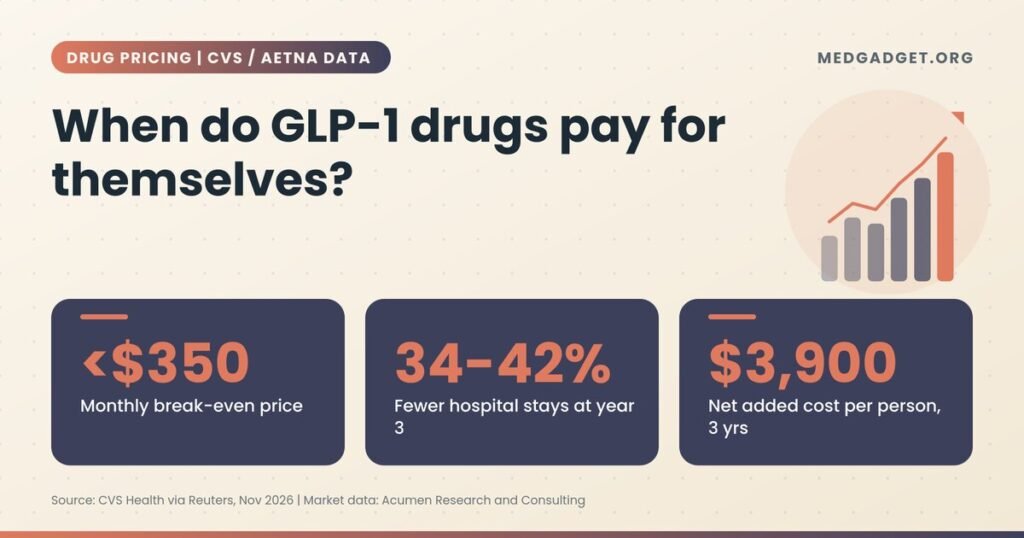

A new CVS GLP-1 study of Aetna insurance claims, disclosed to Reuters on 14 November 2026 ahead of the HLTH USA conference in Las Vegas, finds that employers would roughly break even on drugs such as Ozempic, Wegovy, Mounjaro and Zepbound if they paid less than $350 a month. At today’s prices the drugs still add to total spending: over three years, CVS counted $9,400 in medical savings per person against $13,300 in extra prescription costs, leaving a net added cost of $3,900.
Key takeaways on the CVS GLP-1 study
- CVS says plan sponsors break even on GLP-1s at a net price below about $350 per month.
- Emergency room visits fell 10% to 12% in the first two years of use.
- Hospitalisations were 34% to 42% lower among about 4,000 people still on treatment after three years.
- Medical savings did not yet cover drug costs: net added cost was $3,900 per person over three years.
- Employers currently pay roughly $617 to $766 a month, so prices would need to fall by about 43% to 54% to hit $350, by our calculation.
- CVS will present the findings at HLTH on 15 November. The analysis has not been published in a peer-reviewed journal.
How CVS ran the numbers
CVS Health, which owns the insurer Aetna and the pharmacy benefit manager Caremark, compared people newly starting Eli Lilly or Novo Nordisk GLP-1 drugs between 2023 and 2025 with similar patients who did not take them. The drugs included Mounjaro and Ozempic, approved for type 2 diabetes, and Zepbound and Wegovy, approved for weight management. Patients were followed for up to three years.
The groups shrink over time because many people stop these drugs. About 60,000 people were in the first-year analysis, 20,000 in the second year, and 4,000 who were still on treatment at three years. CVS did not break out results for people treated only for obesity, which matters because that is the use employers are most likely to drop.
The cost ledger, side by side
| Measure (per person) | Three-year total | Monthly equivalent (by our calculation) |
|---|---|---|
| Medical savings (fewer ER visits, admissions) | $9,400 | about $261 |
| Added prescription spending | $13,300 | about $369 |
| Net added cost | $3,900 | about $108 |
Read this way, the gap between what the drugs save and what they cost is a little over $100 a month per person. That is why CVS lands on a break-even threshold far below the prices most employers pay today.
Where $350 sits against today’s GLP-1 prices
| Price point | Monthly cost |
|---|---|
| Medicare pilot price agreed with Lilly and Novo (injectables) | $245 |
| Zepbound cash-pay price | about $299 |
| Wegovy cash-pay price | about $349 |
| CVS break-even estimate | under $350 |
| What employers and plans pay (EBRI, 2025) | $617 to $766 |
CVS chief medical officer Dr. Amy Compton-Phillips told Reuters that drugmakers’ own direct-to-consumer prices suggest they can still make money below $350. “I hope that we can reach that price sooner rather than later,” she said. She added that the break-even point depends on the patient: higher-risk people, who are more likely to end up in hospital, pay back the investment faster. The self-pay channel has been growing quickly, as seen in our coverage of Zepbound on Hims & Hers.
Why this lands as employers pull back
Coverage of GLP-1s for weight loss is shrinking. Reuters reports that about 14% of companies have dropped these drugs or plan to in 2027, as employer health premiums are expected to rise by more than 9% next year. For a benefits manager, the CVS data offers two messages at once: the drugs do appear to reduce costly emergency and hospital care, but not by enough to pay for themselves at current net prices.
The study also gives CVS, as a pharmacy benefit manager, a public number to bring to price talks with Lilly and Novo. That is worth keeping in mind when reading it. The company has a commercial interest in lower drug prices, and it declined to say what plans currently pay on average after rebates.
Limits of the analysis
- Not peer reviewed. The findings come from a company analysis and a conference presentation.
- Survivor effect. The three-year hospitalisation result covers only the 4,000 people who stayed on the drug, who may differ from those who stopped.
- Mixed conditions. Diabetes and obesity patients are pooled, so the obesity-only economics are unknown.
- Short horizon. Benefits such as fewer heart attacks, strokes or joint replacements may take longer than three years to show up in claims.
Not every person with obesity is equally likely to benefit early, a point also raised by the Nature clinical obesity study we covered this week.
Market context
Acumen Research and Consulting estimated the global anti-obesity drugs market at USD 2.1 billion in 2022 and projected USD 8.2 billion by 2032, a CAGR of 14.6%, with prescription drugs holding the largest share and Asia-Pacific the fastest-growing region. That forecast was last updated in September 2023, before the biggest wave of GLP-1 demand and price cuts, so treat it as indicative. Price thresholds like the one CVS has now put forward are likely to shape how much of that demand employers are willing to fund.
FAQ
Do GLP-1 drugs save money?
Not yet at current prices, according to CVS. They cut ER visits and hospital stays, saving about $9,400 per person over three years, but added about $13,300 in drug costs.
What price makes GLP-1s break even?
CVS puts the break-even point for employers at a net price below about $350 per month, and sooner for higher-risk patients.
Will my employer keep covering Wegovy or Zepbound?
It depends on the plan. About 14% of companies have dropped or plan to drop weight-loss GLP-1 coverage in 2027. Check your 2027 benefits documents during open enrolment.
Which drugs were in the CVS analysis?
Mounjaro and Ozempic for diabetes, and Zepbound and Wegovy for weight management, in patients who started between 2023 and 2025.
Sources: Reuters via Investing.com (14 Nov 2026); CVS Health; Employee Benefit Research Institute. Market data: Acumen Research and Consulting. More in Pharmaceutical. Not medical or investment advice. Last updated 14 November 2026.