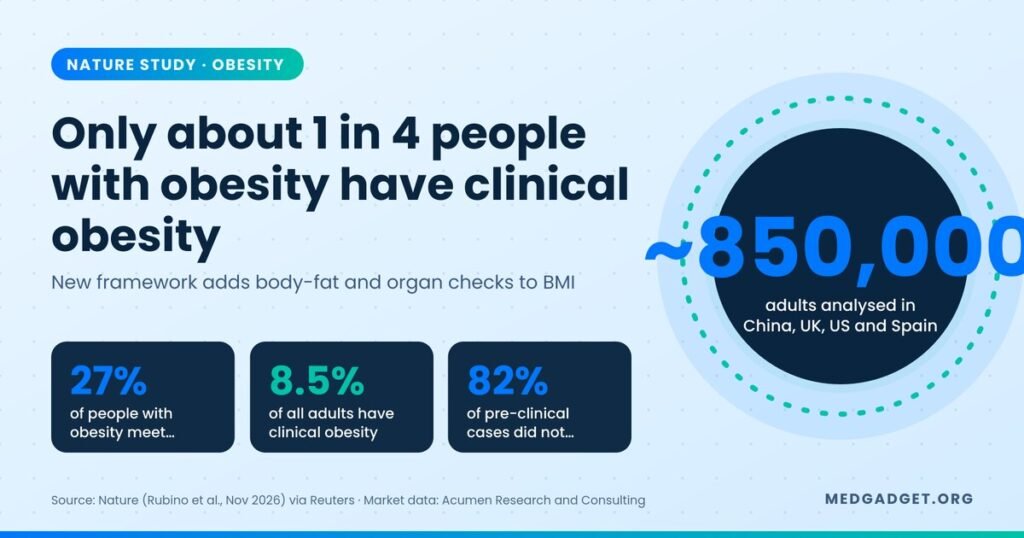

A clinical obesity study published in Nature on 11 November 2026 found that only about 27% of adults labelled obese by body mass index (BMI) actually show the weight-related organ damage that defines clinical obesity, roughly 8.5% of all adults across cohorts from China, the United Kingdom, the United States and Spain. The analysis of close to 850,000 people, led by Francesco Rubino of King’s College London, is the first large test of a diagnostic framework that splits obesity into an illness and a risk state.
Key takeaways on clinical obesity
- About 27% of people with obesity across four countries met the criteria for clinical obesity, meaning excess fat was already linked to organ dysfunction or limits on daily life.
- Around 82% of people with pre-clinical obesity did not progress to clinical obesity during follow-up, according to Reuters’ summary of the paper. Progression was more common in China and Spain.
- Adding waist and body-fat measures to BMI removed 1% to 3% of people from the obese category and added 5% to 9% who BMI had missed.
- The findings support treating clinical obesity as an active disease that needs prompt care, while pre-clinical obesity is managed as a risk to monitor and reduce.
- The study does not change any official guideline on its own. Health systems still rely on BMI for screening and for drug eligibility rules.
Why BMI alone is under pressure
BMI divides weight by height squared. It is cheap and quick, but it cannot tell fat from muscle, does not show where fat sits, and says nothing about whether a person’s heart, liver, joints or lungs are actually affected. Rubino, who chairs metabolic and bariatric surgery at King’s College London, acknowledged the measure’s long-known flaws to Reuters, adding: “But we haven’t so far got a better system.”
The framework tested here came from the 2025 Lancet Diabetes & Endocrinology Commission on clinical obesity, which Rubino chaired. It asks doctors to confirm excess body fat with a second measure, such as waist circumference, and then check for specific signs of organ dysfunction or reduced ability to carry out everyday activities. If those signs are present, the diagnosis is clinical obesity. If fat is high but organs still function normally, the diagnosis is pre-clinical obesity.
What the Nature study measured
The researchers applied the new definitions to population cohorts in four countries with very different body types, diets and health systems. The headline numbers reported so far are below.
| Measure | Result |
|---|---|
| Adults analysed | About 850,000 (China, UK, US, Spain) |
| People with obesity who had clinical obesity | About 27% on average |
| Clinical obesity as a share of all adults | About 8.5% |
| Pre-clinical cases that did not progress | About 82% on average |
| BMI-obese people reclassified as not obese | 1% to 3% |
| Additional people newly diagnosed with obesity | 5% to 9% |
| Implied obesity prevalence in the pooled cohorts | Roughly 31% (8.5 divided by 27, by our calculation) |
Two results stand out. First, the reclassification cuts both ways: a small group who look obese on BMI, often muscular people, drop out, while a larger group with normal-looking BMI but high waist or body-fat measures are brought in. Second, most people in the pre-clinical group stayed there, which suggests that a high BMI is a risk marker for many people rather than a disease already in progress.
What it means if you have a high BMI
For patients, the practical message is that a BMI number should start a conversation, not end it. Under the framework, a clinician would check waist size or body composition, then look for concrete problems such as breathlessness, high blood pressure linked to weight, fatty liver disease, sleep apnoea, joint pain that limits movement, or heart strain. Those findings, not the scale alone, would decide how urgent treatment is.
- Clinical obesity: treated as an active chronic disease. Options can include structured lifestyle programmes, anti-obesity medicines such as GLP-1 based drugs, and in some cases surgery.
- Pre-clinical obesity: treated as elevated risk. The focus is on monitoring, counselling and prevention, with drug treatment considered case by case.
This matters because demand for weight-loss drugs is high and supply and insurance budgets are finite. Recent safety updates, such as the FDA’s NAION eye warning for GLP-1 drugs, are a reminder that these medicines carry risks as well as benefits. A sharper way to identify who is already ill could help direct treatment to those most likely to gain from it. Readers should not change any treatment based on this study and should discuss their own situation with a clinician.
Limits and open questions
- Follow-up length and outcomes: the public summaries do not say how long people were tracked or how clinical obesity related to deaths, heart attacks or other hard outcomes. Those details sit in the full paper.
- Country differences: progression was higher in China and Spain, but exact rates were not given in reporting we could verify.
- Practicality: checking organ function takes more time and testing than a BMI reading, which could be hard for busy primary care clinics.
- Stigma and access: some clinicians worry that labelling people “pre-clinical” could be used to deny them treatment. Supporters argue it does the opposite, by recognising clinical obesity as a disease that deserves cover.
Market context
How obesity is defined shapes how many people qualify for treatment, and therefore the size of the market for apps, coaching and medicines. According to Acumen Research and Consulting’s digital health for obesity market report, that market was worth USD 48.1 billion in 2023 and is projected to reach USD 276.5 billion by 2032, growing at a CAGR of 21.7%, with services the largest component and Asia-Pacific the fastest-growing region. A stricter, function-based diagnosis could steer more of that spending toward people with clinical obesity, while widening monitoring tools for those in the pre-clinical group.
What to watch next
The key test is whether medical societies, the World Health Organization, and payers adopt the clinical versus pre-clinical split in guidelines and coverage rules. The WHO estimates that more than 1 billion people live with obesity worldwide, so even small changes in definitions affect millions. Expect debate over how the framework fits with existing drug labels, which are written around BMI thresholds, and over whether it can be applied fairly across ethnic groups that store fat differently. More coverage is in our Healthcare Services section, including our look at Zepbound pricing on Hims & Hers.
FAQ
What is clinical obesity?
Clinical obesity is excess body fat that is already causing measurable harm, such as organ dysfunction or a reduced ability to carry out daily activities. It is treated as an active chronic disease.
What is the difference between clinical and pre-clinical obesity?
Both involve confirmed excess body fat. In pre-clinical obesity, organs still work normally and the condition is mainly a risk factor. In clinical obesity, weight-related damage or functional limits are present.
Is BMI still used to diagnose obesity?
Yes. BMI remains the standard screening tool, but the new framework adds waist circumference or other body-fat measures and a check of organ function before a diagnosis is made.
How many people with obesity are actually ill?
In this Nature study, about 27% of people classed as obese met clinical obesity criteria, around 8.5% of all adults in the four countries studied.
Sources: Nature, “Validation of clinical and preclinical obesity across global cohorts”; Reuters reporting (11 Nov 2026). Market data: Acumen Research and Consulting. This article is for information only and is not medical advice. Last updated 12 November 2026.