
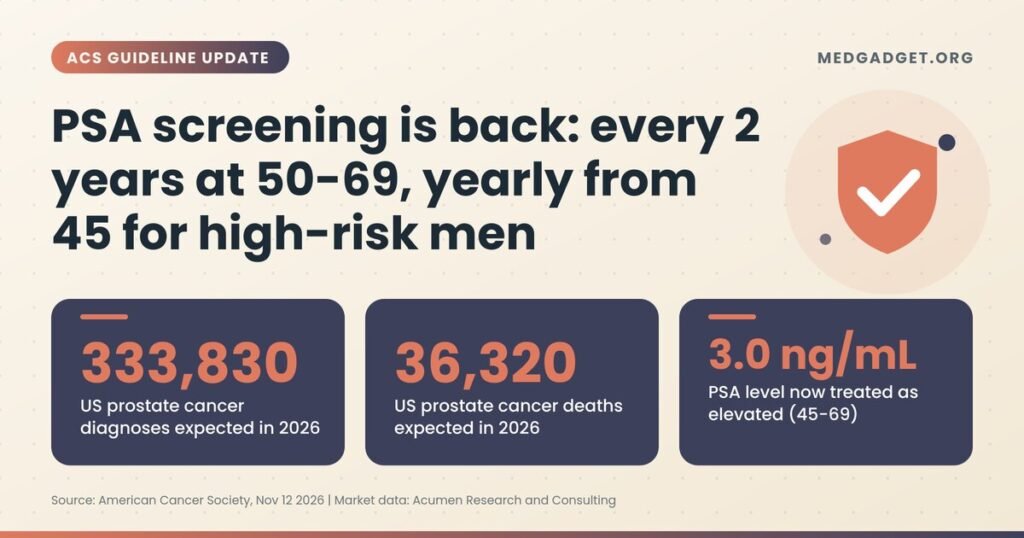

The prostate cancer screening guidelines from the American Cancer Society (ACS) changed on November 12, 2026: the society now recommends a PSA blood test every two years for average-risk men aged 50 to 69, and every year from age 45 for Black men and men with a strong family history. That replaces its 2010 position, which left testing to an individual conversation between a man and his doctor. The update was published in CA: A Cancer Journal for Clinicians as ACS projects about 333,830 new US prostate cancer diagnoses and 36,320 deaths this year.
Key takeaways on prostate cancer screening guidelines
- Average-risk men aged 50 to 69: PSA-based screening every two years, after a discussion of benefits, limits and harms.
- Black men and men with a strong family history: annual PSA screening from 45 to 69.
- A PSA of 3.0 ng/mL or higher counts as elevated at ages 45 to 69 and should be repeated within two weeks to three months.
- A confirmed high PSA should lead to an MRI and/or a validated biomarker test before any biopsy decision.
- Screening becomes an individual choice at 70 to 74 and is not recommended from 75 for most men, or at any age with a life expectancy under 10 years.
- The US Preventive Services Task Force (USPSTF) has not yet matched the change, which matters for insurance coverage.
The new ACS schedule, group by group
The biggest shift is that the ACS now gives men a default schedule instead of a decision aid. The table below summarises who is covered and how often, based on the society’s November 12 announcement.
| Group | Ages | Recommended PSA screening |
|---|---|---|
| Average risk | 50 to 69 | Every 2 years |
| Black men (any family history) | 45 to 69 | Every year |
| Non-Black men, first-degree relative diagnosed before 65, or several first-degree relatives at any age | 45 to 69 | Every year |
| Non-Black men, one first-degree relative diagnosed at 65 or older | 45 to 69 | Every 2 years |
| All men | 70 to 74 | Individual decision |
| Very healthy men, especially with rising PSA | 75 to 79 | Possible, after discussion with a clinician |
| Men 80+ or with life expectancy under 10 years | Any | Not recommended |
Why the society reversed its 2010 advice
In 2010 the ACS stepped back from routine PSA testing because the test is not very specific. Many men with a raised PSA turned out to have no cancer, or a tumour so slow-growing it would never have harmed them, yet went through biopsies and sometimes surgery or radiation with lasting side effects.
For this update the society ran a systematic evidence review and commissioned a modelling study of different PSA strategies. It concluded that screening significantly reduces prostate cancer deaths and the number of men diagnosed at an advanced stage. STAT reported that a Cochrane review published in May 2026, finding fewer disease-specific deaths among certain screened men, was central to the shift. Senior author Dr. Robert Smith said the society now has “stronger evidence of its benefits.”
Equity is the other driver. According to the ACS, Black men have a 67% higher incidence of prostate cancer than White men and nearly double the death rate, which is why the guideline puts every Black man on an annual schedule from 45 regardless of family history.
What happens after a high PSA result
The guideline tries to keep the harms that sank PSA testing in 2010 from coming back. It sets 3.0 ng/mL as the elevated threshold for men aged 45 to 69 and 6.5 ng/mL for men aged 70 to 74. Many US lab reports still treat values under 4.0 as normal; Memorial Sloan Kettering urologist James Eastham told STAT the cutoff “really should be under 3.”
- Repeat first: an elevated reading should be rechecked between two weeks and three months later.
- Triage next: if it stays high, offer an MRI, a validated biomarker test, or both, to decide who really needs a biopsy. The ACS does not favour a particular biomarker; tests such as the 4Kscore, which we covered in the Labcorp BioReference deal, sit in this category.
- Watch, do not rush: if a low-risk cancer is found, active surveillance should be the first option rather than immediate treatment.
ACS versus USPSTF: why coverage could lag
The USPSTF’s 2018 guidance still treats PSA screening at 55 to 69 as an individual decision and recommends against it from age 70. Its recommendations shape which preventive services insurers must cover without cost sharing under US law, so men following the new ACS schedule could see coverage questions, particularly for starting at 45 or 50. The task force has said an update is coming, but has not set a date.
The numbers behind the decision
Prostate cancer is the second leading cause of cancer death among US men. By our calculation, the ACS 2026 projections imply roughly one prostate cancer death for every nine new diagnoses in the same year (36,320 versus 333,830). That ratio is not a survival rate, because deaths this year mostly reflect cancers found years earlier, but it shows the scale of the problem screening is meant to shrink. More screening will also find more early-stage disease, which is why the guideline leans so heavily on MRI, biomarkers and surveillance.
Market context
Earlier detection changes what treatment looks like. Acumen Research and Consulting valued the global prostate cancer treatment market at USD 8,124 million in 2021 and projected USD 12,152 million by 2030, a 4.7% CAGR, with hormone therapy holding the largest share and North America growing fastest. The report was last updated in September 2022, so treat those figures as indicative. If routine screening shifts more diagnoses to localised, low-risk disease, demand for imaging, biomarker tests and surveillance programmes may grow faster than demand for late-stage drugs.
What men can do now
- Know your family history, including the age at which any father, brother or son was diagnosed.
- Ask your clinician which schedule applies to you and what PSA threshold your lab uses.
- If a result is high, ask about a repeat test and MRI or biomarker testing before agreeing to a biopsy.
- Check with your insurer before screening outside USPSTF age ranges.
For a look at where cancer detection is heading beyond single-cancer tests, see our report on the NHS multi-cancer blood test trial, or browse more healthcare services news.
FAQ
At what age should men get a PSA test under the new guidelines?
Average-risk men should start at 50 and test every two years until 69. Black men and men with a strong family history should start at 45 and test every year.
What PSA level is considered high?
The ACS treats 3.0 ng/mL or higher as elevated for men aged 45 to 69, and 6.5 ng/mL or higher for men aged 70 to 74. A high result should be repeated before further steps.
Does a high PSA mean I need a biopsy?
Not automatically. The guideline recommends confirming the result, then using MRI and/or a validated biomarker to decide whether a biopsy is needed.
Will insurance cover PSA screening every two years?
It depends on your plan. Mandatory no-cost coverage generally follows USPSTF recommendations, which have not yet been updated, so check with your insurer.
Sources: American Cancer Society press release and guideline in CA: A Cancer Journal for Clinicians (November 12, 2026); STAT News. Market data: Acumen Research and Consulting. This article is for information only and is not medical advice. Last updated November 13, 2026.