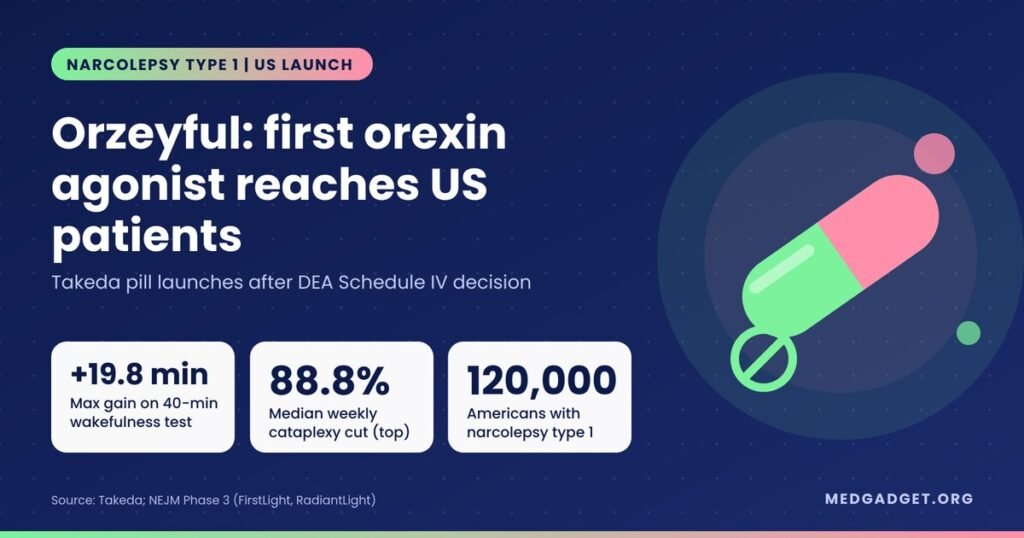

Orzeyful narcolepsy treatment is now in the hands of US patients: Takeda said on 12 November 2026 that Orzeyful (oveporexton), the first orexin receptor 2 agonist approved for adults with narcolepsy type 1, is available by prescription after the US Drug Enforcement Administration placed it in Schedule IV. The FDA cleared the twice-daily pill in August, but it could not ship until the DEA decision. Takeda estimates that about 120,000 Americans live with narcolepsy type 1, and roughly half of them have never been diagnosed.
Key takeaways on Orzeyful narcolepsy treatment
- Orzeyful is the first marketed drug that directly stimulates the orexin system, the brain wake signal that is missing in narcolepsy type 1.
- The DEA classified it as a Schedule IV controlled substance, the last step before launch; it is dispensed through Accredo specialty pharmacy.
- In two 12-week Phase 3 trials published in the New England Journal of Medicine, patients stayed awake 14.3 to 19.8 minutes longer on a 40-minute wakefulness test, while placebo groups slightly worsened.
- Insomnia (55% to 60%) and urinary frequency (53% to 58%) were very common side effects, versus 1% and 5% on placebo.
- It is approved only for narcolepsy type 1 (with cataplexy) in adults, not for type 2 narcolepsy or other sleep disorders.
Why the launch took three months after FDA approval
New drugs that act on the central nervous system and carry some potential for misuse cannot be sold in the US until the DEA decides whether, and how tightly, to control them. The FDA label for Orzeyful flagged abuse and misuse potential, particularly in people with a history of stimulant use, so the August approval came with a wait. Schedule IV is the same tier used for many sleep and wake-promoting medicines, such as modafinil. It allows refills and ordinary prescribing, but pharmacies and prescribers must follow controlled-substance record rules.
Takeda’s launch announcement says the drug is routed through Accredo, part of Evernorth, with a patient support program to help with insurance steps. Takeda did not publish a list price in the announcement, so out-of-pocket costs will depend on each plan’s coverage decision over the coming months.
How an orexin agonist differs from existing narcolepsy drugs
Narcolepsy type 1 is caused by the loss of a small group of brain cells that make orexin (also called hypocretin), a chemical messenger that keeps people awake and stops dream-sleep features such as muscle paralysis from spilling into the day. That spillover is cataplexy: sudden weakness triggered by laughter or surprise.
Current treatments work around the missing signal. Stimulants and wake-promoting agents push alertness through other pathways, and oxybates consolidate night-time sleep. Oveporexton instead binds the orexin 2 receptor and mimics the absent messenger. That is why Takeda describes it as treating the underlying cause, although it replaces the signal rather than restoring the lost neurons, so it is expected to be taken long term. According to the company, more than half of treated patients remain symptomatic on existing options, which is the gap Orzeyful is aimed at.
What the Phase 3 trials showed
Approval rested on FirstLight (168 patients, 1 mg or 2 mg twice daily versus placebo) and RadiantLight (105 patients, 2 mg twice daily versus placebo). Both ran 12 weeks and were published in the New England Journal of Medicine in September. The ranges below cover both studies and doses.
| Measure (12 weeks) | Oveporexton | Placebo |
|---|---|---|
| Maintenance of Wakefulness Test (40-min), change | +14.3 to +19.8 min | -0.4 to -0.8 min |
| Epworth Sleepiness Scale, change | -9.7 to -11.8 points | -1.5 to -1.7 points |
| Weekly cataplexy, median reduction | 79.0% to 88.8% | 27.7% to 39.1% |
| Insomnia (pooled) | 55% to 60% | 1% |
| Urinary frequency (pooled) | 53% to 58% | 5% |
| CPK above 5x upper limit | 11% (21/196) | 5% (4/76) |
For context, an Epworth score above 10 indicates excessive daytime sleepiness, and untreated narcolepsy patients commonly score well into the high teens. A drop of 10 or more points can move a patient from severe sleepiness toward the normal range, which is a larger shift than is typical in narcolepsy trials of older agents. Cross-trial comparisons are imperfect, though, and no head-to-head study against stimulants or oxybates has been reported.
The trade-offs: sleep, bladder and muscle enzymes
The side-effect profile follows from the mechanism. A drug that switches on wakefulness can also keep people awake at night, and insomnia affected well over half of treated patients. The label advises dose reduction or stopping if insomnia lasts beyond a week and disrupts daily life. Urinary frequency and urgency were also common, so doctors are told to screen for bladder symptoms first. Salivary hypersecretion was among the most frequent reactions.
Doctors will also watch creatine phosphokinase (CPK), a muscle enzyme. Elevations were asymptomatic in most cases, but two trial patients with marked CPK and liver enzyme rises stopped treatment. Patients are advised to report unexplained muscle pain, weakness or dark urine. Oveporexton is contraindicated with strong CYP3A inhibitors, a group that includes some antifungals and antibiotics, and should be avoided in severe liver impairment and in dialysis patients. This is not dosing advice; treatment decisions belong with a sleep specialist.
Who is likely to benefit, and who is not
The label is narrow. Narcolepsy type 2, idiopathic hypersomnia and sleepiness from sleep apnea involve different biology and were not studied in these trials, so off-label hopes should be tempered. Within type 1, the best early candidates are likely adults whose sleepiness or cataplexy persists on current drugs. A large hidden population exists too: with about 120,000 US cases and roughly 50% diagnosed, around 60,000 Americans with narcolepsy type 1 have no diagnosis yet, by our calculation. Takeda notes diagnosis can take an average of 10 years, often after misdiagnosis as depression or poor sleep habits.
Market context
Orzeyful enters a broad and growing treatment space. Acumen Research and Consulting projected the global sleep disorder treatment drug market would reach about US$29.1 billion by 2027, growing at roughly 7.9% a year from 2020, with North America holding a major revenue share. That forecast was last updated in 2020 and predates orexin agonists, so treat it as indicative. Other drugmakers are testing their own orexin agonists, which makes Takeda’s first-mover position meaningful. For related sleep news, see our coverage of Foundayo in sleep apnea.
What to watch next
- Insurer coverage policies and whether plans require patients to fail stimulants or oxybates first.
- Long-term extension data on durability of effect and the CPK signal.
- Regulatory filings outside the US, including Japan and Europe.
- Studies in narcolepsy type 2 and idiopathic hypersomnia, where orexin levels are often normal.
FAQ
Is Orzeyful available now?
Yes. Takeda announced US availability on 12 November 2026 after DEA scheduling. It is prescription only and dispensed through Accredo specialty pharmacy.
What is oveporexton used for?
It is approved for adults with narcolepsy type 1, the form of narcolepsy with cataplexy, to treat excessive daytime sleepiness and cataplexy.
Is Orzeyful a controlled substance?
Yes. The DEA placed it in Schedule IV, the same category as several other wake-promoting and sleep medicines.
What are the most common Orzeyful side effects?
Insomnia, urinary frequency and urgency, and excess salivation were the most common in trials. Raised muscle enzymes (CPK) were also seen.
Sources: Takeda press release (12 Nov 2026); NEJM FirstLight and RadiantLight publication via NeurologyLive; Drugs.com label summary. Market data: Acumen Research and Consulting. More in our Pharmaceutical section. This article is for information only and is not medical or investment advice. Last updated 13 November 2026.