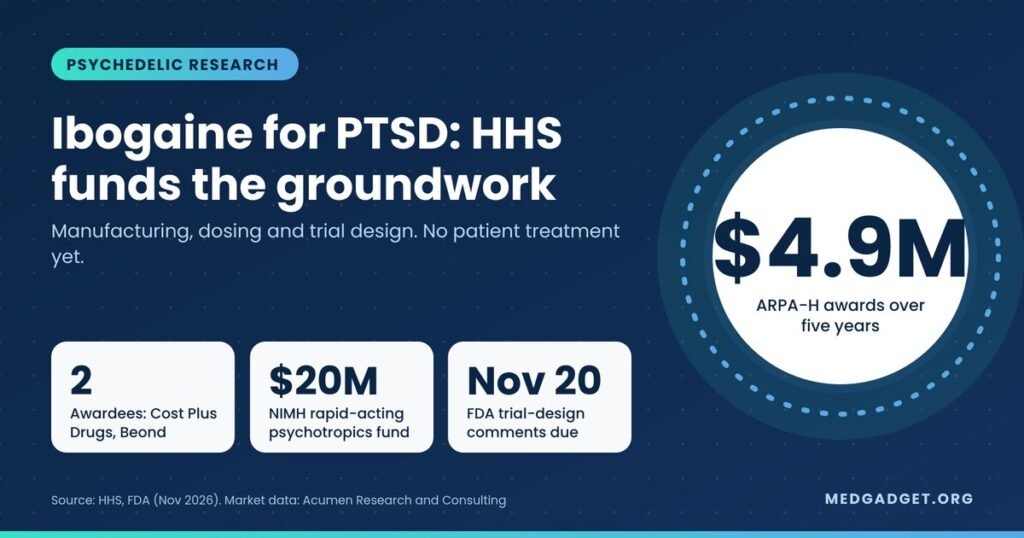

The U.S. Department of Health and Human Services on November 12, 2026 announced up to $4.9 million in ARPA-H awards to lay the groundwork for studying ibogaine for PTSD, naming Mark Cuban Cost Plus Drug Company and Texas-based Beond, Inc. as recipients. The money, spread over five years and paid against milestones, covers manufacturing, dosing and trial preparation. It does not pay for treating patients or for any human study, and ibogaine remains illegal in the United States.
The announcement came the day after Veterans Day, with Veterans Affairs leaders alongside Health Secretary Robert F. Kennedy Jr., and it drew wide pickup because of the drug’s reputation among veterans and its well-documented heart risks. Here is what the awards actually buy, why ibogaine research has stalled for decades, and what has to happen before a single U.S. patient is dosed in a federally backed trial.
Key takeaways on ibogaine for PTSD
- ARPA-H will provide up to $4.9 million over five years to two awardees: Mark Cuban Cost Plus Drug Company (manufacturing and regulatory groundwork) and Beond, Inc. (clinical data on safety, dosing and durability).
- The awards fund preparation for Investigational New Drug (IND) applications and clinical-grade, domestically made ibogaine hydrochloride. They do not fund patient treatment or human-subject research.
- Ibogaine can cause potentially life-threatening heart rhythm problems; HHS says any future study must include screening, cardiac monitoring and independent safety oversight.
- NIMH separately opened a $20 million funding opportunity for a research network on rapid-acting psychotropics such as ketamine, esketamine and psilocybin, with awards due in summer 2027.
- Public comments on FDA’s request for input on early-phase ibogaine trial design close on November 20, 2026.
Who got the money, and what each award covers
According to the HHS press release, funding amounts vary by awardee and are released only as accelerated research milestones are met. All awardees must share their research data publicly, and HHS says it will publish results whether they show benefit, no benefit or harm.
| Item | Detail |
|---|---|
| Funder | ARPA-H (Advanced Research Projects Agency for Health) |
| Total ceiling | Up to $4.9 million over five years |
| Average per year (by our calculation) | About $0.98 million if fully paid out |
| Mark Cuban Cost Plus Drug Company | Regulatory, chemistry and engineering groundwork for a U.S.-made, single-molecule ibogaine hydrochloride product |
| Beond, Inc. | Clinical data on safety, dosing, efficacy and durability, drawn from its treatment experience in Mexico |
| Not funded | Patient treatment, human-subject research, trial authorization or FDA approval |
| Next ARPA-H step | Further awards focused on substance use disorder, including opioid use disorder |
Beond has treated more than 3,000 patients with ibogaine in Mexico, where the drug is not prohibited, according to reporting on the announcement. Private clinics there typically charge $10,000 to $20,000 for a treatment course and often run continuous heart monitoring with emergency staff on standby. HHS says the goal, if a product is ever approved, is pricing at production cost plus a fair margin, which is the Cost Plus model.
Why ibogaine research has been stuck for decades
Ibogaine is a psychoactive alkaloid from the root bark of the West African shrub iboga. It sits in the most restrictive U.S. drug schedule alongside LSD and MDMA, which makes it hard to source, store and study. Its effects are also demanding: users describe long, intense hallucinatory experiences, and nausea, vomiting and tremor are common.
The bigger barrier is cardiac. Ibogaine can disturb the heart’s electrical recovery and trigger dangerous irregular rhythms, the main reason regulators and academic centers have kept their distance. Interest has grown anyway, driven by veteran advocacy groups and observational reports from clinics abroad. Those reports are not controlled trials, which is exactly the gap these awards are meant to start closing.
The safety questions FDA wants answered first
The awards sit inside a broader federal push that began with President Trump’s April 2026 executive order on speeding research into treatments for serious mental illness. In October, FDA issued a request for information on how early-phase ibogaine trials should be built, under docket FDA-2026-N-10429. It asks about patient selection, a proposed starting dose of no more than 10 mg/kg, dose escalation, cardiac and neurologic monitoring, care setting, stopping rules and informed consent. Comments are due November 20, 2026.
Put simply, the scientific question is not only whether ibogaine eases PTSD symptoms but whether it can be given safely enough, in a controlled setting, to make any benefit worth the risk. Clean manufacturing matters here too: plant extracts vary, and a single-molecule product gives researchers a consistent dose to test.
Market context: psychedelic medicine
Federal money is flowing into a field that drug developers already treat as a commercial category. According to Acumen Research and Consulting, the global psychedelic drugs market was worth about $2.6 billion in 2022 and is projected to reach $7.1 billion by 2032, a compound annual growth rate of 10.9%. Acumen’s analysis, last updated in April 2023, names North America as the largest region and Asia-Pacific as the fastest growing. Because the report predates this year’s policy changes, treat the figures as indicative.
Three psychedelic-derived drug applications, including products based on psilocybin and MDMA, are pending at FDA, which means ibogaine is entering the pipeline well behind its better-studied peers.
What this does not mean for veterans today
- No federal ibogaine trial is enrolling. The awards fund the steps needed before an IND can even be filed.
- The VA is not offering ibogaine. VA Secretary Doug Collins said the department wants to prepare clinicians in case treatments win FDA approval, with safety and research quality first.
- Ibogaine remains illegal to possess in the United States, and treatment abroad carries real cardiac risk outside a regulated setting.
For veterans living with PTSD now, evidence-based options such as trauma-focused psychotherapy and approved medicines remain the standard of care. We have covered how care models are changing in our look at Talkiatry’s nationwide virtual therapy services, and more pharma pipeline coverage sits in our Pharmaceutical section.
Milestones to watch
- November 20, 2026: FDA comment period on early-phase ibogaine trial design closes.
- End of 2026 (expected): separate ARPA-H ibogaine awards for substance use disorder.
- Summer 2027: NIMH names recipients of its $20 million rapid-acting psychotropics network.
- Later: any IND filing for U.S.-made ibogaine hydrochloride, which would be the first real signal that human trials are near.
FAQ
Is ibogaine legal in the US?
No. Ibogaine is in the most restrictive federal drug schedule. The new awards support research preparation and do not change its legal status.
Can veterans get ibogaine through the VA?
Not now. The VA says it is preparing for possible future approvals, but no ibogaine treatment or federally funded patient trial is available.
Why is ibogaine considered dangerous?
It can cause potentially fatal heart rhythm disturbances, plus intense hallucinations, vomiting and tremor. HHS says future studies must include cardiac screening and monitoring.
How much is the government spending on ibogaine research?
These ARPA-H awards total up to $4.9 million over five years. The administration also set aside $50 million in April 2026 for ibogaine research, and more ARPA-H awards on substance use disorder are expected.
Sources: HHS press release (November 12, 2026); FDA request for information, docket FDA-2026-N-10429; Reuters and AP reporting. Market data: Acumen Research and Consulting, Psychedelic Drugs Market report. This article is for information only and is not medical or investment advice. Last updated November 13, 2026.