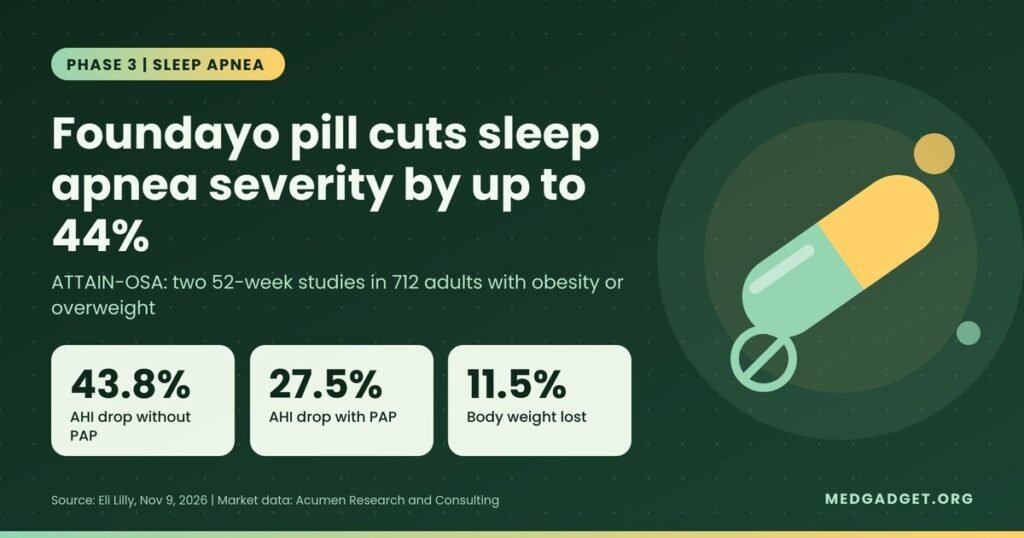

Foundayo sleep apnea data from Eli Lilly’s Phase 3 ATTAIN-OSA program show that the once-daily oral GLP-1 pill orforglipron cut breathing interruptions during sleep by up to 43.8% over 52 weeks in adults with moderate-to-severe obstructive sleep apnea (OSA) and obesity or overweight. Lilly reported the two pivotal studies on November 9, 2026, presented them at the American Heart Association Scientific Sessions, published them in JAMA, and said it will ask the FDA to add an OSA indication by the end of 2026.
The results matter because OSA affects millions of people who struggle with nightly CPAP, and because Foundayo is a tablet rather than an injection. Below we break down what the trials actually measured, how the two study populations differed, where the drug fell short, and what has to happen before doctors can prescribe it for sleep apnea.
Key takeaways on Foundayo sleep apnea
- Two 52-week, placebo-controlled Phase 3 studies enrolled 712 adults in total: 363 who could not or would not use positive airway pressure (PAP) and 349 who stayed on PAP.
- Without PAP, the apnea-hypopnea index (AHI) fell by 21.1 events per hour (43.8%) on Foundayo versus 4.3 events (6.3%) on placebo.
- On PAP, AHI fell 18.3 events per hour (27.5%) versus 5.5 events (3.0%) on placebo.
- Roughly 3 in 10 patients not using PAP reached remission or mild, symptom-free OSA, alongside about 11% body weight loss.
- Stopping treatment because of side effects was more common on Foundayo (12.2% vs 3.8% without PAP), mostly gastrointestinal.
- Foundayo is approved for chronic weight management but is not yet approved for sleep apnea; Lilly plans a US filing before year-end.
Inside ATTAIN-OSA: two studies, two kinds of patient
ATTAIN-OSA (NCT06649045) was designed to mirror real practice. Study 1 recruited people who were unable or unwilling to use a PAP machine, the group with the fewest options today. Study 2 recruited people already using PAP for at least three months, who kept using it during the trial. Both groups started with severe disease: average baseline AHI was 50.7 events per hour in Study 1 and 57.6 in Study 2, well above the threshold of 30 that defines severe OSA.
Participants took Foundayo once a day, starting at 0.8 mg and stepping up every four weeks to a maximum tolerated dose of 9 mg, 14.5 mg or 17.2 mg. Lilly notes the trials used an investigational formulation with doses equivalent to the marketed tablets. Results below use the efficacy estimand, which reflects patients who stayed on treatment.
The numbers at 52 weeks
| Measure | Study 1 (no PAP) | Study 2 (on PAP) |
|---|---|---|
| Baseline AHI (events/hour) | 50.7 | 57.6 |
| AHI change, Foundayo | -21.1 (-43.8%) | -18.3 (-27.5%) |
| AHI change, placebo | -4.3 (-6.3%) | -5.5 (-3.0%) |
| Placebo-adjusted AHI change (by our calculation) | -16.8 events/hour | -12.8 events/hour |
| Hypoxic burden change, Foundayo vs placebo | -55.9% vs -18.3% | -45.8% vs -17.0% |
| Body weight change, Foundayo vs placebo | -11.5% vs -1.8% | -11.2% vs -0.9% |
| At least 50% AHI reduction (Foundayo) | 47.2% | 33.7% |
| Remission or mild OSA (Foundayo) | 31.5% | 19.6% |
| Stopped for adverse events, Foundayo vs placebo | 12.2% vs 3.8% | 6.8% vs 0.6% |
Two details stand out. First, hypoxic burden, a measure of how much oxygen levels drop during breathing events, fell by roughly half on Foundayo. Many sleep specialists see this as more closely tied to cardiovascular risk than the AHI count alone. Second, the drug lowered high-sensitivity C-reactive protein, an inflammation marker, by 48.9% without PAP and 38.6% with PAP, and reduced systolic blood pressure by 8.6 and 7.3 mmHg respectively. Lilly says every measure except blood pressure was controlled for multiple testing, so the blood pressure result should be read as supportive rather than confirmatory.
Why a pill could change sleep apnea care
Excess weight narrows the upper airway, so losing weight is one of the most reliable ways to ease OSA. Until recently, the main medical option was CPAP, which works well when used but is abandoned by a meaningful share of patients. Injectable incretin drugs opened a new route, and Lilly’s tirzepatide (Zepbound) already carries a US sleep apnea indication. Foundayo would extend that approach to a daily tablet that does not need refrigeration or injections, which could matter for patients who dislike needles and for health systems trying to scale treatment.
Lilly’s product development lead for cardiometabolic health, Thomas Seck, framed the stakes plainly: “OSA is one of the most serious complications of obesity and is closely linked to cardiovascular disease.” For readers following Lilly’s broader pipeline, our coverage of Eli Lilly’s Q3 2026 results and pipeline explains how Foundayo fits alongside Zepbound and Mounjaro.
Where the data fall short
The pill is not a cure for most patients. Even in the better-performing no-PAP group, about two thirds did not reach remission or mild disease, and average AHI after a year remained in the moderate-to-severe range for many participants. People on PAP saw smaller relative gains, partly because PAP was already controlling much of their disease during the night.
Tolerability is the other caveat. The most common side effects were nausea, diarrhea, constipation, indigestion and vomiting, mostly mild to moderate. Still, one in eight no-PAP patients on Foundayo stopped because of side effects, more than three times the placebo rate. All GLP-1 medicines also now carry the FDA’s class-wide label language on a rare eye condition, which we covered in our report on the GLP-1 NAION warning. Finally, these are company-reported topline figures; full peer-reviewed details sit in the JAMA paper and will be scrutinised by the FDA.
Market context: a growing sleep apnea treatment field
According to Acumen Research and Consulting’s sleep apnea devices market report, the global sleep apnea devices market was valued at USD 6.4 billion in 2022 and is projected to reach USD 13.1 billion by 2032, a compound annual growth rate of 6.7%. The report finds North America held the largest share and therapeutic devices were the biggest product segment. Those figures predate the arrival of incretin drugs for OSA, so they are best read as a baseline: if pills and injections reduce disease severity for some patients, device makers may see demand shift toward diagnostics and combination care rather than disappear.
What happens next
- US filing: Lilly plans to submit an OSA application for adults with obesity or overweight by the end of 2026, with other countries to follow.
- Label scope: Watch whether the FDA limits use to people with obesity, as with Zepbound, and how it handles patients who continue PAP.
- Payer coverage: An OSA indication could help some patients obtain coverage where weight-loss drugs alone are excluded.
- Long-term data: Whether AHI and oxygen improvements translate into fewer heart attacks or strokes remains unproven.
More device and drug news is in our Pharmaceutical section.
FAQ
Is Foundayo approved for sleep apnea?
Not yet. Foundayo (orforglipron) is FDA approved for chronic weight management. Lilly plans to apply for a sleep apnea indication by the end of 2026, and approval would depend on FDA review.
How much did Foundayo reduce sleep apnea severity?
In people not using CPAP, the AHI fell 43.8% (21.1 events per hour) after 52 weeks versus 6.3% on placebo. In people using CPAP, it fell 27.5% versus 3.0% on placebo.
Can Foundayo replace a CPAP machine?
The trials do not show that. Most participants still had OSA after a year, and Study 2 tested the drug alongside continued PAP. Any change to CPAP use should be decided with a sleep physician.
How does Foundayo compare with Zepbound for sleep apnea?
Zepbound is an injectable already approved for OSA in adults with obesity, while Foundayo is a daily pill that is still investigational for OSA. No head-to-head trial has compared them, so cross-trial comparisons are unreliable.
Sources: Eli Lilly press release (November 9, 2026); ATTAIN-OSA, NCT06649045. Market data: Acumen Research and Consulting. This article is for information only and is not medical or investment advice. Last updated November 11, 2026.