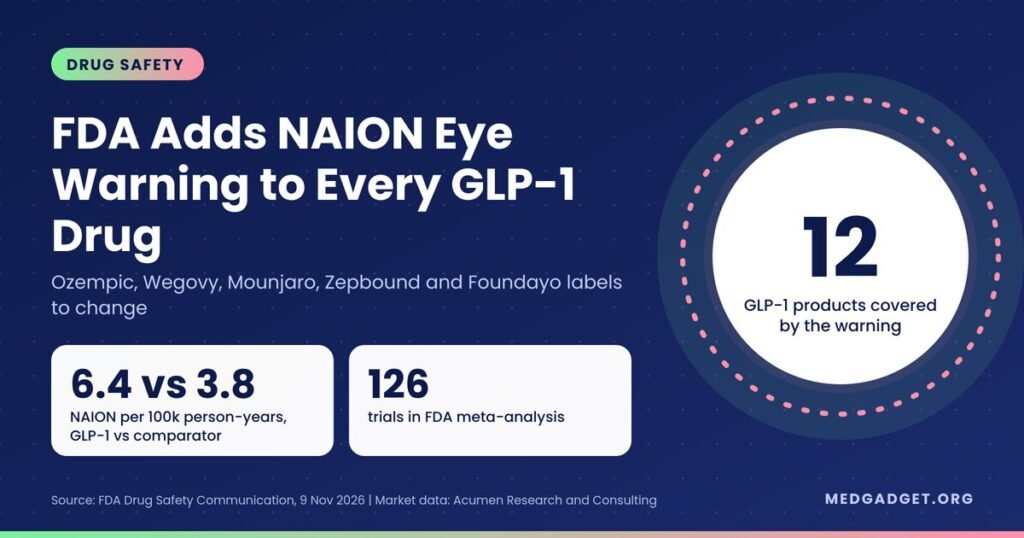

The GLP-1 NAION warning is now official: on 9 November 2026 the US Food and Drug Administration told the makers of every approved GLP-1 receptor agonist, including Ozempic, Wegovy, Rybelsus, Mounjaro, Zepbound and the new oral pill Foundayo, to add a potential increased risk of non-arteritic anterior ischemic optic neuropathy (NAION) to the Warnings and Precautions section of their labels. NAION is a rare condition in which blood flow to the front of the optic nerve drops, causing sudden, painless vision loss in one eye that can be permanent. The FDA called the risk rare and did not tell patients to stop treatment, but it did ask doctors to refer suspected cases to an ophthalmologist quickly and to consider stopping the drug if NAION develops.
Key takeaways on the GLP-1 NAION warning
- The label change applies class-wide, not only to semaglutide: 12 products are listed, from exenatide and liraglutide to tirzepatide and orforglipron.
- In an FDA meta-analysis of 126 randomised trials with 134,253 participants, NAION occurred at 6.4 events per 100,000 person-years on GLP-1 drugs versus 3.8 on comparators.
- Only 15 probable NAION events were found in those trials, so the absolute risk is very low.
- An FDA Sentinel study found a higher risk versus DPP-4 inhibitors (hazard ratio 1.43) but no statistically significant difference versus SGLT-2 inhibitors.
- Patients should not stop a GLP-1 medicine on their own; anyone with sudden vision loss in one eye should seek care urgently.
What the FDA is requiring
The agency’s Drug Safety Communication requires application holders for all GLP-1 receptor agonists to describe the potential NAION risk in the Warnings and Precautions section of prescribing information. The FDA said NAION cases have been reported after marketing for every GLP-1 product currently sold, which is why it applied the change to the whole class rather than to one brand. That differs from Europe, where the safety review that concluded NAION is a very rare side effect focused on semaglutide.
| Brand | Active ingredient | FDA approval year |
|---|---|---|
| Victoza / Saxenda | liraglutide | 2010 / 2014 |
| Trulicity | dulaglutide | 2014 |
| Xultophy | liraglutide + insulin degludec | 2016 |
| Soliqua | lixisenatide + insulin glargine | 2016 |
| Ozempic / Rybelsus / Wegovy | semaglutide | 2017 / 2019 / 2021 |
| Mounjaro / Zepbound | tirzepatide (GIP and GLP-1) | 2022 / 2023 |
| Foundayo | orforglipron | 2026 |
| Generic exenatide | exenatide | Byetta brand withdrawn |
What is NAION and what are the symptoms?
NAION is sometimes described as a stroke of the optic nerve. The FDA lists the warning signs as sudden, painless loss of vision in one eye that is often noticed on waking, blurred or missing areas of vision such as blind spots or tunnel vision, colour distortion and reduced central sharpness. Known risk factors include smoking, diabetes, high blood pressure, sleep apnoea, anaemia and kidney disease, several of which are common in people who take GLP-1 medicines. Once one eye is affected, the other eye carries a higher risk. In adults over 50, published background rates range from 2.3 to 10.2 cases per 100,000 people a year.
The evidence behind the GLP-1 eye risk
| Data source | What it showed |
|---|---|
| 126 randomised trials (134,253 patients, 288,879 person-years) | 15 probable NAION events: 10 on GLP-1 drugs, 5 on placebo, 0 on other diabetes drugs. 6.4 vs 3.8 events per 100,000 person-years |
| FDA Sentinel cohort, type 2 diabetes, 2019 to 2024 | 30 to 32 per 100,000 person-years on GLP-1 drugs. HR 1.43 (95% CI 1.02 to 2.01) vs DPP-4 inhibitors; HR 1.19 (0.91 to 1.54) vs SGLT-2 inhibitors |
| Published observational studies | Rigorous studies consistently reported higher NAION risk when people with type 2 diabetes started a GLP-1 drug instead of a DPP-4 or SGLT-2 inhibitor |
| Animal data | No biological mechanism identified |
By our calculation, the trial rates imply roughly 2.6 extra NAION cases for every 100,000 person-years of GLP-1 treatment, a very small absolute number even though the relative figure looks large. The FDA was open that no single dataset settled the question: the trial count was small, the animal work found no mechanism and the real-world results depended on which comparator drug was used. Reports to the FDA’s adverse event system were hard to interpret because NAION risk factors overlap heavily with the conditions GLP-1 drugs treat.
What patients and doctors should do now
- Patients: know the symptoms, contact a clinician right away if vision changes suddenly in one eye, and talk to your doctor before stopping any GLP-1 medicine. If you have had NAION before, discuss whether to continue.
- Clinicians: tell patients to report sudden, painless vision loss or visual field defects, refer suspected NAION to an ophthalmologist promptly, and consider discontinuing the GLP-1 drug if NAION is confirmed unless the benefits clearly outweigh the risk.
- Reporting: suspected cases can be reported through the FDA MedWatch programme.
Why the label change matters for the GLP-1 market
GLP-1 drugs are among the best-selling medicines in the world, so even a rare risk now has to be explained to millions of patients. Eli Lilly said the communication does not cite findings specific to its medicines and that it would respond promptly; Novo Nordisk did not comment immediately, according to press reports. The NAION question has also been the subject of litigation in the United States. For most patients with obesity or diabetes, the cardiovascular, metabolic and weight benefits of these medicines are likely to remain the main consideration, but the warning gives eye symptoms a clearer place in routine follow-up. Our earlier coverage of Eli Lilly’s third-quarter results and Viking’s oral GLP-1/GIP Phase 3 programme shows how fast this class is still growing.
Market context: eye-care medicines
The warning also brings eye health into the diabetes conversation. According to Acumen Research and Consulting, the global ophthalmic drugs market was worth USD 33.5 billion in 2022 and is projected to reach USD 64.2 billion by 2032, growing at a CAGR of 6.8% from 2023 to 2032. Acumen expects retinal disorders to be the fastest-growing segment because of the rising prevalence of diabetes, while anti-VEGF agents held more than 33% of the market in 2022. NAION itself has no approved drug treatment, so the figures describe the wider eye-care market rather than this condition.
What is still unknown
- Whether GLP-1 drugs cause NAION, or whether the link reflects shared risk factors.
- Whether risk differs by dose, duration or individual product.
- Whether people taking GLP-1 drugs for obesity without diabetes face the same risk.
- The exact label wording each company will adopt and when.
Frequently asked questions about the GLP-1 NAION warning
Does Ozempic cause blindness?
The FDA says GLP-1 drugs, including Ozempic, are associated with a potential increased risk of NAION, a rare condition that can cause permanent vision loss in one eye. The absolute risk in trials was very low.
Does the warning cover Mounjaro and Zepbound?
Yes. Tirzepatide products are on the FDA list, along with semaglutide, liraglutide, dulaglutide, exenatide, lixisenatide and orforglipron.
Should I stop taking my GLP-1 medicine?
Not without speaking to your doctor. The FDA advises stopping only if NAION develops and the benefits do not clearly outweigh the risk.
What are the first signs of NAION?
Sudden, painless vision loss in one eye, often on waking, with blind spots, blurring or faded colours.
Sources: FDA Drug Safety Communication on GLP-1 receptor agonists and NAION (9 November 2026); company statements reported by Reuters. Market figures are attributed to Acumen Research and Consulting; calculations marked as ours are our own. This article is for information and is not medical advice. Last updated 10 November 2026.