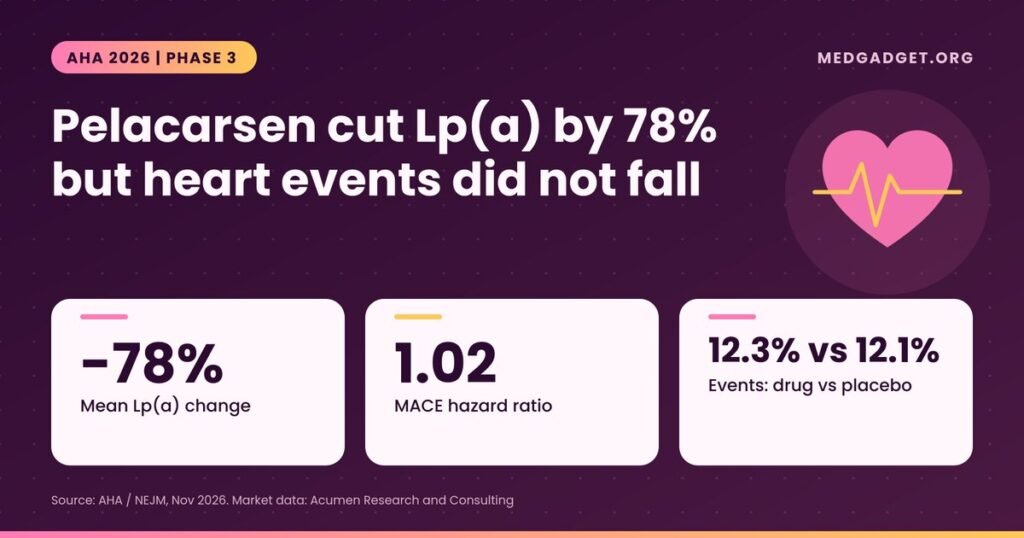

The pelacarsen Lp(a) HORIZON results, presented on 7 November 2026 at the American Heart Association Scientific Sessions in Chicago and published in The New England Journal of Medicine, show that Novartis’s antisense drug cut lipoprotein(a) by an average of 78% in 8,323 people with heart disease, yet did not reduce heart attacks, strokes, urgent revascularisation or cardiovascular death over a median 4.7 years. Major events occurred in 12.3% of pelacarsen patients and 12.1% of placebo patients (hazard ratio 1.02).
It is the first completed cardiovascular outcomes trial of a drug designed specifically to lower Lp(a), a genetically determined particle that roughly one in five people carry at elevated levels. A clean miss on a 78% reduction is a result the whole field will have to digest, from cardiologists ordering Lp(a) tests to the companies running rival trials.
Key takeaways on pelacarsen Lp(a) HORIZON results
- Pelacarsen lowered Lp(a) by a mean 78% but the primary composite of major adverse cardiovascular events (MACE) was unchanged: HR 1.02, 95% CI 0.90 to 1.15, P=0.76.
- The result held in the higher-risk subgroup with baseline Lp(a) of 90 mg/dL or more (HR 1.00, P=0.99).
- No secondary endpoint, including all-cause death, favoured the drug.
- Anaphylaxis occurred in 19 pelacarsen patients and none on placebo; about 21% stopped the drug for adverse effects versus just over 7% on placebo.
- Outcome trials of olpasiran, lepodisiran and muvalaplin are still running, and their results now carry far more weight.
The numbers behind a neutral trial
Lp(a) HORIZON was a randomised, double-blind, placebo-controlled Phase 3 study run at 797 sites in 42 countries between 2019 and 2026. Patients had a prior heart attack, ischaemic stroke or symptomatic peripheral artery disease and an Lp(a) of at least 70 mg/dL (about 148 nmol/L). They received 80 mg of pelacarsen or placebo by monthly injection on top of standard care.
| Measure | Pelacarsen | Placebo |
|---|---|---|
| Patients randomised | 4,157 | 4,165 |
| Primary MACE events | 511 (12.3%) | 503 (12.1%) |
| Hazard ratio (95% CI) | 1.02 (0.90 to 1.15), P=0.76 | |
| Mean Lp(a) change | -78% | Minimal |
| Serious adverse events | 37.3% | 41.1% |
| Anaphylaxis | 19 patients | 0 |
| Stopped for adverse effects | ~21% | >7% |
By our calculation, the absolute difference in event rates was about 0.2 percentage points in the wrong direction, well inside the play of chance. The baseline population was typical of secondary prevention: mean age 60, 27% women, 26% with diabetes and 82% with a previous heart attack. Median Lp(a) at entry was 109 mg/dL, more than double the commonly used 50 mg/dL risk threshold.
Why a 78% cut may not have been enough
Genetic studies have long linked high Lp(a) to heart attack and aortic stenosis, which is why the hypothesis looked so strong. Senior author Steven Nissen of Cleveland Clinic did not soften the verdict: “I cannot avoid the disappointing conclusion: it didn’t work.” He still described Lp(a) as an important part of cardiovascular risk.
Researchers are weighing several explanations, none yet proven:
- Lifetime versus late exposure. Mendelian randomisation reflects decades of lower Lp(a). Lowering it for under five years in people who already have atherosclerosis may be too little, too late.
- Depth of lowering. Some modelling suggested very large absolute reductions are needed to cut events meaningfully. A 78% average still leaves some patients above risk thresholds.
- Adherence. With roughly one in five patients on the active arm stopping for side effects, the real-world exposure was lower than the headline percentage implies.
- Biology. Lp(a) may be a marker of risk that tracks with other processes rather than a target whose removal alone protects arteries.
Extended analyses published alongside the main paper in NEJM Evidence looked at many endpoint combinations and found no benefit in any of them, which weakens the argument that the trial simply chose the wrong endpoint.
The safety signal clinicians will remember
Overall serious adverse events were slightly lower with pelacarsen, but the drug brought more flu-like symptoms, injection-site reactions and allergic reactions. Nineteen anaphylaxis cases, with none on placebo and no deaths, is an unusual finding for an antisense oligonucleotide and will be scrutinised. Discontinuation for adverse effects ran at roughly three times the placebo rate by our calculation.
What it means for olpasiran, lepodisiran and muvalaplin
Three other Lp(a) programmes have outcome trials under way: Amgen’s siRNA olpasiran, Lilly’s siRNA lepodisiran and Lilly’s oral muvalaplin. In earlier studies the siRNA drugs lowered Lp(a) by more than 90% and muvalaplin by about 85%, deeper than pelacarsen. Supporters argue that extra depth, and less frequent dosing, could still produce a benefit. Sceptics will say a near-identical event curve after 78% lowering is hard to overturn with a further 10 to 15 points. Until those readouts arrive, the HORIZON result is the only hard outcomes evidence available. For broader pipeline context, see our analysis of Novartis’s Q3 2026 results and pipeline risk and coverage of Sun Pharma’s lerodalcibep deal in lipid lowering.
Market context for RNA-targeted cardiovascular drugs
Pelacarsen belongs to a fast-growing class. According to Acumen Research and Consulting, the global antisense and RNAi therapeutics market was valued at USD 4.9 billion in 2023 and is projected to reach USD 22.1 billion by 2032, a compound annual growth rate of 18.4%, with North America the leading region. Large common-disease indications such as Lp(a) were a big part of the expected upside for the class, so a high-profile failure is likely to shift investor attention towards programmes with outcome data in hand.
What people with high Lp(a) should take from this
Lp(a) testing remains useful for understanding risk: an elevated level still signals higher cardiovascular danger and can justify more aggressive control of LDL cholesterol, blood pressure, diabetes and smoking, the levers with proven outcome benefit. What this trial removes is the expectation that a dedicated Lp(a) drug is close to the clinic. Pelacarsen is not approved anywhere, and anyone with questions about their own results should discuss them with their cardiologist. The Pharmaceutical section will follow the remaining Lp(a) trials.
Frequently asked questions
Did pelacarsen work in the Lp(a) HORIZON trial?
It lowered Lp(a) by 78% on average but did not reduce major cardiovascular events compared with placebo (HR 1.02), so the trial missed its primary endpoint.
Is high Lp(a) still a heart risk?
Yes. Genetic and observational data still tie high Lp(a) to heart disease. The trial shows only that lowering it with pelacarsen for about five years did not prevent events in people who already had cardiovascular disease.
What side effects did pelacarsen cause?
More flu-like symptoms, injection-site reactions and allergic reactions than placebo, including 19 cases of anaphylaxis. About 21% of patients stopped treatment because of adverse effects.
Are other Lp(a) lowering drugs still being tested?
Yes. Olpasiran, lepodisiran and muvalaplin are in Phase 3 outcome trials. They lower Lp(a) more deeply, but whether that changes the outcome is unknown.
Sources: American Heart Association newsroom; NEJM Evidence extended analyses. Market data: Acumen Research and Consulting. This article is for information only and is not medical or investment advice. Last updated 10 November 2026.