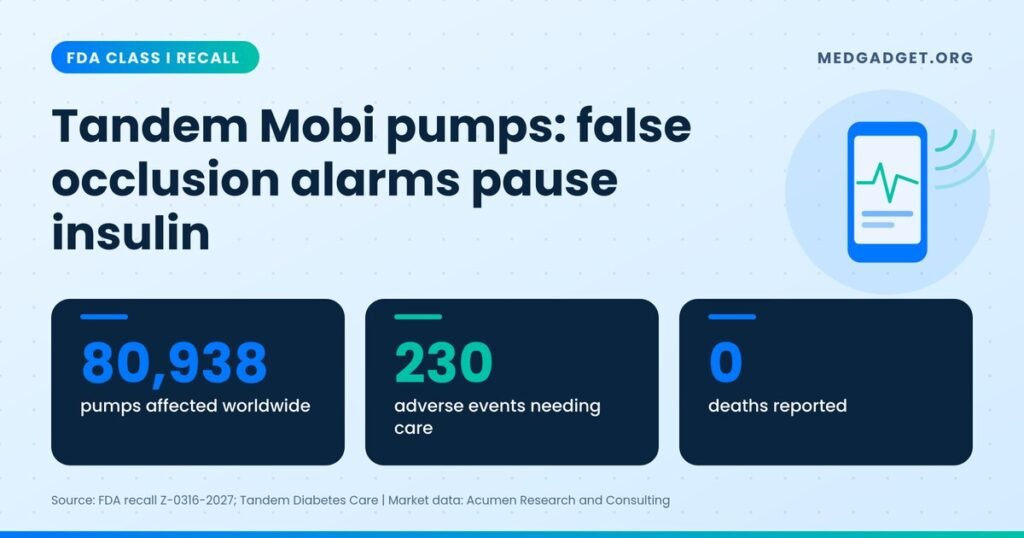

The Tandem Mobi recall now carries the FDA’s most serious rating: the agency has listed Tandem Diabetes Care’s correction of 80,938 Tandem Mobi insulin pumps as a Class I recall because some pumps raise false occlusion alarms that pause insulin delivery. Tandem started the correction on September 23, 2026, the FDA database entry was posted on October 30 and updated on November 3, and the company has received 230 reports of adverse events needing medical intervention or hospitalization as of October 29, with no deaths reported.
Key takeaways on the Tandem Mobi recall
- The problem is a false occlusion alarm: the pump reports a blockage that is not there and stops insulin until the user acknowledges the alarm and resumes therapy.
- The FDA lists 80,938 pumps (77,559 in the US and 3,379 abroad) and says all Mobi models and serial numbers may be affected.
- Tandem traces the fault to extra friction in the drive module that can sap motor power below the occlusion detection threshold.
- Pumps are not being pulled from use. Users are told to answer every alarm, keep backup insulin ready and call Tandem if alarms are frequent; pumps with a pattern of frequent false alarms are being exchanged.
- This is the second Mobi correction to reach Class I status in 2026, after a software fix flagged in April.
What goes wrong inside the pump
Every insulin pump watches for occlusions, meaning a kink or blockage in the tubing or cannula that stops insulin from reaching the body. Mobi infers an occlusion partly from how its motor behaves while pushing insulin. According to the FDA recall record (Z-0316-2027), increased friction in the drive module can reduce motor power. Under some conditions the motor slows enough to cross the threshold the software uses to detect a blockage, so the pump flags an occlusion even when the line is clear.
The alarm itself is the safety design working as intended: the pump suspends delivery because it believes insulin is not getting through. The risk comes from repetition. Each false alarm pauses basal insulin until the wearer responds, and for someone asleep, busy or without their phone nearby, repeated pauses can let glucose climb. The FDA entry says severe hyperglycemia from these interruptions may require medical care or hospitalization. The agency’s root cause category is listed as process change control, which points to a manufacturing or design change rather than a one-off defect, although neither Tandem nor the FDA has detailed what changed.
The recall by the numbers
| Item | Detail |
|---|---|
| Recall number | Z-0316-2027 (FDA Class I) |
| Product | Tandem Mobi insulin pump, 20 model numbers, product code QFG |
| Units affected | 80,938 total: 77,559 US, 3,379 outside the US |
| Share in the US | About 96% (by our calculation) |
| Firm-initiated | September 23, 2026 |
| Posted by FDA | October 30, 2026 (updated November 3) |
| Adverse events reported | 230 needing medical intervention or hospitalization, as of October 29 |
| Deaths reported | None |
What Mobi users should do now
Tandem’s correction notice, summarized in the FDA record, does not tell people to stop using the pump. Instead it sets out five steps, which are worth following alongside advice from your diabetes care team:
- Respond to every occlusion alarm and work through the troubleshooting steps in the user guide.
- Turn on push notifications in the Tandem Mobi app so alarms are not missed when the pump is out of earshot.
- Contact Tandem customer support if alarms are unusually frequent, keep returning after troubleshooting, or repeatedly disrupt therapy.
- Keep a backup way to take insulin, such as pens or syringes, within reach.
- Complete Tandem’s online acknowledgement form.
The FDA record lists specific serial numbers already linked to frequent false alarms, and those pumps are being exchanged. Exchanges can be arranged through Tandem support at 1-877-801-6901. Anyone who has had unexplained high glucose readings after occlusion alarms should check ketones as their care plan advises and raise the pattern with their clinician.
Why the Class I label matters
Class I is reserved for situations where the FDA judges there is a reasonable probability that a product problem could cause serious health consequences or death. It does not mean the device is banned, and many Class I actions, like this one, are corrections rather than removals. What the label does is signal that the agency sees the risk as serious enough that users and clinicians need to know. With 230 adverse events already requiring medical care, the Mobi alarm issue clears that bar even though no deaths have been reported.
It is also a reputational point for Tandem. In April 2026 the FDA gave Class I status to a separate Mobi software correction tied to a motor-detection fault, and earlier, a defect in version 7.9 software affecting the Control-IQ+ algorithm was handled the same way. Mobi is Tandem’s small, phone-controlled pump and is central to its growth strategy against tubeless rivals, so repeated corrections are likely to draw questions from clinicians who choose devices for patients. For wider context on how glucose devices are evolving, see our coverage of Medtronic’s Simplera Sync sensor launch and the recent Nova StatStrip glucose meter FDA update.
Market context: a fast-growing device category under scrutiny
Insulin pumps are one of the faster-growing segments in diabetes technology, which raises the stakes when a widely used model has a fault. According to Acumen Research and Consulting’s insulin pump market report, the global market was worth USD 5.1 billion in 2022 and is projected to reach USD 11.4 billion by 2032, a compound annual growth rate of 8.5%. Acumen identifies North America as the largest regional market and type 1 diabetes as the leading application, which matches where most recalled Mobi units sit: about 96% of them are in the US. The report was last updated in April 2023, so treat the forecast as indicative.
Growth is being driven by automated insulin delivery, where pumps take dosing cues from continuous glucose monitors. Those systems depend on the pump reliably delivering insulin when the algorithm asks for it, so a fault that silently interrupts delivery cuts against the core promise of the technology.
What we still do not know
- How often false alarms occur across the installed base, and how many pumps Tandem expects to exchange.
- Whether a hardware fix or a software threshold change is planned. Tandem says it has taken steps during testing to prevent recurrence but has not described them publicly.
- The severity breakdown of the 230 adverse events, such as how many involved diabetic ketoacidosis.
- Whether regulators outside the US will issue their own notices for the 3,379 units distributed abroad.
FAQ
Is my Tandem Mobi pump part of the recall?
The FDA record says all Mobi models and serial numbers may be affected. A subset of serial numbers with frequent false alarms is being exchanged. Contact Tandem support to check yours.
Should I stop using my Tandem Mobi?
Tandem is not asking users to stop. It advises answering every occlusion alarm, keeping backup insulin on hand and calling support if alarms are frequent. Talk to your care team before changing therapy.
What is a false occlusion alarm?
It is a blockage warning when no blockage exists. On Mobi, extra drive-module friction can slow the motor enough to trigger it, and the pump suspends insulin until the alarm is cleared.
Has anyone died because of the Tandem Mobi recall issue?
No deaths have been reported. Tandem had received 230 reports of adverse events requiring medical intervention or hospitalization as of October 29, 2026.
More device safety news in our Medical Device section.
Sources: FDA Medical Device Recall database entry Z-0316-2027; Tandem Diabetes Care correction notice as summarized by the FDA; MedTech Dive reporting (November 11, 2026). Market data: Acumen Research and Consulting, Insulin Pump Market report. This article is for information only and is not medical or investment advice. Last updated: November 11, 2026.