
The Optune Mya FDA review has ended in a setback: on 9 November 2026 Novocure said the US Food and Drug Administration issued a Not Approvable Letter for its premarket approval (PMA) application for Optune Mya, a wearable tumor treating fields (TTFields) device for adults with brain metastases from non-small cell lung cancer (NSCLC) after stereotactic radiation. The agency cited uncertainty about the degree of clinical benefit, raised no safety concerns, and Novocure shares fell about 4% in premarket trading.
Key takeaways on Optune Mya FDA decision
- The FDA did not approve Optune Mya for NSCLC brain metastases, citing uncertainty about how much clinical benefit the device delivers.
- The agency did not flag safety problems with the device.
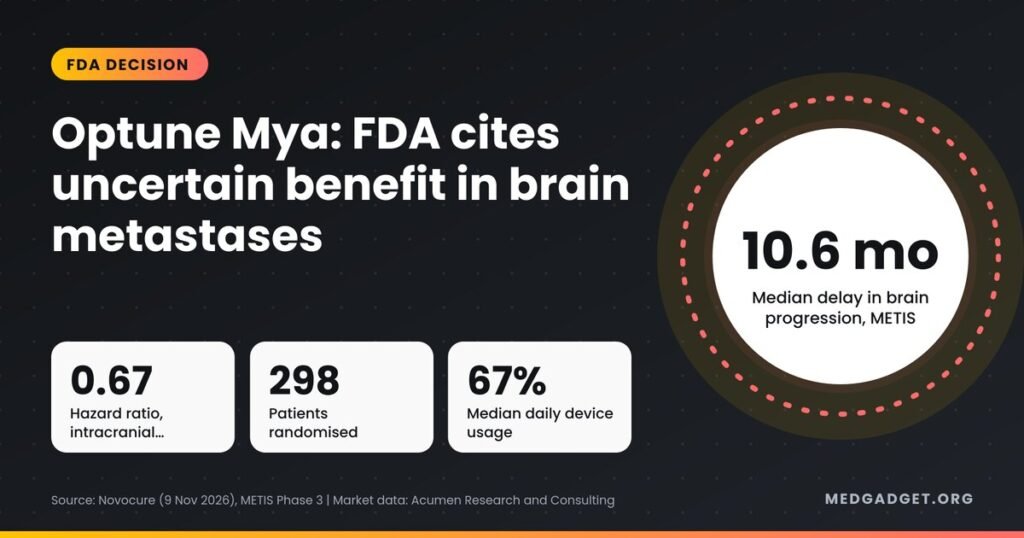
- The application rested on the Phase 3 METIS trial, which met its primary endpoint of delaying intracranial progression (median 21.9 vs 11.3 months).
- Novocure plans to meet the FDA to look for a path to approval without new clinical studies, and says there is no assurance of success.
- Patients and clinicians should not expect Optune Mya to be available in the US for this use in the near term.
What Novocure disclosed
In its regulatory update, Novocure said the FDA concluded that “uncertainty around the degree of clinical benefit provided by Optune Mya prevented approval.” A Not Approvable Letter is the device-side equivalent of a rejection with a stated reason: the applicant can respond, amend the PMA or provide more evidence, but the current file is not enough. The company did not give a timeline for its meeting with the agency, and it did not quantify any financial impact.
The METIS data the FDA weighed
METIS randomised 298 adults with 1 to 10 brain metastases from NSCLC, after stereotactic radiosurgery, to TTFields plus best supportive care or best supportive care alone. Topline results were first reported in 2024.
| METIS measure | TTFields + supportive care | Supportive care alone |
|---|---|---|
| Patients randomised | 149 | 149 |
| Median time to intracranial progression (primary endpoint) | 21.9 months | 11.3 months |
| Hazard ratio (p-value) | 0.67 (p=0.016) | |
| Overall survival (preliminary, not significant) | 11.3 months | 10.6 months |
| Quality-of-life deterioration-free survival | Not reached | 7.7 months (p=0.038) |
| Median therapy duration / device usage | 16 weeks / 67% of the day | |
By our calculation, the primary endpoint gap is about 10.6 months, and the hazard ratio of 0.67 corresponds to a 33% lower risk of intracranial progression at any point in follow-up. The overall survival difference, by contrast, was well under one month and not statistically significant.
Why a positive trial still fell short: our analysis
The FDA has not published its reasoning, so the points below are informed analysis rather than confirmed agency findings.
- The endpoint question. Time to intracranial progression depends on scan schedules and how progression is judged. Without a survival gain, regulators look hard at whether delayed brain progression translates into something patients feel.
- The comparator. The control arm received supportive care rather than an active treatment, and a wearable device cannot easily be blinded or matched with a sham. Open-label designs leave more room for assessment bias.
- A moving standard of care. Many NSCLC patients now receive targeted drugs or immunotherapy with meaningful brain activity. Benefit measured on top of supportive care may not map neatly onto today’s practice.
- Burden versus benefit. TTFields require patients to wear scalp arrays for most of the day. Median usage in METIS was 67%, and any trade-off between daily burden and a progression delay becomes central when survival is unchanged.
How tumor treating fields work
TTFields are low-intensity, alternating electric fields delivered through transducer arrays placed on the skin. The fields are tuned to disrupt dividing cancer cells, interfering with the structures that pull chromosomes apart during cell division. Because the effect is physical rather than chemical, the therapy adds little systemic toxicity; skin irritation under the arrays is the most common side effect. Novocure’s devices are approved in certain countries for glioblastoma, pancreatic cancer, NSCLC and pleural mesothelioma, and in the US its Optune Lua system has been approved for metastatic NSCLC since 2024. Brain metastases would have been a significant new use.
Market context
Brain metastases are common in NSCLC, which is why device and drug makers keep pushing into the space. Acumen Research and Consulting’s lung cancer market report valued the global lung cancer market at US$21.1 billion in 2021 and projected US$67.9 billion by 2030, a compound annual growth rate of 14.1%, with Asia-Pacific the fastest-growing region. Most of that spending flows to drugs; a device gaining a foothold in brain metastases would need to prove value alongside potent targeted therapies, a theme also visible in new lung cancer data such as Roche’s KRASCENDO 1 results.
What happens next
The near-term catalyst is Novocure’s meeting with the FDA. Possible outcomes range from a narrower label or additional analyses of existing METIS data to a request for a new trial, which would push any approval out by years. Investors will also watch whether the decision colours FDA views of TTFields in other indications. For more device regulatory news, see our medical device coverage.
FAQ
Did the FDA reject Optune Mya?
Yes, for now. The FDA issued a Not Approvable Letter on the PMA for brain metastases from NSCLC, citing uncertainty about clinical benefit. Novocure can respond and is seeking a meeting.
Was Optune Mya rejected for safety reasons?
No. Novocure said the FDA did not raise concerns about the device’s safety profile.
What did the METIS trial show?
TTFields after radiosurgery extended median time to intracranial progression to 21.9 months from 11.3 months (HR 0.67), but preliminary overall survival was similar between groups.
Is Optune approved for lung cancer in the US?
Novocure’s Optune Lua is approved in the US for metastatic NSCLC. The rejected application covered a different use: brain metastases after stereotactic radiation.
Sources: Novocure regulatory update and Form 8-K (9 November 2026), Novocure METIS release (June 2024), RTTNews market data. Market data: Acumen Research and Consulting. This article is for information only and is not medical or investment advice. Last updated 11 November 2026.