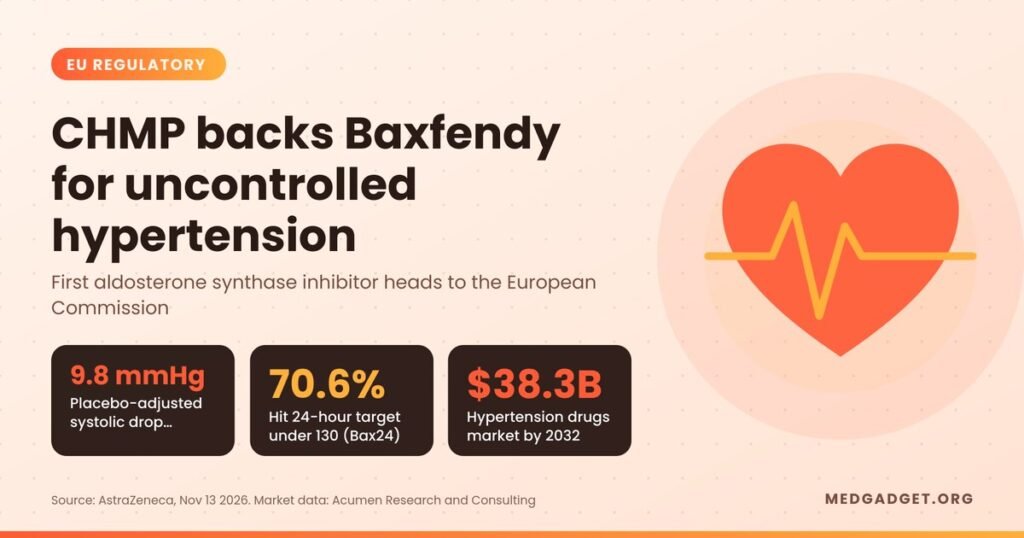

Baxfendy EU approval is now a step away: on November 13, 2026, the European Medicines Agency’s CHMP recommended AstraZeneca’s Baxfendy (baxdrostat) for adults whose high blood pressure stays uncontrolled on at least two antihypertensive medicines. If the European Commission follows the opinion, as it usually does within about two months, baxdrostat would become the first aldosterone synthase inhibitor available in the EU, six months after the US FDA approved it in May 2026.
Key takeaways on Baxfendy EU approval
- The CHMP backed Baxfendy 2 mg once daily as an add-on for adults with hypertension not controlled by two or more drugs.
- In the 796-patient BaxHTN trial, the 2 mg dose lowered seated systolic pressure by 9.8 mmHg more than placebo at 12 weeks.
- In the 218-patient Bax24 trial in resistant hypertension, 70.6% of treated patients reached a 24-hour systolic average below 130 mmHg versus 16.7% on placebo.
- High potassium is the main safety issue: the US label reports hyperkalemia in 10.2% of patients on 2 mg in pooled trials, so blood tests are needed before and during treatment.
- The final decision now rests with the European Commission; filings in Japan and China are still under review.
Why a new blood pressure pill matters now
Most people with high blood pressure are treated with familiar classes: ACE inhibitors or ARBs, calcium channel blockers, diuretics. Yet a large group stays above target no matter how many pills are stacked. AstraZeneca puts the number of people with hypertension worldwide at about 1.4 billion and says roughly half of those already taking two or more drugs remain uncontrolled. In Europe alone, the company estimates around 70 million adults have uncontrolled hypertension despite treatment. Each uncontrolled reading carries a higher long-term risk of heart attack, stroke, kidney disease and dementia.
One reason some patients resist standard therapy is excess aldosterone, the hormone that makes the kidneys hold on to salt and water. Older drugs such as spironolactone block aldosterone’s receptor, but they are poorly tolerated by some patients and can cause hormonal side effects. Baxdrostat works one step upstream: it blocks aldosterone synthase, the enzyme that makes the hormone, while largely sparing the closely related enzyme that produces cortisol.
What the two pivotal trials showed
The CHMP opinion rests on BaxHTN, published in the New England Journal of Medicine, and Bax24, published in The Lancet. Both added baxdrostat or placebo on top of patients’ existing medicines.
| Measure (2 mg, week 12) | BaxHTN (n=796) | Bax24 (n=218) |
|---|---|---|
| Patient group | Uncontrolled or resistant hypertension | Resistant hypertension |
| Blood pressure measure | Seated office systolic | 24-hour ambulatory systolic |
| Reduction from baseline | 15.7 mmHg | 16.6 mmHg |
| Reduction versus placebo | 9.8 mmHg (p<0.001) | 14.0 mmHg (p<0.0001) |
| Patients reaching target | Not reported in release | 70.6% vs 16.7% below 130 mmHg |
Two details stand out. First, the Bax24 result used round-the-clock ambulatory monitoring, which captures night-time pressure and removes the white-coat effect that can flatter office readings. Second, a post-hoc look at BaxHTN found the placebo-adjusted drop was 12.6 mmHg at 52 weeks, suggesting the effect did not fade over a year. By our calculation, the Bax24 target result means patients on baxdrostat were about 4.2 times as likely as those on placebo to reach a 24-hour average under 130 mmHg. For context, a sustained 10 mmHg fall in systolic pressure is widely associated in large analyses with meaningfully fewer strokes and cardiac events, though baxdrostat itself has not yet completed an outcomes trial.
Lead investigator Bryan Williams called the drug “a triumph of science” in AstraZeneca’s statement. Device-based options for the same patients, such as renal denervation, typically deliver office reductions in a similar single-digit to low double-digit range, so the two approaches may end up competing for the same hard-to-treat population.
The potassium question doctors will ask first
AstraZeneca describes baxdrostat as generally well tolerated, but the US prescribing information gives a clearer picture. Because lowering aldosterone makes the kidneys retain potassium, hyperkalemia occurred in 10.2% of patients on 2 mg and 6.6% on 1 mg in pooled placebo-controlled trials. Low sodium (hyponatremia) occurred in 3.2% and 2.1%, and low blood pressure, dizziness and muscle spasms were each reported in roughly 2% to 4%.
- The US label asks clinicians to check potassium and sodium before starting and periodically afterwards.
- More frequent monitoring is advised for people aged 65 or older, those with diabetes or chronic kidney disease, and anyone taking other potassium-raising drugs.
- A 1 mg dose is available in the US for patients at higher risk of high potassium or low sodium.
- The EU product information will be published only after the Commission decision, so European monitoring rules may differ in detail.
In practice, that means Baxfendy is unlikely to be a casual first-line add-on. It is aimed at patients whose pressure stays high after two or more drugs, under a doctor who can arrange regular blood tests.
Market context
According to Acumen Research and Consulting, the global hypertension drugs market was worth USD 26.5 billion in 2023 and is projected to reach USD 38.3 billion by 2032, a compound annual growth rate of 4.2%. Acumen identifies Asia-Pacific as the fastest-growing region. Much of today’s market is generic, which is why a branded first-in-class pill like baxdrostat will be judged as much on payer access as on trial data.
What is still unknown
- Hard outcomes: the approvals are based on blood pressure, not on fewer heart attacks or strokes. AstraZeneca is running further trials, including in primary aldosteronism, chronic kidney disease alongside dapagliflozin, and heart failure prevention.
- Price and reimbursement: no EU price has been set; national health technology assessments will decide how widely it is used.
- Head-to-head data: there is no published direct comparison with spironolactone, the current go-to for resistant hypertension.
- Rivals: other aldosterone synthase inhibitors, including Mineralys Therapeutics’ lorundrostat, are in late development, so baxdrostat’s first-mover lead may be short.
What to watch next
The European Commission decision is the next milestone, followed by country-by-country launch and reimbursement. Decisions in Japan and China are pending. Watch for longer-term safety data on potassium in real-world use and for the outcomes trials that will show whether lower readings translate into fewer cardiovascular events. For more on our coverage of cardiovascular drugs, see our Pharmaceutical section and our report on the pelacarsen HORIZON results.
FAQ
Is Baxfendy approved in the EU?
Not yet. The CHMP issued a positive opinion on November 13, 2026. The European Commission makes the final, legally binding decision, usually within about 67 days.
How does baxdrostat lower blood pressure?
It blocks aldosterone synthase, the enzyme that produces aldosterone. Less aldosterone means the kidneys hold less salt and water, which lowers blood pressure.
Who is Baxfendy for?
Adults whose hypertension is not controlled despite at least two blood pressure medicines. It is taken in addition to existing treatment, not instead of it.
What are the main side effects of baxdrostat?
High potassium is the most important, seen in about 1 in 10 patients on the 2 mg dose in US trials. Low sodium, low blood pressure and dizziness are less common. Blood tests are needed during treatment.
Sources: AstraZeneca press release, November 13, 2026; US prescribing information as summarised by Drugs.com. Market data: Acumen Research and Consulting. Not medical or investment advice. Last updated November 14, 2026.