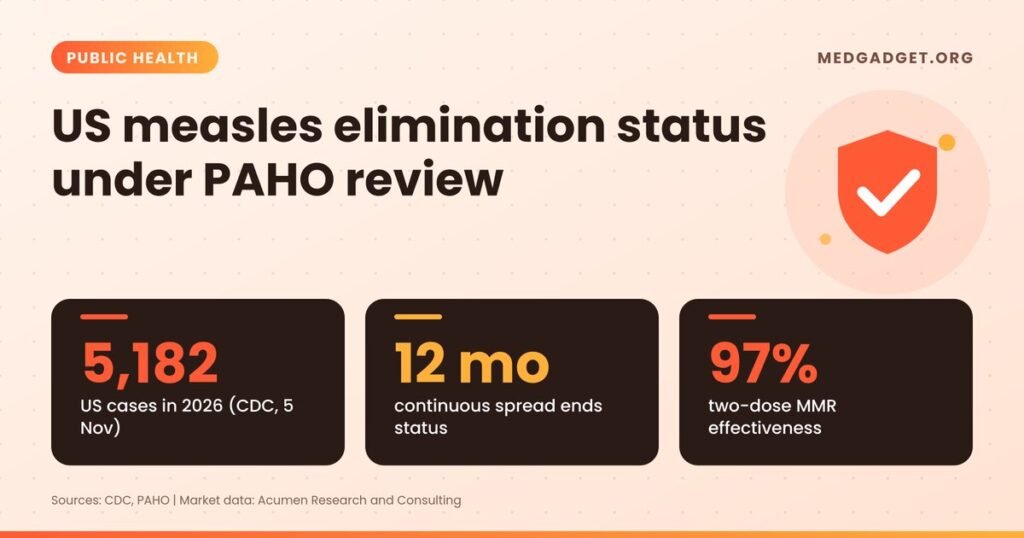

The US measles elimination status, held since 2000, is under formal review this week as the Pan American Health Organization’s independent Regional Verification Commission (RVC) meets from 10 to 13 November 2026 to decide whether measles has become endemic again in the United States. With 5,182 confirmed US cases reported to the CDC as of 5 November 2026, more than double the 2,289 cases logged in all of 2025, the commission is weighing whether one chain of transmission has run unbroken for at least 12 months. A formal decision from PAHO’s director is expected early next week.
Key takeaways on US measles elimination status
- PAHO’s Regional Verification Commission is reviewing reports from all member states between 10 and 13 November 2026, with a particular focus on the United States and Mexico.
- A country loses elimination status when the same measles genotype and lineage circulates without interruption for 12 months or more.
- PAHO set 20 January 2025, the start of the West Texas outbreak, as the beginning of the US analysis window.
- The CDC counts 5,182 confirmed US cases in 2026 across 47 jurisdictions, with 96% linked to outbreaks and four deaths.
- The CDC director says the agency’s response will not change if status is lost; two MMR doses remain about 97% effective.
What the commission is actually deciding
Losing elimination status is not triggered by case counts, deaths or headlines. It is a technical judgment about continuity. The RVC, which reports to PAHO Director Jarbas Barbosa, asks one core question: did the same strain of the virus keep spreading inside a country or defined area for a full year without a break? If genetic sequencing and epidemiological links show that it did, measles is considered re-established as endemic, even if most of the country never saw a case.
PAHO announced on 2 March 2026 that it would fold the US and Mexico reviews into this November meeting rather than hold separate hearings. For the United States, the review draws on complete viral genome sequencing, a bioinformatics platform that compares molecular data across outbreaks, and evidence about how quickly outbreaks were controlled. The commission is looking at 2025 data and the first half of 2026. Mexico’s analysis window opened on 1 February 2025, when its own outbreak was first reported, according to PAHO’s review update.
The numbers in front of the reviewers
| Indicator | Figure | Source / date |
|---|---|---|
| Confirmed US cases, 2026 | 5,182 (18 in international visitors) | CDC, as of 5 Nov 2026 |
| Confirmed US cases, 2025 | 2,289 | CDC |
| Increase, 2026 vs full-year 2025 | About 2.3 times (by our calculation) | Derived from CDC counts |
| Jurisdictions reporting cases | 47 | CDC |
| New outbreaks starting in 2026 | 43 | CDC |
| Outbreak-associated cases | 96% (4,993), including 1,385 from outbreaks that began in 2025 | CDC |
| US measles deaths in 2026 (CDC count) | 4 (subject to change) | CDC |
| Confirmed cases in the Americas, Jan to Oct 2026 | 57,666 across 17 countries and territories | PAHO, via Al Jazeera |
The 1,385 cases tied to outbreaks that began in 2025 matter most for the review. They show that at least some transmission chains crossed the calendar year. Whether those chains share a single lineage that ran continuously from January 2025 is what the sequencing evidence has to settle. We have covered how CDC and state death counts can differ and how to read Pennsylvania’s outbreak numbers, both of which feed into this picture.
How the US got here
The current wave traces back to a small community in West Texas, where cases were first reported on 20 January 2025. Large outbreaks have since been reported in Utah, Arizona, South Carolina and Pennsylvania. Public reporting so far has not established whether those state outbreaks were seeded by the Texas strain or by separate importations, which is exactly the gap that genome sequencing is meant to close.
The regional backdrop is already weak. In November 2025, the same commission found that measles had circulated uninterrupted in Canada for at least 12 months, ending Canada’s status and, under PAHO’s framework, ending the Americas’ status as a region free of endemic measles. The Americas had been the first region to eliminate endemic transmission, in 2016. Mexico, Guatemala, Peru and Bolivia are also among the countries at risk this year.
What changes if the status is lost
Practically, very little changes overnight. There are no automatic sanctions, travel restrictions or funding penalties. CDC Director Erica Schwartz told Reuters on 10 November that the agency would keep working with states as it does now: “We’re going to be doing the same exact thing that we’ve been doing today.” She attributed most infections to close-knit communities with low vaccination rates and said the CDC would continue to stress MMR vaccination as the main defense.
The bigger effect is reputational and political. Public health experts quoted by Al Jazeera described a loss as a disappointment rather than a surprise, and some argued it could give state and local officials shared language to push for catch-up vaccination. Brazil offers a precedent for recovery: it lost its status in 2019 and regained it in 2024 after a targeted vaccination drive. To regain status, a country must go at least 12 months without continuous spread of a single strain.
What it means for families and travelers
Whatever PAHO decides, the clinical advice is unchanged. Two doses of MMR vaccine are about 97% effective against measles. The CDC recommends the first dose at 12 to 15 months and the second at 4 to 6 years. Infants aged 6 to 11 months should receive an early dose before international travel. The groups at highest risk of complications are babies under 12 months, unvaccinated children and adults, pregnant people without immunity and people with weakened immune systems. Anyone unsure of their status should check records with a clinician rather than wait for the PAHO announcement.
Market context: pediatric vaccines
Measles control depends on routine childhood immunization, a segment that Acumen Research and Consulting valued at USD 51.0 billion in 2022 and projects will reach USD 160.6 billion by 2032, a compound annual growth rate of 11.1% from 2023 to 2032. Acumen found North America held the largest share, while Asia-Pacific is expected to grow fastest. The report was last updated in March 2023, so it predates the current US outbreak; the figures describe the overall market rather than measles vaccines alone.
What to watch next week
- The PAHO director’s formal classification letters to the US and Mexico, expected shortly after the meeting closes on 13 November.
- Whether PAHO publishes the genomic evidence linking (or separating) the Texas, Utah, Arizona, South Carolina and Pennsylvania outbreaks.
- The next weekly CDC case update, and whether state health departments revise death counts.
- Any state-level catch-up vaccination campaigns announced in response.
FAQ
Has the US lost its measles elimination status?
Not as of 12 November 2026. PAHO’s commission is meeting from 10 to 13 November, and the formal decision from PAHO’s director is expected early the following week.
What does measles elimination status mean?
It means no single measles strain has spread continuously within the country for 12 months or more. Imported cases and short outbreaks can still occur in a country with elimination status.
How many measles cases are there in the US in 2026?
The CDC reported 5,182 confirmed cases as of 5 November 2026, across 47 jurisdictions, with four deaths in its national count.
Can the US get its measles-free status back?
Yes. A country must show at least 12 months without continuous transmission of a single strain. Brazil lost its status in 2019 and regained it in 2024.
Sources: PAHO review update (2 March 2026); CDC measles cases and outbreaks page (updated 6 November 2026); Reuters interview with the CDC director (10 November 2026); Al Jazeera (12 November 2026). Market data: Acumen Research and Consulting, Pediatrics Vaccines Market report. This article is for information only and is not medical advice. More in Healthcare Services. Last updated 12 November 2026.