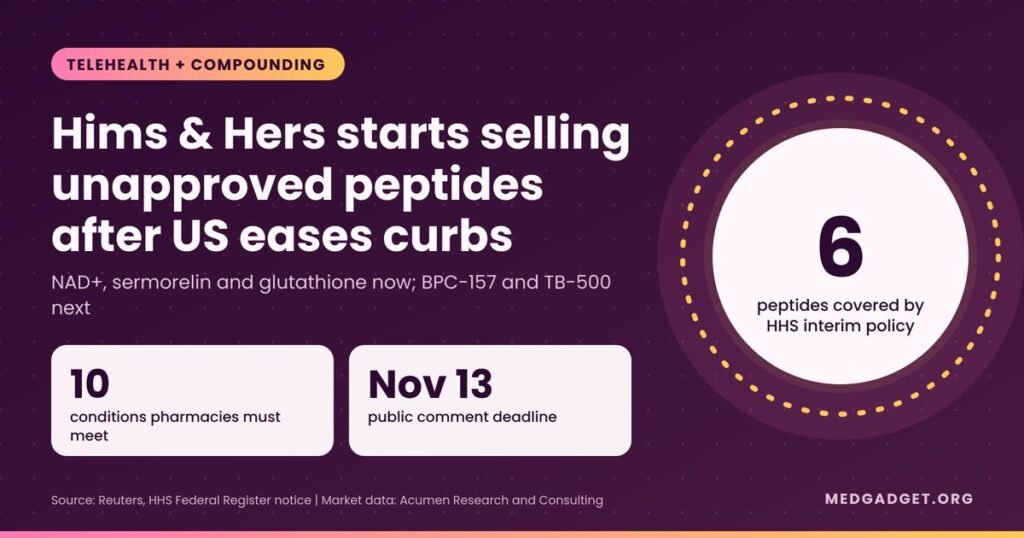

Hims & Hers peptides go on sale this month: the telehealth company said on November 9, 2026 that it will start offering compounded NAD+, sermorelin and glutathione in November, and later add BPC-157 and TB-500, two injectable peptides that have never been approved by the FDA. The move follows an October 28 federal policy that lets pharmacies compound six unapproved peptides while rulemaking is pending, and it lands as public comments on that policy close on November 13.
Key takeaways on Hims & Hers peptides
- First wave (November 2026): NAD+, sermorelin and glutathione, ingredients that compounders could already use.
- Second wave: compounded BPC-157 and TB-500, the pairing sold online as the “Wolverine stack” for recovery. Hims says it will make them in the US.
- None of these peptides is an FDA-approved drug. The legal basis is HHS enforcement discretion, not approval.
- HHS’s interim policy covers six peptides: BPC-157, TB-500, KPV, MOTS-c, Epitalon and Semax, under 10 conditions.
- FDA’s own drug reviewers had advised against listing these peptides; an FDA advisory committee voted in favor in July 2026.
- Hims expects peptide revenue to be immaterial in 2026.
What changed in US peptide rules
Until this autumn, most of the peptides popular in gyms and wellness clinics sat in a grey market, sold online as “research use only” chemicals. On October 28, 2026, HHS Secretary Robert F. Kennedy Jr. signed an interim enforcement discretion notice in the Federal Register. It tells 503A compounding pharmacies that HHS will not take action against them for compounding six named peptides, as long as they meet strict conditions, until a final rule decides whether those peptides join the official bulk substances list.
According to a Holland & Knight analysis of the notice, the conditions include a certificate of analysis from an FDA-registered facility, disclosure of the original manufacturer, adverse event reporting to MedWatch, single-ingredient products only, approved routes for each peptide, a 510(k)-cleared syringe for injections, a patient-specific prescription and the label line “This is a compounded drug product. Not for resale.” HHS argues that a supervised channel is safer than the overseas research-chemical market.
The peptides, in plain terms
| Peptide | Hims timing | Regulatory basis | Evidence in humans |
|---|---|---|---|
| NAD+ | November 2026 | Already compoundable | Limited; marketed for energy and ageing |
| Sermorelin | November 2026 | Already compoundable | Growth hormone-releasing analog; once FDA-approved, later withdrawn from market for business reasons |
| Glutathione | November 2026 | Already compoundable | Antioxidant; limited outcome data |
| BPC-157 | Later phase | HHS interim enforcement discretion | Mostly animal studies |
| TB-500 | Later phase | HHS interim enforcement discretion | Mostly animal studies |
The safety debate
The split inside government is the most important context for anyone considering these products. In July 2026, the FDA’s Pharmacy Compounding Advisory Committee voted to recommend six of seven peptides it reviewed for the 503A list, rejecting one (emideltide) for lack of evidence. But CDER’s scientific reviewers had recommended against listing them, citing thin human data. Critics quoted by Reuters warn of contamination, impurities and unknown side effects and argue that peptides should go through standard drug approval. Kennedy has described himself as a “big fan” of peptide access.
Practical points for consumers: a compounded peptide still needs a prescription, the policy can be revised or withdrawn at any time, and the absence of FDA approval means there is no agency-reviewed evidence that these products are safe or effective for recovery, muscle growth or anti-ageing. Anyone with a medical condition should discuss risks with a clinician rather than rely on online marketing.
Why Hims is moving now: the business picture
The peptide launch came alongside a mixed third quarter. Reuters reported revenue up 49% to $890.4 million, a $33 million net loss versus a $15.8 million profit a year earlier, and gross margin down to 57% from 74% as Hims shifted from compounded GLP-1s toward branded weight-loss drugs (see our coverage of Zepbound on Hims & Hers). Subscribers rose 13% to nearly 2.8 million. The company narrowed its 2026 revenue forecast to $3.13 to $3.15 billion and cut its core profit outlook.
| Metric (Q3 2026) | Value | Change |
|---|---|---|
| Revenue | $890.4M | +49% year on year |
| Gross margin | 57% | Down from 74% |
| Subscribers | ~2.8M | +13% |
| Monthly revenue per subscriber | $105 | +30% |
| International revenue | $233.3M | More than 4x |
By our calculation, international revenue is now about 26% of the total. Peptides give Hims a new cash-pay category that fits its subscription model, though management says it will not move the numbers this year.
Market context
Hims sits at the intersection of two growth markets. Acumen Research and Consulting sizes the global telehealth market at USD 84.1 billion in 2022, projecting USD 716.5 billion by 2032 at a 24.2% CAGR, with North America leading. Acumen’s compounding pharmacies report, older and best read as indicative, projected that market at around USD 14.3 billion by 2026.
What to watch
- November 13: comment deadline on the HHS notice (Docket HHS-OASH-2026-0496).
- Whether FDA issues a final rule adding the peptides to the 503A list, which would replace the temporary policy.
- State pharmacy boards, which can impose stricter rules.
- Adverse event reports filed through MedWatch once compounded versions reach patients.
FAQ
Is BPC-157 legal now?
It is still not an FDA-approved drug. Under HHS’s interim policy, licensed 503A pharmacies may compound it for an individual patient’s prescription if they meet 10 conditions. The policy is temporary and non-binding.
What peptides does Hims & Hers sell?
From November 2026: NAD+, sermorelin and glutathione. BPC-157 and TB-500 are planned for a later phase.
What is the Wolverine stack?
A popular name for BPC-157 combined with TB-500, marketed for injury recovery. Human evidence for the combination is limited.
Are compounded peptides safe?
Their safety and effectiveness have not been established through FDA review. FDA scientists raised concerns; HHS says regulated compounding is safer than unregulated research chemicals.
More: Pharmaceutical news | FDA’s GLP-1 eye warning
Sources: Reuters (November 9, 2026); HHS Federal Register notice (October 28, 2026) via Holland & Knight; Becker’s Hospital Review. Market data: Acumen Research and Consulting, Telehealth Market and Compounding Pharmacies Market reports. Not medical or investment advice. Last updated: November 12, 2026.