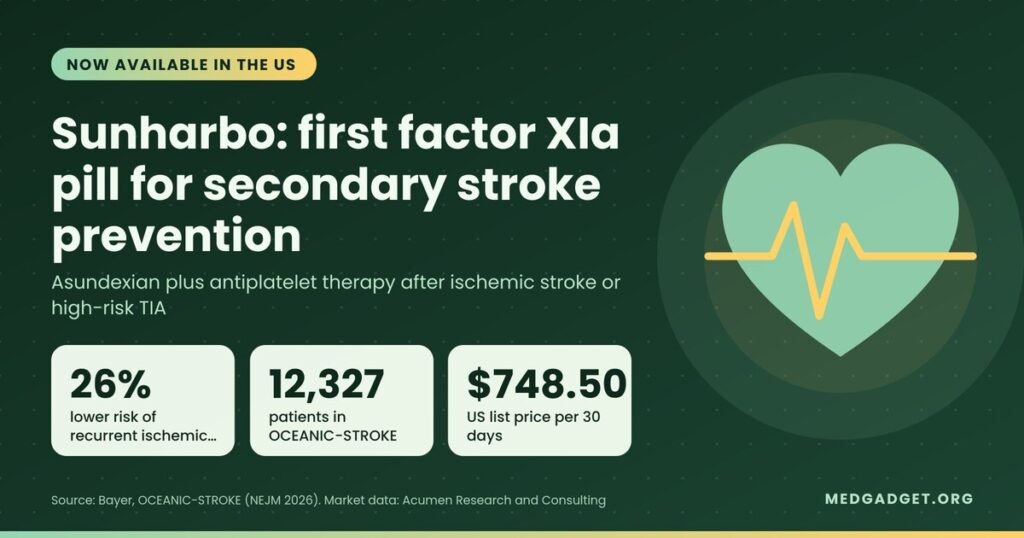

The Sunharbo stroke drug (asundexian), Bayer’s first-in-class factor XIa inhibitor, became available to order by US hospitals, health systems and pharmacies on 20 November 2026, eleven days after the FDA approved it on 9 November to lower the risk of another stroke in adults who have just had a non-cardioembolic ischemic stroke or a high-risk transient ischemic attack (TIA). In the 12,327-patient OCEANIC-STROKE trial, adding Sunharbo to antiplatelet therapy cut recurrent ischemic strokes by 26% without a meaningful rise in overall major bleeding. The list price is $748.50 for a 30-day supply.
Key takeaways on the Sunharbo stroke drug
- Sunharbo is the first factor XIa inhibitor approved in the US and the first new class of oral antithrombotic for secondary stroke prevention in years.
- It is taken once daily on top of single or dual antiplatelet therapy, not instead of it.
- Ischemic stroke occurred in 6.2% of patients on Sunharbo versus 8.4% on placebo (hazard ratio 0.74).
- ISTH major bleeding was 1.6 versus 1.5 per 100 patient-years, but bleeding was higher early on, in people over 75 and in the high-risk TIA group.
- It is not approved for atrial fibrillation, where an earlier trial against apixaban was stopped for lack of efficacy.
- China approved asundexian first, in late October 2026; reviews in the EU and Japan are ongoing.
Who Sunharbo is for, and who it is not for
The US label covers adults with a recent non-cardioembolic ischemic stroke with an NIH Stroke Scale score of 15 or less, or a high-risk TIA, used in combination with antiplatelet therapy. In plain terms, it targets the large group of stroke survivors whose clot did not come from the heart. That group is usually sent home on aspirin, clopidogrel or a short course of both, and still faces a substantial risk of a second stroke in the following months.
The label is explicit about the boundaries. Sunharbo is not approved for people with atrial fibrillation, who remain on established anticoagulants such as apixaban or rivaroxaban. It is not recommended for people taking drugs that are combined P-gp and strong CYP3A4 inducers, because these can strip out its effect, nor for people with moderate or severe liver impairment (Child-Pugh B or C) or end-stage kidney disease. The label lists no formal contraindications. Anyone who has had a stroke should discuss these points with their neurologist rather than adjust medicines on their own.
OCEANIC-STROKE results in numbers
OCEANIC-STROKE (NCT05686070) randomized 12,327 patients worldwide to asundexian 50 mg once daily (6,162) or placebo (6,165), each on top of the antiplatelet regimen their doctors chose, with roughly two years of follow-up. Results were presented at the International Stroke Conference in February 2026 and published in the New England Journal of Medicine in April.
| Measure | Sunharbo + antiplatelet | Placebo + antiplatelet |
|---|---|---|
| Ischemic stroke (primary endpoint) | 6.2% | 8.4% |
| Hazard ratio (95% CI) | 0.74 (0.65 to 0.84) | |
| ISTH major bleeding, per 100 patient-years | 1.6 | 1.5 |
| Major bleeding, first 90 days | 4.5 | 3.1 |
| Major bleeding, patients over 75 | 2.6 | 1.7 |
| Major bleeding, high-risk TIA subgroup | 2.9 | 1.0 |
| GI bleeding, per 100 patient-years | 2.7 | 2.1 |
| Diarrhea | 3.4% | 2.8% |
The absolute reduction was 2.2 percentage points. By our calculation, that means roughly 45 patients would need to take Sunharbo for about two years to prevent one ischemic stroke, a rough figure that ignores differences in follow-up time. The benefit was consistent across age, sex, stroke subtype, severity and whether patients were on one or two antiplatelet drugs. Co-principal investigator Ashkan Shoamanesh described it to TCTMD as “a simple, once-daily oral medication that demonstrated substantial efficacy in preventing recurrent ischemic stroke.”
Why factor XIa matters
Today’s blood thinners work further down the clotting cascade. Warfarin lowers several clotting factors, while drugs such as apixaban block factor Xa or thrombin directly. They prevent clots well, but they also blunt the body’s normal response to injury, which is why bleeding is the main worry. Factor XIa sits higher up, in the loop that amplifies thrombin generation once a clot starts forming. Bayer’s preclinical work suggests that blocking it dampens pathological clotting more than the protective clotting that seals a wound. OCEANIC-STROKE is the first large outcome trial to show that idea can translate into fewer strokes with little change in overall major bleeding, though the early and subgroup bleeding signals show the separation is not complete.
Price, access and the bleeding trade-off
At $748.50 per 30 days, the annual list cost works out to about $9,100 by our calculation, before insurer discounts. Bayer says most health plans and patients will not pay list price, and its US Patient Assistance Foundation may supply the drug free to eligible patients. Stroke specialists quoted by TCTMD expect cost and coverage, rather than clinical data, to be the main brake on uptake, since the antiplatelet drugs it is added to are cheap generics.
Clinicians will also weigh who gains most. The extra early bleeding, and the higher rates in people over 75 and after TIA, mean doctors are likely to think hard about timing and patient selection. Most gastrointestinal bleeds on the drug were minor or clinically relevant non-major, often from the rectum, but they still matter to patients.
Market context: anticoagulants
Sunharbo enters a large and growing market. According to Acumen Research and Consulting, the global anticoagulants market was worth USD 37.2 billion in 2023 and is projected to reach USD 78.3 billion by 2032, a compound annual growth rate of 8.8%. Acumen notes that factor Xa inhibitors held the largest share and that North America dominates, with Asia-Pacific growing fastest. These figures are indicative; they do not yet reflect a new factor XIa class, which could take share in stroke prevention if payers cooperate.
The race behind Bayer
Bayer’s lead may be short. Bristol Myers Squibb and Johnson & Johnson expect Phase 3 secondary stroke prevention data for milvexian, a twice-daily factor XIa pill, by the end of 2026, and are also testing it in atrial fibrillation. Novartis is developing abelacimab, an injectable factor XI antibody, and ADARx has an siRNA approach. Analysts at Leerink have argued that milvexian would need a stroke reduction of at least 30% to dislodge Sunharbo. Asundexian itself failed in atrial fibrillation in 2023, so whether factor XIa drugs can replace standard anticoagulants beyond stroke remains open. For related cardiovascular coverage, see our report on Baxfendy’s EU recommendation for hard-to-treat hypertension and the SIMPLAAFY trial of post-implant drug regimens, or browse more pharmaceutical news.
Frequently asked questions
What is Sunharbo used for?
Sunharbo (asundexian) is approved in the US, together with antiplatelet therapy, to reduce the risk of stroke in adults after a recent non-cardioembolic ischemic stroke (NIHSS 15 or less) or a high-risk TIA.
Is Sunharbo a blood thinner?
Yes. It is an oral anticoagulant that blocks factor XIa, a different target from apixaban, rivaroxaban or warfarin. It is not approved for atrial fibrillation.
How much does Sunharbo cost?
The US list price is $748.50 for 30 days. Out-of-pocket cost depends on insurance, and Bayer’s patient assistance foundation may help eligible patients.
Does Sunharbo increase bleeding risk?
Overall major bleeding was similar to placebo in OCEANIC-STROKE, but rates were higher in the first 90 days, in people over 75 and after high-risk TIA, and gastrointestinal bleeding was somewhat more common.
Sources: Bayer US availability release (20 Nov 2026); TCTMD; MedCity News; Drugs.com approval history. Market data: Acumen Research and Consulting. This article is for information only and is not medical or investment advice. Last updated 20 November 2026.