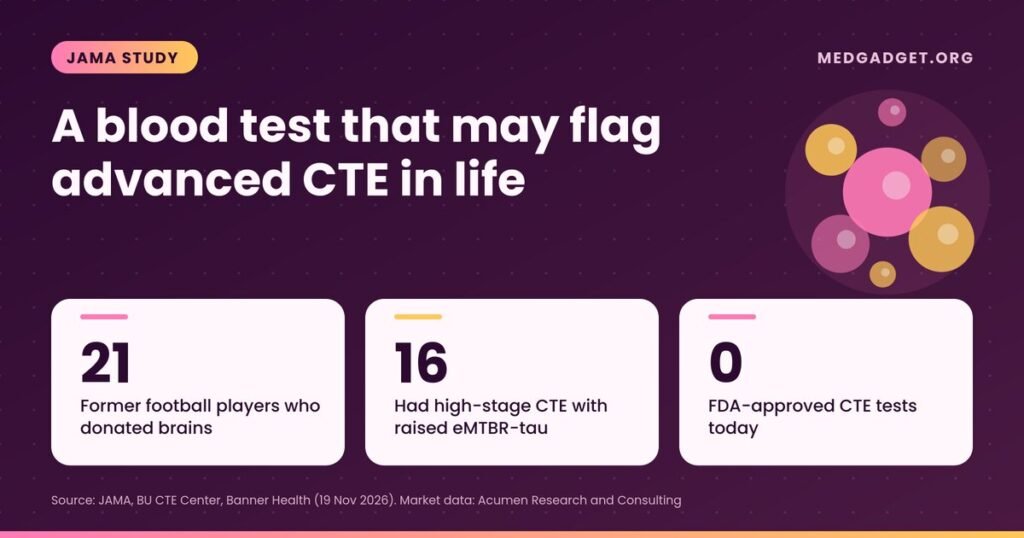

A CTE blood test measuring a tau protein fragment called eMTBR-tau picked out advanced chronic traumatic encephalopathy in former American football players, according to a study from the Boston University CTE Center and Banner Health published in JAMA on 19 November 2026. The research looked at blood drawn from 21 players during life and compared it with what their brains showed at autopsy: levels were clearly higher in the 16 men with high-stage CTE than in those with early-stage disease or none at all.
CTE, the degenerative brain disease linked to repeated head impacts in contact sports, can currently be confirmed only by examining brain tissue after death. That is why the result drew wide attention from sports media and families of former players. The researchers are just as clear about what it is not: an approved test, or one anyone can order today.
Key takeaways on the CTE blood test
- Plasma eMTBR-tau, a marker of tau tangles, was significantly raised in former football players whose autopsies showed high-stage CTE (McKee stage 3 or 4).
- It was not raised in players with low-stage CTE or no CTE, so the test does not yet detect early disease.
- The study is small: 21 brain donors, 18 with CTE and only 3 without.
- A widely used Alzheimer’s marker, p-tau217, rose only in players who also had Alzheimer’s disease, not in CTE alone.
- The test is not FDA-approved and is not available to the public. The team says it should not guide diagnosis until larger validation studies are done.
- A second, independent JAMA paper in the same issue also found eMTBR-tau elevated in autopsy-confirmed CTE.
Who was studied
All participants had given blood while taking part in BU-led research and later donated their brains to the BU CTE Center Brain Bank. Neuropathologists then staged any CTE using the McKee system, which runs from stage 1 (mild, localised tau deposits) to stage 4 (widespread).
| Group (autopsy-confirmed) | Number of donors | eMTBR-tau pattern |
|---|---|---|
| High-stage CTE (McKee 3 or 4) | 16 | Significantly elevated |
| Low-stage CTE (McKee 1 or 2) | 2 | Not elevated |
| No CTE | 3 | Not elevated |
| CTE plus Alzheimer’s disease (subset of CTE cases) | 5 | Highest levels |
| Total | 21 |
By playing level, 12 donors had played professionally, 7 in college and 2 only in high school. By our calculation, 76% of the sample (16 of 21) had advanced disease, which is far higher than would be expected in any group of living former players a clinic might test. That skew matters when judging how the test would perform in the real world.
Why eMTBR-tau and not the Alzheimer’s blood tests
Blood tests for Alzheimer’s disease have moved quickly in the last two years, mostly built on phosphorylated tau such as p-tau217. Those markers track the amyloid-driven tau changes typical of Alzheimer’s. CTE has its own tau pattern, clustered around small blood vessels in the depths of the brain’s folds, and it can occur with little or no amyloid.
eMTBR-tau, short for endogenously cleaved microtubule-binding region tau, comes from the part of the tau protein that forms the core of tangles themselves. In this study, p-tau217 only rose in players who also had Alzheimer’s pathology, while eMTBR-tau rose with advanced CTE whether or not Alzheimer’s was present. Banner’s Nicholas Ashton, co-senior author, pointed to how blood tests have reshaped Alzheimer’s research and said the team is “optimistic that the same will be true for CTE.” Readers interested in the Alzheimer’s side of this field can see our earlier report on p-tau217 research tools.
What a test in life would change
Today, a former athlete with memory loss, mood changes or impulsivity can be told by a neurologist only that CTE is possible. A reliable biomarker could help separate CTE from Alzheimer’s, depression or other causes, allow researchers to enrol the right people into treatment trials, and eventually track whether a therapy is working. No treatment for CTE is approved, so for now the main benefits would be clearer diagnosis and better research.
The limits the authors flag
- Small, selected sample: 21 donors drawn from existing research cohorts rather than a planned diagnostic study.
- Few early cases: only two low-stage CTE brains, so the test’s failure to flag early disease is itself based on very few people.
- No age-matched controls: the three donors without CTE were not matched by age, and tau markers change with age.
- No accuracy figures: the public summaries give no sensitivity, specificity or cut-off value, so it is too soon to say how often the test would be right for an individual.
Lead investigator Michael Alosco of BU described the work as discovery-phase and said he hopes larger studies can move it forward over roughly the next five years.
Market context
Blood-based brain biomarkers sit within the wider neurodiagnostics field. Acumen Research and Consulting valued the global neurodiagnostics market at US$7.8 billion in 2022 and projects it will reach US$15.9 billion by 2032, growing at a 7.5% compound annual rate, with North America the largest region and Asia-Pacific the fastest growing. The report was last updated in February 2024 and predates the latest blood-biomarker approvals.
Frequently asked questions
Is there a blood test for CTE?
Not one you can get. The eMTBR-tau test is a research assay. It is not FDA-approved, and its developers say it should not be used to diagnose anyone yet.
Can CTE be diagnosed while someone is alive?
Not definitively. Doctors can diagnose traumatic encephalopathy syndrome based on symptoms and head-impact history, but CTE itself is confirmed only by brain autopsy.
Does the test detect early CTE?
No. In this study eMTBR-tau was raised only in high-stage CTE, not in the two low-stage cases.
When could a CTE blood test be available?
The lead researcher has suggested a timeframe of about five years, depending on larger validation studies and regulatory review. No approval application has been announced.
More from our life science coverage.
Sources: JAMA study, Boston University, Banner Health. Market data: Acumen Research and Consulting. This article is for information only and is not medical advice. Last updated 20 November 2026.