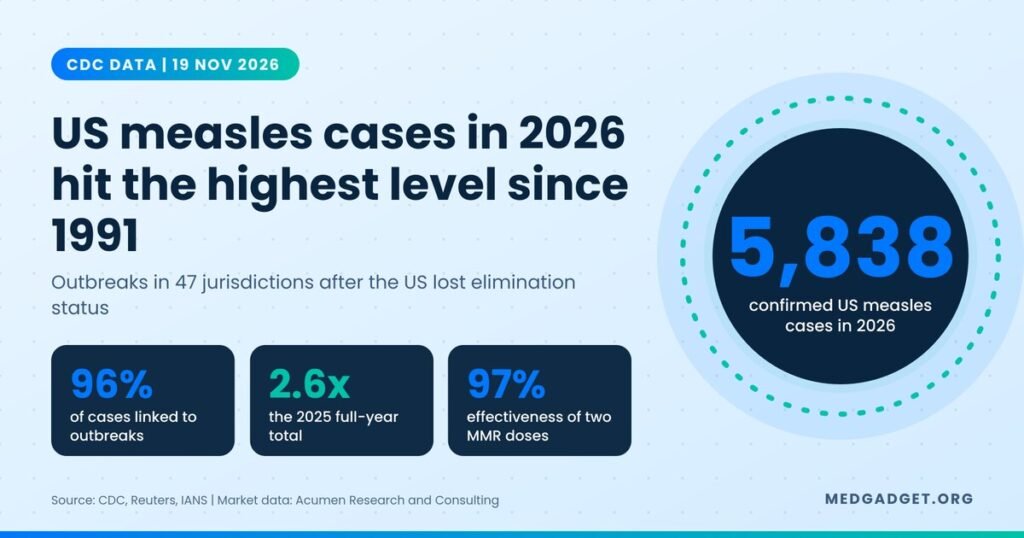

US measles cases in 2026 have reached 5,838 confirmed infections, the highest yearly total since 1991, according to Centers for Disease Control and Prevention (CDC) data current to noon on 19 November and posted on 20 November. The count is more than two and a half times last year’s total and comes days after the United States formally lost the measles elimination status it had held since 2000.
Key takeaways on US measles cases in 2026
- The CDC has confirmed 5,838 cases this year: 5,820 among residents of 47 jurisdictions, plus 18 international visitors.
- Nearly all cases (96%) are linked to outbreaks; 43 new outbreaks have begun in 2026, and outbreaks that started in 2025 are still adding cases.
- About 646 people, roughly 11% of patients, have been hospitalised, according to figures reported by IANS and Xinhua.
- The CDC lists six confirmed deaths, but state health departments report more, because the agency now counts deaths from national mortality records.
- Pennsylvania is the hardest-hit state, with 1,631 confirmed cases and 326 hospitalisations as of 20 November, Reuters reported.
- Two doses of MMR vaccine are 97% effective at preventing measles, the CDC says.
How 2026 compares with recent years
For most of the past two decades, the US recorded a few hundred measles cases a year at most. The current surge began in early 2025 and has not stopped. The table uses CDC year-end and year-to-date figures.
| Year | Confirmed cases | Outbreaks | Share linked to outbreaks |
|---|---|---|---|
| 2019 | 1,274 (31 states) | Not compared here | Not compared here |
| 2024 | 285 | 16 | 69% |
| 2025 | 2,289 | 48 | 90% |
| 2026 (to 19 Nov) | 5,838 | 43 new | 96% |
By our calculation, 2026 already has about 2.6 times as many cases as all of 2025 and roughly 20 times as many as 2024, with six weeks of the year still to go. Of this year’s outbreak-linked cases, 4,244 came from outbreaks that started in 2026 and 1,385 from outbreaks that began in 2025, the CDC says. That long tail of transmission is exactly what cost the country its elimination status.
Why elimination status was lost
A country is considered to have eliminated measles when no single chain of transmission lasts 12 months. A regional commission convened by the Pan American Health Organization (PAHO) met from 10 to 13 November and found that the same measles virus lineage had circulated without a break for at least a year in the United States, Mexico and Bolivia. PAHO accepted the recommendation to withdraw elimination status for all three countries this week. We explained the decision in detail in what losing measles elimination status means.
In practical terms, measles is now treated as endemic again in the US. That does not change the advice for individuals, but it does mean public health agencies expect continued spread rather than occasional imported cases that fizzle out.
Who is getting sick
The pattern is consistent with earlier years of this outbreak: about 96% of cases are in people who were unvaccinated or whose vaccination status is unknown, according to CDC figures cited by IANS. Roughly one in ten measles infections are breakthrough cases in vaccinated people, a share the CDC says is in line with previous years and expected given that no vaccine is perfect.
Falling childhood coverage is the root cause. The CDC reports that MMR coverage among kindergartners dropped from 95.2% in the 2019-2020 school year to 92.4% in 2025-2026, leaving about 280,000 kindergartners unprotected. Measles is so contagious that coverage of about 95% is generally needed to stop community spread, so a gap of a few percentage points, concentrated in particular schools and communities, is enough to sustain outbreaks.
Why death counts do not match
Readers may see different death tolls. The CDC lists six confirmed measles deaths in 2026 and marks the number as subject to change. Pennsylvania alone has reported eight measles-related deaths, Wisconsin two, and New York state recently recorded its first, a child. Reuters reports that the CDC now relies on National Center for Health Statistics mortality data rather than state reports, which lag behind. We tracked the state-reported losses in our Pennsylvania measles coverage. Before the vaccine era, the CDC notes, measles put about 48,000 Americans in hospital and killed 400 to 500 every year.
Market context: childhood vaccines
The resurgence is also renewing attention on routine paediatric immunisation programmes and the companies that supply them. According to Acumen Research and Consulting, the global paediatric vaccines market was worth USD 51.0 billion in 2022 and is projected to reach USD 160.6 billion by 2032, growing at a compound annual rate of 11.1%. Acumen says North America held the leading share, while Asia-Pacific is the fastest-growing region. The figures come from a report last updated in March 2023, so they predate the current US outbreak.
What to do if you are unsure of your protection
- Check records: two documented doses of MMR, or a blood test showing immunity, generally mean you are protected.
- Children normally get their first dose at 12 to 15 months and the second at 4 to 6 years; ask a paediatrician about catch-up doses.
- Adults without records, travellers and people in outbreak areas should talk to a doctor or pharmacist. Our guide to MMR boosters for adults covers who needs one.
- If you suspect measles (high fever, cough, red eyes, then a spreading rash), call ahead before visiting a clinic so staff can prevent exposure in waiting rooms.
FAQ
How many measles cases are there in the US in 2026?
The CDC counts 5,838 confirmed cases as of 19 November 2026, including 18 international visitors. It updates the total weekly, on Wednesdays or Thursdays.
Is this the worst measles year since 1991?
Yes. This is the first time since 1991 that the US has passed 5,000 cases in a year, Reuters reported, citing CDC data.
Which state has the most measles cases?
Pennsylvania, with 1,631 confirmed cases as of 20 November, according to Reuters. Cases have been reported in 47 jurisdictions in total.
How effective is the MMR vaccine against measles?
The CDC says one dose is about 93% effective and two doses about 97% effective at preventing measles.
Sources: CDC measles cases and outbreaks (updated 20 November 2026); Reuters via AOL; IANS. Market data: Acumen Research and Consulting. This article is for information only and is not medical advice. Last updated 21 November 2026. More in Healthcare Services.