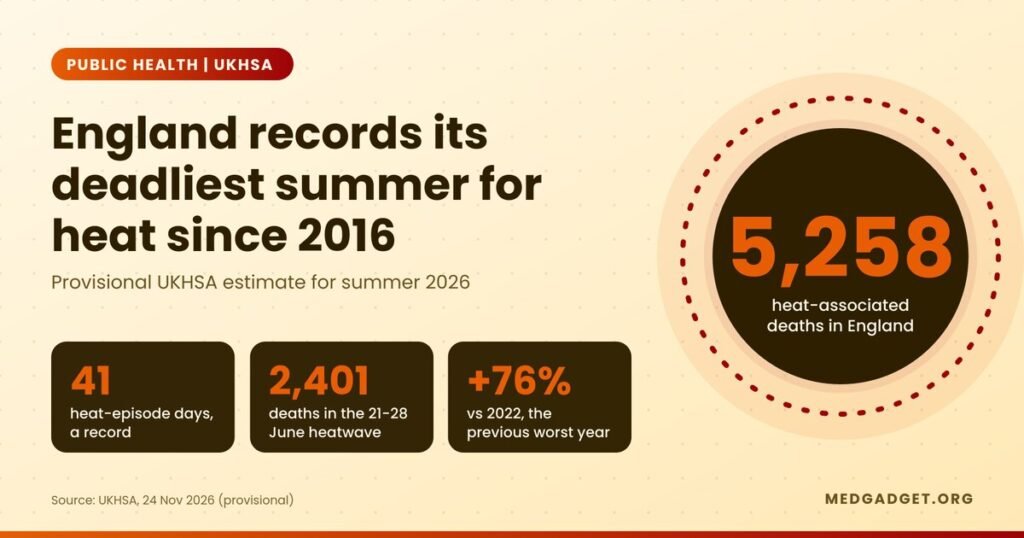

Heat-related deaths in England in 2026 reached an estimated 5,258, the highest annual toll since the UK Health Security Agency (UKHSA) began this kind of monitoring in 2016, according to provisional figures the agency published on 24 November 2026. Seven separate heat episodes covering 41 days drove the total, and a single week in late June accounted for roughly 2,400 of those deaths.
Key takeaways on heat-related deaths in England 2026
- UKHSA estimates 5,258 heat-associated deaths across the summer of 2026, a record in its monitoring series.
- The country logged 7 heat episodes lasting 41 days in total, beating the previous record of 40 heat-episode days set in 2022.
- The deadliest stretch, 21 to 28 June, is linked to an estimated 2,401 deaths.
- UKHSA issued its first ever May Heat-Health Alert, and only the second red alert in England’s history.
- The figures are provisional; age, regional and cause-of-death breakdowns are due in the final report in early 2027.
What UKHSA reported
The new number comes from UKHSA’s second interim heat mortality report for the year, which added a further 2,381 deaths to the earlier estimate. The agency counts deaths during defined heat episodes and compares them with deaths in nearby periods without heat, the same method it uses for its annual heat mortality monitoring statistics. Because death registrations are still coming in, the agency describes the total as provisional and expects to publish official statistics in early 2027.
The season started unusually early. Hot weather in late May prompted the first Heat-Health Alert ever issued in that month, before the formal alerting season begins. The June heatwave, part of wider extreme heat across Europe, then produced the single worst week. UKHSA’s blog says the May and June episodes together were associated with more than 3,000 deaths, more than all of the later episodes combined, while July and August episodes added more than 2,000.
Dr Ross Thompson, Principal Environmental Health Scientist at UKHSA, said the summer “saw a prolonged period of hot weather that had a substantial impact on public health.”
How 2026 compares with previous summers
The table below uses UKHSA’s published summer totals for England. The comparison columns are by our calculation.
| Summer | Heat-associated deaths (England) | 2026 vs that year (by our calculation) |
|---|---|---|
| 2022 | 2,985 | +76% |
| 2023 | 2,295 | +129% |
| 2024 | 1,311 | about 4.0x |
| 2025 | 1,504 | about 3.5x |
| 2026 (provisional) | 5,258 | Record |
Put another way, by our calculation the 2026 toll equals about 65% of the combined 8,095 deaths recorded across the four previous summers. The 2022 season, when England first saw temperatures above 40C, had been the benchmark for heat harm. 2026 beat it on both deaths and the number of days spent in heat-episode conditions.
Why heat kills, and who is most exposed
Most heat deaths are not heatstroke. Hot weather strains the heart and kidneys, thickens the blood through dehydration and worsens existing respiratory and cardiovascular disease, so many deaths are recorded under those underlying conditions. That is why agencies estimate heat mortality statistically rather than counting death certificates that mention heat.
UKHSA lists older adults, young children, pregnant women and people with long-term health conditions as the groups at greatest risk. People who live alone, take medicines that affect fluid balance or temperature control, or live in top-floor flats that trap heat also face higher risk. The interim report does not yet break deaths down by age or region, so it is not yet possible to say which areas of England were hit hardest in 2026.
The early-season problem
The most striking finding for health planners is timing. The heaviest losses came in May and June, before many people and services had switched into summer mode. Early heat tends to be more lethal because bodies have not acclimatised and preparations such as checking on vulnerable neighbours, adjusting care-home routines or stocking cooling equipment may not be in place.
UKHSA’s response is to push preparedness earlier: plans should be ready before May, heat-health actions should run across the whole season, and longer-term adaptation in housing, the built environment and health and care services is needed alongside alerts. The agency points organisations to its Adverse Weather and Health Plan for England.
The European picture
England was not alone. A separate rapid analysis by researchers at Imperial College London and the London School of Hygiene and Tropical Medicine, reported by AFP, estimated more than 50,000 heat-related deaths in cities across 30 European countries over summer 2026, which would be the highest since 2000. That study uses a different modelling method from UKHSA, so the two figures should not be added or directly compared.
What we do not know yet
- The age profile of deaths, including how many were among people aged 65 and over.
- Which English regions and cities saw the largest excess.
- How much of the toll occurred in hospitals, care homes or private homes.
- Whether late death registrations will push the final total higher.
Heat is one of several pressures on health services this year. Readers following seasonal risk can also see our coverage of the early H1N1 flu surge in the US and more in our healthcare services section.
FAQ
How many people died from heat in England in 2026?
UKHSA’s provisional estimate is 5,258 heat-associated deaths over summer 2026, the highest since its monitoring began in 2016.
Which heatwave was the deadliest in 2026?
The June heatwave. UKHSA links an estimated 2,401 deaths to extreme heat between 21 and 28 June.
How does UKHSA count heat deaths?
It compares observed deaths during defined heat episodes with deaths in nearby non-heat periods. The result is an estimate of extra deaths associated with heat, not a count of death certificates naming heat.
Who is most at risk in a heatwave?
Older adults, young children, pregnant women and people with heart, lung, kidney or other long-term conditions. Anyone concerned about symptoms in hot weather should seek medical advice.
Sources: UKHSA news release; UKHSA blog; AFP via Al Jazeera for the European estimate. Figures are provisional. This article is for information only and is not medical advice. Last updated 25 November 2026.