
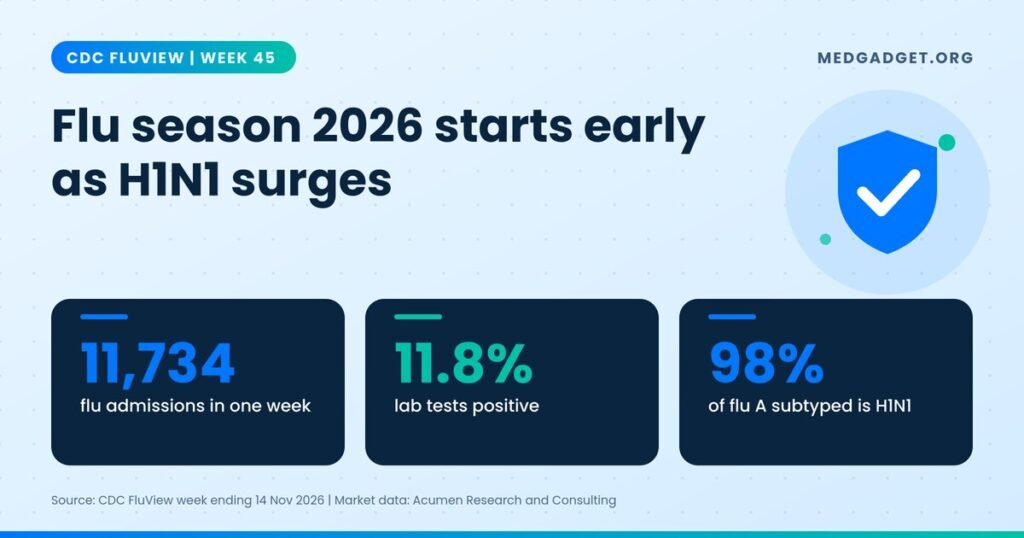

The flu season 2026 has arrived in the United States weeks ahead of the usual winter curve. In its FluView report for the week ending 14 November 2026, published on 20 November, the CDC counted 11,734 laboratory-confirmed influenza hospital admissions in a single week, 11.8% of clinical lab tests positive for flu, and seven paediatric flu deaths already this season. Nearly every subtyped virus is influenza A(H1N1), and the cumulative hospitalisation rate is the highest the CDC has recorded at this point of a season since 2010-11. On the same day, the Ohio Department of Health announced the state’s first paediatric flu death of 2026-27, a teenager from Ross County.
Key takeaways on flu season 2026
- US flu activity is rising early: outpatient visits for flu-like illness reached 3.8% in week 45, above the national baseline of 2.9% for a second straight week.
- Weekly flu admissions (11,734) are roughly seven times the 1,665 recorded in the same week last season, by our calculation from CDC and published figures.
- The dominant strain is A(H1N1)pdm09, about 98% of subtyped influenza A viruses since 4 October, a switch from last winter’s H3N2 subclade K season.
- CDC estimates at least 3.7 million illnesses, 50,000 hospitalisations and 2,800 deaths so far, yet rates current severity as low.
- Lab testing shows circulating viruses are well matched to this year’s vaccine, and antiviral resistance remains rare.
Why this flu season looks different
Most US flu seasons build slowly through November and peak between late December and February. This one has taken off sooner. The CDC’s FluSurv-NET network, which tracks hospitalisations in 14 states covering about a tenth of the population, logged 4,497 lab-confirmed flu hospitalisations between 4 October and 14 November, a cumulative rate of 12.0 per 100,000 people. The agency says that is the highest week-45 figure since the 2010-11 season. Eleven jurisdictions now report high or very high flu-like illness activity, up from eight a week earlier, and 68 metropolitan areas sit in the same bands.
An early start does not guarantee a bad winter. The CDC itself cautions that an earlier rise does not necessarily mean a higher peak or a more severe season overall, and its preliminary severity assessment is low for every age group. What it does mean is that the usual window to get vaccinated before flu spreads widely, typically the weeks around Thanksgiving, is shorter than normal this year.
The numbers in CDC’s latest FluView
| Indicator (week ending 14 Nov 2026) | Value | Context |
|---|---|---|
| Clinical lab tests positive | 11.8% (7,269 of 61,838) | Stable vs prior week; 8.8% since 4 Oct |
| Outpatient flu-like illness | 3.8% of visits | Up from 3.2%; baseline 2.9% |
| Weekly lab-confirmed admissions | 11,734 | 3.5 per 100,000; about 7x same week last season |
| Cumulative FluSurv-NET rate | 12.0 per 100,000 | Highest for week 45 since 2010-11 |
| Paediatric deaths, 2026-27 | 7 | Two added in week 45, both H1N1 |
| Paediatric deaths, 2025-26 | 204 | Final count still preliminary |
| Jurisdictions high or very high | 11 | Up from 8 the week before |
Older adults are bearing the brunt so far. Among people 65 and over, the weekly admission rate was 10.6 per 100,000, three times the national average, followed by children under five at 4.0 and adults aged 50 to 64 at 3.4. Regionally, the south-eastern states in HHS Region 4 had the highest weekly admission rate at 4.5 per 100,000.
H1N1 is back in charge
Last winter was dominated by H3N2 viruses from subclade K, a season that ended with more than 200 paediatric deaths. This autumn the picture has flipped. Of 5,688 influenza A viruses subtyped by public health labs since 4 October, 98.3% were A(H1N1)pdm09 and only 1.6% were H3N2. Genetic sequencing places almost all of the H1N1 viruses in a newly named subclade E family, with E.1 and E.3 the most common branches.
The more reassuring finding is in the antigenic testing. CDC labs report that 93.4% of H1N1 viruses tested (170 of 182) were well recognised by antibodies raised against the 2026-27 vaccine reference strain, as were all H3N2 and B/Victoria viruses tested. The agency says it is still too early to predict vaccine effectiveness, but a mismatch is not showing up in the data so far. The same week, CDC also reported one human H5 bird flu case in an Oregon dairy worker, with no person-to-person spread identified.
Ohio’s first child death of the season
The Ohio Department of Health said on 20 November that a teenager from Ross County had died of flu-associated causes, the state’s first paediatric flu death of 2026-27. The department did not release the child’s vaccination status or other details. Ohio typically records between one and seven paediatric flu deaths in a season, and state officials noted that hospitalisations usually climb toward the end of the year. ODH Director Dr. Bruce Vanderhoff said, “Our hearts go out to the family on this tragic loss,” and urged Ohioans to get vaccinated before holiday gatherings. The CDC lists Ohio’s current activity as low, a reminder that severe outcomes can occur even before a state’s curve turns upward. It is not yet clear whether the Ohio death is included in CDC’s national count of seven.
What to do before the holidays
- Get vaccinated now. The CDC recommends a flu shot for everyone aged 6 months and older. Protection takes about two weeks to build, so a shot in the next few days covers Christmas travel.
- Act fast on symptoms if you are high risk. CDC advises that prescription antivirals start as early as possible, especially for adults 65 and over, young children, pregnant people and those with chronic conditions. Ask a clinician; this article does not give dosing advice.
- Expect treatments to work. Only 1.0% of viruses tested since May showed reduced inhibition by oseltamivir, and none showed reduced susceptibility to zanamivir, peramivir or baloxavir.
- Watch the overlap. Flu is rising alongside RSV and COVID-19 season, and the US is also managing a record measles year (see our report on US measles cases in 2026).
Market context: antiviral demand
Early, H1N1-heavy seasons tend to pull forward demand for influenza antivirals and testing. For broader context, Acumen Research and Consulting projected the global antiviral drugs market to reach around US$74.7 billion by 2027, growing at roughly 3.7% a year. That report was last updated in March 2021 and covers all antivirals, with HIV therapies the largest segment, so treat the figure as dated and indicative rather than a flu-specific forecast.
What to watch next
Because of Thanksgiving, CDC’s next FluView (week 46) is due on 30 November. Its FluSight ensemble forecasts that weekly admissions will likely keep rising into early December, with a wide range of 9,200 to 36,100 new admissions for the week ending 5 December. Key signals will be whether positivity breaks above 12%, how many more states move into the high band, and whether H3N2 or influenza B begin to gain ground later in the winter, as sometimes happens in a second wave. We cover outbreak and public-health news in our Healthcare Services section, including the recent Cal-Maine bird flu outbreak.
FAQ
Is the 2026 flu season worse than normal?
It is earlier than normal. The cumulative hospitalisation rate is the highest for mid-November since 2010-11, but the CDC currently rates overall severity as low and says an early start does not necessarily mean a worse peak.
What flu strain is going around in November 2026?
Influenza A(H1N1)pdm09, the descendant of the 2009 pandemic virus, accounts for about 98% of subtyped influenza A viruses this season, mostly from the new subclade E group.
Does this year’s flu shot match the H1N1 strain?
Early lab data are encouraging: 93.4% of H1N1 viruses tested were well recognised by antibodies to the 2026-27 vaccine strain. Real-world effectiveness estimates usually come later in the season.
How many children have died of flu this season?
CDC had recorded seven paediatric flu deaths for 2026-27 as of 14 November. Ohio announced its first, a Ross County teenager, on 20 November.
Sources: CDC FluView, week 45 2026; Ohio Department of Health statement via WLWT; CIDRAP. Market data: Acumen Research and Consulting. This article is for information only and is not medical advice. Last updated 23 November 2026.