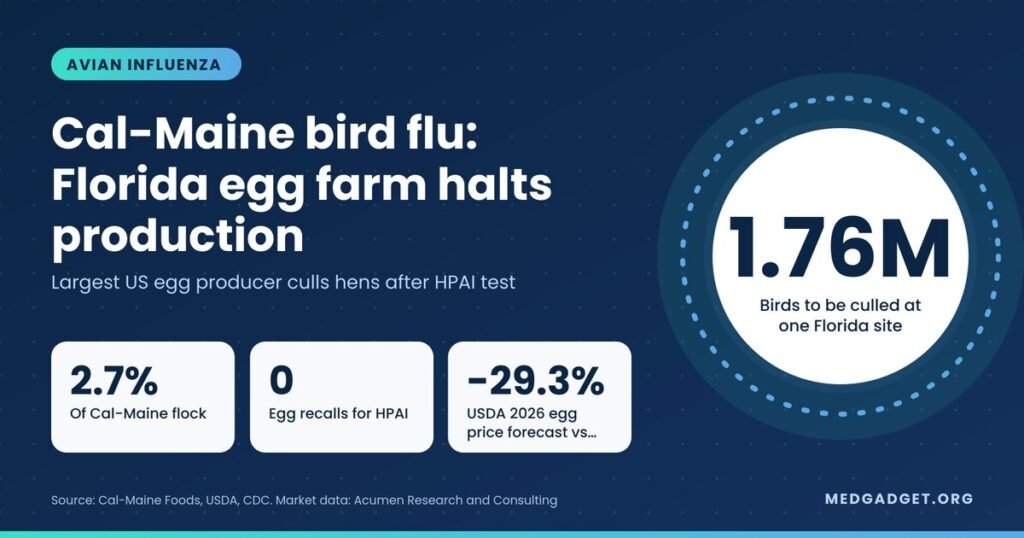

A Cal-Maine bird flu outbreak has forced the largest egg producer in the US to halt production at one of its Florida facilities and cull about 1.76 million birds, the company said on 18 November 2026. The site tested positive for highly pathogenic avian influenza (HPAI); about 1.4 million laying hens and 360,000 pullets will be depopulated under USDA protocols, equal to 2.7% of Cal-Maine’s flock. No eggs have been recalled, and health officials say properly cooked eggs remain safe to eat.
Key takeaways on Cal-Maine bird flu
- One Cal-Maine Foods facility in Florida confirmed HPAI; the company has not named the town or county.
- About 1.76 million birds (1.4 million hens plus 360,000 young pullets) will be culled, roughly 2.7% of the company’s total flock.
- Production at the site is temporarily stopped; Cal-Maine says it will shift output across other farms to protect customer supply.
- The CDC rates the risk to the general US public as low, and USDA says HPAI cannot spread through safely handled and properly cooked eggs.
- This is at least the third large commercial layer outbreak reported in about a month, after Illinois and California in October.
Are eggs safe to eat right now?
This is the question most shoppers are asking, and the answer from regulators is yes, with normal kitchen care. Birds from an infected flock are destroyed and do not enter the food supply. Cal-Maine says there is no known HPAI risk from eggs currently on the market and that no eggs have been recalled because of bird flu. USDA’s position is that the virus is not transmitted through eggs that are handled safely and cooked properly.
Practical steps are the same ones food-safety agencies recommend year round: refrigerate eggs, cook them until whites and yolks are firm, cook egg dishes to 160°F (71°C), and wash hands and surfaces after handling raw eggs. Raw or runny-egg recipes carry a separate, long-standing salmonella risk regardless of bird flu.
The numbers behind the cull
| Measure | Figure | Source |
|---|---|---|
| Laying hens to be culled | About 1.4 million | Cal-Maine, 18 Nov 2026 |
| Pullets (young hens) to be culled | About 360,000 | Cal-Maine |
| Total birds affected | About 1.76 million | Cal-Maine |
| Share of Cal-Maine flock | 2.7% | Cal-Maine |
| Implied total flock | About 65 million birds | By our calculation (1.76M / 2.7%) |
| Illinois layer outbreak (confirmed 19 Oct) | 934,600 birds | USDA data via Food Ingredients First |
| California layer outbreak (confirmed 28 Oct) | About 1.3 million hens | USDA data via Food Ingredients First |
By our calculation, those three outbreaks alone add up to roughly 4 million birds in about a month. Autumn bird migration typically drives a rise in detections, which is why the Florida case is unlikely to be the last of the season.
Will egg prices go up again?
Probably not nationally, at least not from this outbreak alone. USDA’s October Food Price Outlook projected US retail egg prices would fall 29.3% in 2026 compared with 2025, after the record spikes of the previous bird flu wave. That forecast was made before the latest outbreaks, and analysts have warned that the more immediate effect tends to be regional: stores supplied by an affected farm can see tighter supply or higher shelf prices for a few weeks while producers reroute eggs.
A 2.7% cut to the biggest producer’s flock is meaningful for the company but small against the national laying flock. The bigger risk is accumulation. If the winter migration season brings a cluster of large layer outbreaks, as happened in 2022 and again in late 2024 and early 2025, the national supply could tighten quickly. Cal-Maine itself warned in its release that “no farm is immune to HPAI,” and said migration seasons carry higher risk.
Cal-Maine’s track record with HPAI
This is not the company’s first hit. Its filings note that HPAI affected Cal-Maine flocks in the third and fourth quarters of its fiscal 2024 and again in March 2026. Cal-Maine, based in Ridgeland, Mississippi, says its geographically spread farm network is what lets it absorb a single-site loss. It does not plan interim updates and will report any financial effect in its next quarterly SEC filing unless the impact becomes material sooner.
Human health risk and why it is still watched
Human infections with HPAI have been rare in the US and mostly mild, typically among farm workers with close, unprotected contact with sick birds or dairy cattle. The CDC continues to describe the risk to the general public as low. Public health agencies still track every poultry outbreak because each large flock infection gives the virus more chances to mix and change. Workers involved in depopulation are advised to wear protective equipment, and anyone with flu-like symptoms or eye redness after poultry exposure should tell a clinician about that contact. For context on how fast a public health picture can change, see our coverage of the US losing measles elimination status.
Market context: vaccines for poultry flocks
Repeated culls have sharpened interest in vaccinating commercial flocks, a step the US has so far used sparingly because of trade concerns. According to Acumen Research and Consulting’s poultry vaccines market report, the global poultry vaccines market was worth USD 1,752.1 million in 2022 and is projected to reach USD 3,580.8 million by 2032, growing at a CAGR of 7.5%. Acumen reports that avian influenza held the largest share of the market by disease and that North America led by region. The report was last updated in October 2023.
What to watch next
- USDA APHIS confirmation listings for further commercial layer flocks through the winter.
- Weekly USDA wholesale egg price reports, especially for the Southeast.
- Any shift in federal policy on HPAI vaccination for laying hens.
- Cal-Maine’s next quarterly report for the financial impact of the Florida cull.
FAQ
Where is the Cal-Maine bird flu outbreak?
At one Cal-Maine Foods facility in Florida. The company has not disclosed the exact location.
Are Cal-Maine eggs being recalled?
No. Cal-Maine says no eggs have been recalled for HPAI and there is no known risk from eggs already on the market.
Can you get bird flu from eating eggs?
USDA says HPAI cannot be transmitted through safely handled and properly cooked eggs. Cooking eggs until firm also protects against salmonella.
How many chickens is Cal-Maine culling?
About 1.76 million birds: roughly 1.4 million laying hens and 360,000 pullets, or 2.7% of its flock.
More public health and food safety news in our Healthcare Services section.
Sources: Cal-Maine Foods release (18 Nov 2026); CDC and USDA guidance on HPAI; USDA outbreak data and Food Price Outlook as reported by Food Ingredients First. Market data: Acumen Research and Consulting. Not medical or investment advice. Last updated 19 November 2026.