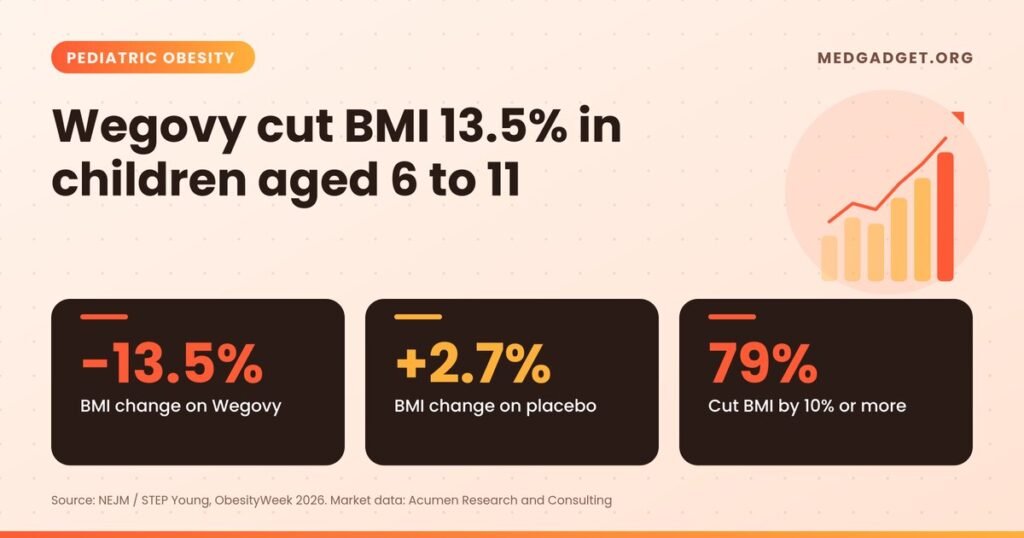

Wegovy for kids as young as six moved a step closer to reality this week: in Novo Nordisk’s Phase 3 STEP Young trial, children aged 6 to 11 with obesity who took once-weekly semaglutide (Wegovy) saw their body mass index (BMI) fall by an average of 13.5% after 68 weeks, while children on placebo saw BMI rise 2.7%. The results were presented at ObesityWeek 2026 in National Harbor, Maryland, and published simultaneously in The New England Journal of Medicine. Wegovy is not approved for any child under 12 in the United States today.
Key takeaways on Wegovy for kids
- STEP Young enrolled 167 children aged 6 to 11 with obesity, randomised 2:1 to semaglutide or placebo, both on top of lifestyle counselling.
- At week 68, BMI dropped 13.5% on Wegovy and rose 2.7% on placebo, a gap of 16.2 percentage points.
- About 79% of treated children cut their BMI by at least 10%; no child on placebo did.
- Stomach side effects were very common (vomiting 70%, diarrhoea 62%, nausea 58%), but only 4% stopped because of side effects.
- BMI started climbing again once the drug was stopped, so treatment may need to be long term.
- No US or EU filing for this age group has been announced yet.
What the STEP Young trial tested
The study enrolled children whose BMI sat at or above the 95th percentile for their age and sex, the standard definition of paediatric obesity. Their average age was 10, 59% were girls and at least 30% had severe obesity. Children received a once-weekly injection that was stepped up to a maximum of 1.7 mg or 2.4 mg depending on body weight, or a matching placebo, for two years. A seven-week drug-free washout followed to see what happens when treatment stops.
The main question was the percentage change in BMI at week 68. In children, BMI is the preferred measure rather than raw weight, because a healthy child is still expected to grow taller and gain some weight.
The numbers in one table
| Measure (week 68 unless noted) | Wegovy | Placebo |
|---|---|---|
| Change in BMI | -13.5% | +2.7% |
| Change in BMI at 2 years | -9.4% | +8.4% |
| BMI cut by 10% or more | 78.7% | 0% |
| BMI back below the 95th percentile | 38% | 2% |
| Waist circumference | -8.5 cm | +2.7 cm |
| Systolic blood pressure | -4.4 mm Hg | -0.9 mm Hg |
| Triglycerides | -26.3% | +0.4% |
| Stopped for side effects | 4% | 2% |
Two details stand out. First, more than a third of treated children left the obesity range altogether, something almost no child achieved with counselling alone. Second, the benefit at two years (a 9.4% BMI drop) was smaller than at 68 weeks, although the gap against placebo stayed wide because children on placebo kept gaining. By our calculation, the two-year difference between the groups was about 17.8 percentage points.
A body-composition substudy of 50 children found the lost weight was mostly fat: fat mass as a share of body weight fell 4.7 points on Wegovy versus 1.1 points on placebo. Among children who started with prediabetes, 93% on semaglutide got their HbA1c back below 5.7%, compared with 56% on placebo.
Side effects parents will ask about
Nearly every child in both groups reported at least one adverse event (96% on Wegovy, 93% on placebo), which is typical for a two-year paediatric trial that logs every cold and scraped knee. The difference lay in the gut. Vomiting, diarrhoea and nausea were roughly twice as common on semaglutide and clustered during the dose-escalation weeks. Serious adverse events were 9% in each arm, and psychiatric events were slightly lower on the drug (21%) than on placebo (24%).
Growth was the safety signal paediatricians watched most closely. The investigators reported no effect on puberty timing, pubertal development or bone mineral density, and Novo Nordisk said no growth safety concerns were identified. Media accounts of the height data have differed, and the presenters noted that children with obesity tend to grow faster than their peers, so a change in growth speed may partly reflect weight normalising. Longer follow-up is needed before anyone can say the drug has no effect on final adult height.
Where this leaves families and doctors
In the US, the FDA cleared Wegovy for adolescents aged 12 to 17 in December 2022, and the American Academy of Pediatrics’ 2023 guideline allows doctors to consider weight-loss medicine from age 8 alongside lifestyle treatment. The World Health Organization’s newer guidance is more cautious, supporting medicine only for 10- and 11-year-olds who cannot reduce BMI with lifestyle changes and not for children aged 9 or younger.
STEP Young gives regulators the first large randomised data set for under-12s. Ania Jastreboff of Yale, the NEJM paper’s lead author, described the BMI reductions as “substantial and clinically meaningful.” Emory’s Daniel Hsia, who was not an investigator, said the findings support moving away from watchful waiting toward earlier treatment. Still, prescribing Wegovy to a child under 12 today would be off-label, and insurance coverage for that use is unlikely until a label change. Families should not use adult pens or compounded products for children.
For context on how GLP-1 drugs are already changing behaviour at the household level, see our report on weight-loss drugs cutting UK grocery spending, and our explainer on Novocare Wegovy prices. More drug coverage is in our Pharmaceutical section.
Market context
Paediatric use would widen an already fast-growing class. Acumen Research and Consulting valued the global anti-obesity drugs market at USD 2.1 billion in 2022 and projects USD 8.2 billion by 2032, a 14.6% compound annual growth rate, with prescription drugs holding the largest share and Asia-Pacific growing fastest. That report was last updated in September 2023, before the most recent surge in GLP-1 demand, so treat its figures as indicative.
What we still do not know
- Whether BMI rebounds fully after stopping; 26-week off-drug data are expected in the coming months.
- Effects on final adult height and long-term heart and metabolic outcomes.
- When, or whether, Novo Nordisk will file for the 6-to-11 age group with the FDA or EMA.
- Whether Lilly’s tirzepatide (Zepbound), which reported adolescent data at the same meeting, will be tested in younger children.
FAQ
Is Wegovy approved for kids under 12?
No. In the US, Wegovy is approved for adults and for adolescents aged 12 and older with obesity. STEP Young is the evidence Novo Nordisk could use to seek approval in children aged 6 to 11, but no filing has been announced.
How much weight did children lose on Wegovy in STEP Young?
Results were reported as BMI rather than kilograms. Average BMI fell 13.5% at 68 weeks on Wegovy versus a 2.7% rise on placebo, and about 79% of treated children cut BMI by at least 10%.
What are the side effects of Wegovy in children?
The most common were vomiting, diarrhoea and nausea, mostly mild to moderate and concentrated during dose increases. Serious adverse events occurred in 9% of children in both groups, and 4% on Wegovy stopped because of side effects.
Does Wegovy affect a child’s growth?
The trial found no effect on puberty or bone density, and the company reported no growth safety concerns over two years. Effects on final adult height are not yet known.
Sources: Jastreboff AM et al., NEJM (doi:10.1056/NEJMoa2604058); STEP Young presentations at ObesityWeek 2026 (14 to 17 November 2026); Novo Nordisk. Market data: Acumen Research and Consulting. This article is for information only and is not medical advice; talk to your child’s doctor about treatment. Last updated 19 November 2026.