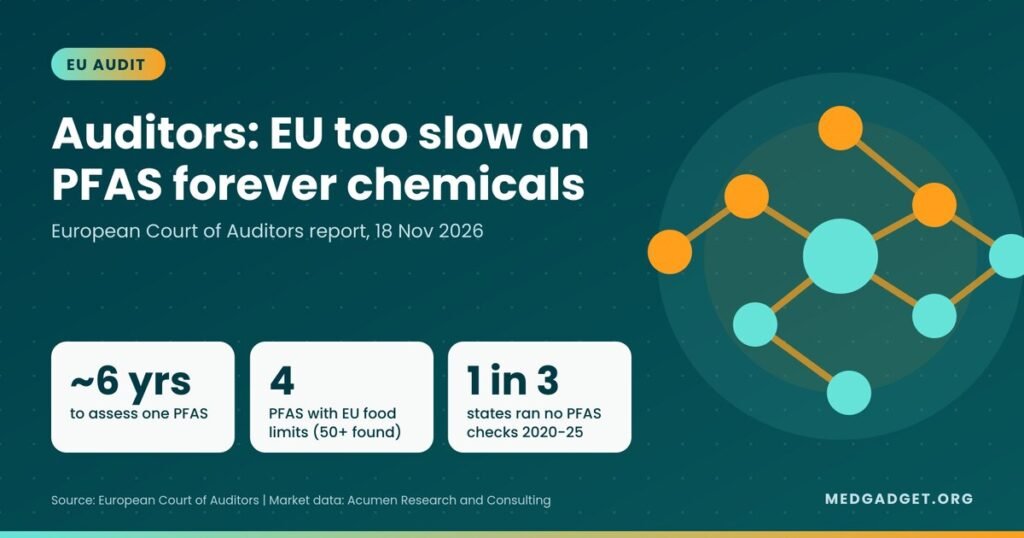

EU PFAS forever chemicals are still largely unregulated six years after Brussels promised to phase out their non-essential uses, the European Court of Auditors (ECA) said in a report published on 18 November 2026. The auditors found that assessing the hazard of a single PFAS takes about six years and adopting a restriction almost five more, that a third of member states ran no targeted PFAS compliance checks between 2020 and 2025, and that EU food limits cover only four PFAS even though more than 50 have been detected in food.
Key takeaways on EU PFAS forever chemicals
- The ECA says the EU has not delivered on its 2020 pledge to phase out harmful, non-essential PFAS uses.
- Regulating PFAS one substance at a time is slow and encourages “regrettable substitution”, where a banned chemical is swapped for a close relative.
- About one in three member states did no targeted PFAS enforcement checks from 2020 to 2025.
- Only four PFAS have maximum limits in certain foods; more than 50 have been found in food.
- The auditors want the Commission to decide on the universal PFAS restriction proposal by 2027 and to update food and drinking water limits.
Why the auditors call PFAS a ticking time bomb
Per- and polyfluoroalkyl substances are synthetic chemicals that make products resistant to water, grease, heat and stains. They are found in outdoor clothing, non-stick cookware, cosmetics, food packaging and firefighting foams. Their carbon-fluorine bonds are so stable that they can take hundreds of years or longer to break down, so they build up in soil, water and people. Exposure to some PFAS has been linked to cancer, reduced fertility and hormonal effects.
Joëlle Elvinger, the ECA member who led the audit, described the situation as a race against time and urged the EU to act “firmly and without delay”. The audit does not find that any specific product on sale is unsafe. Its point is about the system: the rules cannot keep pace with an industry that can introduce new fluorinated substances faster than regulators can assess them.
How much PFAS can be in everyday food
The most striking numbers in the report concern food. The ECA modelled what would happen if foods contained PFAS at the maximum level the law currently allows. In that worst case, a person would reach the tolerable weekly intake set by EU food safety scientists after eating relatively small amounts.
| Food (at maximum legal PFAS level) | Amount that reaches the tolerable weekly intake |
|---|---|
| Anchovies | About 7 g |
| Wild salmon | About 39 g |
| Eggs | About 181 g (roughly three eggs) |
| Beef | About 237 g (about one steak) |
It is important to read this table correctly. Most food on sale does not contain PFAS at the legal ceiling, so this is not a guide to what a typical meal delivers. What it shows is that the current ceilings themselves leave little safety margin, which is why the auditors say the limits rest on outdated science and should be revised where evidence supports it.
Where enforcement is breaking down
Restrictions only work if someone checks them. The ECA found that national authorities often do not, citing limited laboratory capacity, the high cost of PFAS testing and competing priorities. Neither the European Commission nor the European Chemicals Agency (ECHA) has a complete picture of what member states are doing.
- Compliance checks: a third of EU countries ran no targeted PFAS checks between 2020 and 2025.
- Food monitoring: five countries submitted no PFAS food-monitoring data for 2020 to 2024, while Denmark, Germany, France and the Netherlands supplied more than half of all data.
- Named laggards: Bulgaria, Hungary, Romania and Slovakia were urged to add PFAS checks to their 2026 food-control plans.
- Drinking water: the Commission overran its five-year review timetable for water limits and is waiting for World Health Organization recommendations expected in 2027. Eight of the 25 countries that answered the audit have set stricter national limits.
The slow road to a universal PFAS restriction
By our calculation, the ECA’s averages (about six years to assess a substance plus almost five to restrict it) mean a single PFAS can take around 11 years to move from concern to legal limit. With well over a thousand PFAS manufactured, that pace cannot cover the class. Apart from firefighting foams and PFHxA, no new EU restriction procedures have been launched since the broad group restriction was proposed.
That group proposal, submitted in 2023 by five countries, would restrict PFAS as a family rather than one by one. ECHA’s scientific review is expected to take about four years in total, and its two committees have not fully agreed. The final decision rests with the Commission, which the auditors want to decide by 2027. Campaigners such as Corporate Europe Observatory accuse industry of lobbying to weaken the plan, while Pesticide Action Network Europe has called for a ban on PFAS pesticides, which break down into trifluoroacetic acid (TFA) found in drinking water in farming areas.
The cost of waiting
Delay is expensive. Reporting on the audit cites a 2024 estimate that the EU spends about €39.5 billion a year on PFAS-related healthcare, and a Commission estimate that cleaning up contaminated water and soil could cost about €440 billion by 2050 if PFAS use continues at current levels. Those costs fall on health systems and water utilities rather than the companies that make the chemicals.
Market context: testing capacity is the bottleneck
The audit repeatedly points to testing as the weak link, and that is where spending is likely to grow. According to Acumen Research and Consulting’s food safety testing market report, the global food safety testing market was worth USD 19.1 billion in 2021 and is projected to reach USD 35.6 billion by 2030, a compound annual growth rate of 7.4%, with Asia-Pacific the fastest-growing region. Pathogens such as Salmonella still dominate testing volumes, so wider PFAS screening would require laboratories to add capacity for a newer, costlier class of chemical analysis.
What happens next
The ECA asks the Commission to speed up the universal restriction, overhaul its procedures, push member states to enforce existing rules, and refresh food and water limits, with most deadlines running to 2028 or 2029. ECHA’s socio-economic committee is expected to deliver its final view on the group restriction soon. For consumers, the practical message is unchanged: PFAS exposure comes mostly from food and drinking water, and stricter limits depend on decisions still years away. Our coverage of other regulatory gaps, such as the leadership vacuum at the US FDA and the latest bird flu egg-farm outbreak, shows food safety oversight under strain on both sides of the Atlantic. More in our Healthcare Services section.
FAQ
What are PFAS forever chemicals?
PFAS are a large family of man-made fluorinated chemicals used to repel water, grease and stains. They barely break down in nature, so they accumulate in the environment and in the human body.
Has the EU banned PFAS?
No. The EU restricts certain individual PFAS and some uses, such as firefighting foams, but a broad ban on the whole group is still under assessment. The auditors want a Commission decision by 2027.
Are eggs and fish unsafe to eat because of PFAS?
The audit’s figures are a worst case that assumes food contains PFAS at the maximum legal level. They do not mean typical eggs or fish are unsafe; they show the legal limits leave a narrow margin and may need tightening.
Why is PFAS regulation so slow?
The EU mostly assesses PFAS one substance at a time, which takes years per chemical, and testing is costly. Many member states also lack lab capacity to enforce existing restrictions.
Sources: European Court of Auditors report on PFAS (18 November 2026), as reported by Euronews, EUobserver and Reuters; European Court of Auditors. Market data: Acumen Research and Consulting. This article is for information only and is not medical advice. Last updated 19 November 2026.