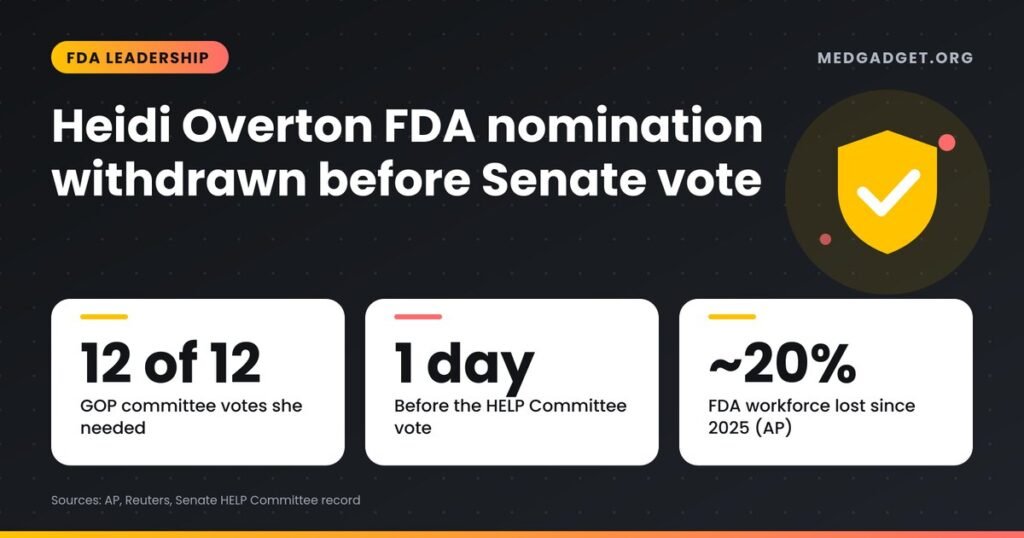

The Heidi Overton FDA nomination withdrawn on Tuesday, 17 November 2026, leaves the US Food and Drug Administration without a Senate-confirmed leader heading into 2027. The White House pulled the physician and domestic policy adviser’s nomination one day before the Senate Health, Education, Labor and Pensions (HELP) Committee was due to vote on 18 November, after it became clear she could not count on every Republican on the panel, according to the Associated Press and Reuters, both citing people familiar with the decision. No replacement has been named.
Key takeaways on the Heidi Overton FDA nomination withdrawn
- Overton was nominated on 19 August 2026 and testified to the HELP Committee on 24 September; her nomination was pulled on 17 November, the eve of the committee vote.
- She needed all 12 Republicans on the 23-member committee because the 11 Democrats were expected to oppose her. One defection would have stalled the nomination.
- Committee chair Sen. Bill Cassidy called her backing for splitting combination vaccines such as MMR “almost disqualifying” and had not committed his vote.
- Kyle Diamantas, the agency’s former top food official, remains acting FDA commissioner, a role he has held since May 2026.
- Day-to-day reviews, approval decisions and recalls continue under career staff; the bigger effect is on long-range policy such as vaccines, flavoured e-cigarettes and food chemicals.
Why the votes were not there
The arithmetic was unforgiving from the start. With Democrats expected to vote as a bloc, Overton had no margin on the committee, and a nominee who cannot clear committee rarely reaches the Senate floor. Three separate pressure points converged in the final week.
Vaccines. Senators from both parties questioned whether Overton would stand apart from the President’s unsupported claims about childhood vaccine risks. Cassidy, a physician, pressed her at the September hearing on scientific independence and on whether she would push back against HHS Secretary Robert F. Kennedy Jr. Her support for the plan to break up combination shots was the issue he singled out. The timing mattered: the Pan American Health Organization confirmed on 17 November that the US has lost its measles elimination status after 26 years, which put vaccine policy at the centre of the debate. (Our earlier explainer covers what losing measles elimination status means.)
E-cigarettes. Sen. Susan Collins raised concerns about Overton’s approach to flavoured vapes after the FDA recently authorised the first fruit-flavoured e-cigarettes for adult smokers trying to quit, a reversal of the agency’s earlier stance on flavours that appeal to young people.
MAHA opposition. Pressure also came from inside the President’s coalition. Figures in the Make America Healthy Again movement argued that Overton and other White House aides had sidelined Kennedy’s priorities on food additives and pesticides. Former Kennedy aide Calley Means alleged on a podcast this month that White House staff, including Overton, helped advance the Supreme Court outcome that blocks thousands of glyphosate lawsuits. Those claims have not been independently verified.
Timeline: from nomination to withdrawal
| Date (2026) | Event |
|---|---|
| May | Kyle Diamantas becomes acting FDA commissioner |
| 19 August | Trump names Heidi Overton as FDA commissioner nominee |
| 24 September | Senate HELP Committee confirmation hearing |
| 17 November | PAHO confirms US lost measles elimination status; Overton nomination withdrawn |
| 18 November | Scheduled HELP Committee vote (no longer needed) |
| January 2027 | Democrats take control of the Senate |
Who runs the FDA now?
Kyle Diamantas, an attorney who led the FDA’s food programme before being elevated in May, stays in charge as acting commissioner. The AP noted that acting officials can normally serve only for a limited period of about seven months. Under the Federal Vacancies Reform Act, a withdrawn nomination generally restarts a 210-day clock for an acting official. If that standard rule applies here, the acting period could run to around mid-June 2027, by our calculation, although agencies sometimes rely on other delegation routes and the exact legal position has not been publicly set out.
The politics of a second nominee are harder than the first. Republicans are racing to confirm nominees before Democrats take control of the Senate in January, and Cassidy, who lost his June primary, leaves office within weeks. A nominee sent up in 2027 will face a committee with a different majority and chair. That makes a quick, partisan confirmation unlikely and raises the odds of a long acting tenure.
What changes for patients, drugmakers and device companies
For most people, very little changes this week. Drug and device reviews run on statutory user-fee timelines and are handled by career reviewers, so scheduled decision dates continue. Recalls, safety alerts and inspections are not paused by a vacancy at the top.
Where leadership matters is direction. An acting chief is less likely to launch major new initiatives, and the agency is already stretched: the AP reports the FDA has lost about 20% of its workforce since early 2025 through layoffs, buyouts, retirements and resignations. Open questions include:
- Vaccine policy: whether the push to split combination vaccines such as MMR moves forward, and how the FDA handles vaccine labelling amid record measles spread.
- Tobacco: how far flavoured e-cigarette authorisations go after the first fruit-flavoured products were cleared.
- Food chemicals: the pace of action on additives, dyes and solvents. Earlier this month the agency revoked several solvent uses in colour additives (our coverage of the methylene chloride ruling).
- Fast-track programmes: Reuters reported last week that the Commissioner’s National Priority Voucher pilot had been shelved, leaving companies unsure how expedited reviews will work.
A pattern in health nominations
Overton is not the first health pick this administration has pulled. Its first CDC nominee, Dr David Weldon, was replaced over doubts about Republican support, and two surgeon general nominees, including Dr Casey Means, were withdrawn after pushback. Overton, a Johns Hopkins-trained preventive medicine physician who previously led health policy at the America First Policy Institute, was seen as a loyal pair of hands who could steady an agency that went through scientific disputes and leadership turnover under former commissioner Marty Makary. Her withdrawal shows that, on vaccines in particular, a narrow Senate majority still acts as a check.
What to watch next
- Whether the White House names a new nominee before January, or leaves the post with an acting chief into the new Congress.
- Any formal statement from the White House or HHS explaining the withdrawal; so far reporting relies on unnamed sources.
- Signals from incoming HELP Committee leadership on vaccine standards a future nominee must meet.
- Whether the acting commissioner’s legal authority is challenged as the vacancy lengthens.
FAQ
Why was Heidi Overton’s FDA nomination withdrawn?
Reporting from Reuters and the AP says the White House concluded she lacked enough Republican votes on the HELP Committee, where she needed all 12 GOP members. Concerns centred on her vaccine positions, flavoured e-cigarette policy and opposition from MAHA activists.
Who is the acting FDA commissioner?
Kyle Diamantas, previously the FDA’s top food official, has been acting commissioner since May 2026 and continues in that role.
Will FDA drug approvals be delayed?
Not directly. Review deadlines are set by law and user-fee agreements and are handled by career staff, so scheduled decisions are expected to proceed. Staffing losses are a bigger risk to timelines than the vacancy itself.
Who will Trump nominate for FDA commissioner next?
No replacement has been named and it is unclear when or whether the White House will send a new nomination before Democrats take the Senate in January 2027.
More policy news: Healthcare Services.
Sources: Associated Press via WISH-TV; Reuters; Axios; public nomination record. Reporting on the withdrawal relies on unnamed sources. This article is for information only and is not medical, legal or investment advice. Last updated 18 November 2026.