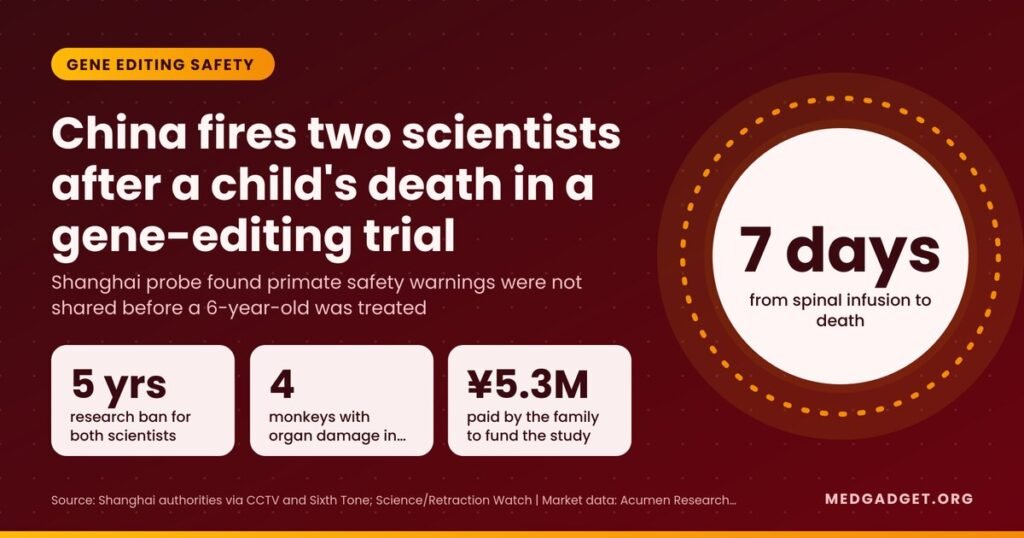

A gene editing trial death in Shanghai has ended two research careers: city authorities have dismissed neuroscientist Qiu Zilong and Xinhua Hospital researcher Yang Kan after an official probe found that a custom base-editing treatment was given to a 6-year-old girl despite unshared primate safety warnings, and that she died seven days later in March 2025. The penalties, announced on 13 November 2026 and reported widely this week, include five-year bans from government science programmes and awards and entry into China’s national database of serious research-integrity violations.
The case matters far beyond one hospital. It is the clearest official finding yet that China’s investigator-initiated trial route, which lets hospitals test experimental therapies under local ethics review instead of national regulatory approval, can let a high-risk gene therapy reach a child without the safeguards a regulator would demand.
Key takeaways on the gene editing trial death
- Who died: a 6-year-old girl with Snijders Blok-Campeau syndrome, a rare neurodevelopmental disorder caused by changes in the CHD3 gene.
- What she received: a personalised base editor packaged in engineered viruses and infused into her spinal fluid at Xinhua Hospital on 24 March 2025.
- Cause of death: thrombotic microangiopathy, a clotting injury to small blood vessels that the hospital’s ethics committee attributed to the gene therapy.
- What investigators found: monkey toxicity data were not passed promptly to the clinical lead, the study was approved with too little toxicology evidence, and the consent form did not clearly state the risk of death.
- Money: the family funded the research with about 5.3 million yuan and separately gave researchers roughly 1.06 million yuan in cash and gifts, later returned or surrendered.
- The paper: a February 2026 Nature study by the team did not mention the death; Nature has added an editor’s note, and no retraction has been reported.
From hidden death to official sanctions: the timeline
| Date | Event |
|---|---|
| 2023 | Parents approach Qiu seeking a treatment for their daughter’s CHD3 mutation |
| January 2025 | Xinhua Hospital ethics committee approves the investigator-initiated study |
| 24 March 2025 | Girl receives the spinal infusion of virus-delivered base editor |
| Seven days later | She dies of treatment complications |
| 2 April 2025 | Emergency ethics review attributes death to thrombotic microangiopathy and halts the study |
| 18 February 2026 | Team publishes mouse and monkey gene-editing work in Nature without disclosing the death |
| July 2026 | Science and Retraction Watch investigation makes the death public |
| 13 November 2026 | Shanghai authorities announce dismissals, bans and penalties |
Who was punished, and for what
According to the Shanghai statement as reported by state broadcaster CCTV, Sixth Tone and AFP, Qiu was removed as deputy director of the Songjiang Research Institute at Shanghai Jiao Tong University School of Medicine. Yang, an associate researcher at Xinhua Hospital and first and corresponding author of the Nature paper, was also dismissed. Both received the five-year bans and database listing.
The sanctions reached further than the lab. The study’s clinical lead investigator was removed as head of the hospital’s research department and demoted, the head of the ethics committee office was removed and demoted, Xinhua Hospital received an administrative penalty and other officials were disciplined. Investigators found no data fabrication in the Nature paper, but did identify gaps between the methods described and those actually used, plus undisclosed financial conflicts involving four researchers. Shanghai’s health commission says it will now inspect clinical research that uses emerging biomedical technologies.
The family’s own account is the most damning. Speaking to Science and Retraction Watch, the girl’s father said: “We did not realize how unusual and dangerous many of the arrangements were.” The parents had supplied reporters with a primate study report showing serious organ damage in four monkeys, and had asked Qiu to withdraw the Nature paper because they feared it could mislead other families.
Why high-dose, virus-delivered editing is so risky
Base editors are a refined form of CRISPR that change a single DNA letter without cutting both strands. The editing machinery itself is not the main danger here. The risk sits in delivery: to reach enough brain cells, teams package editors in adeno-associated viruses and give enormous doses, in this case reported as trillions of viral particles. At those doses the immune system can attack the vector, and complications such as thrombotic microangiopathy, liver injury and complement activation have been seen across several gene therapy programmes worldwide.
That is why the unshared monkey data matter. Organ damage in primates is exactly the kind of signal that, under a standard regulatory review, would usually trigger dose changes, extra toxicology work or a full stop before any child was dosed. By our reading, the system failed at three points at once: the lab, the ethics committee and the consent process.
Readers following US safety debates will recognise the pattern. The FDA recently confirmed a tumour link in two children after Zolgensma gene therapy, and has created a dedicated CBER safety council for vaccines and gene therapies.
Not an isolated case in China
A second death has sharpened the scrutiny. Shanghai-based HuidaGene Therapeutics disclosed in a Cell paper published on 26 October 2026 that a young boy died in 2025 after a CRISPR-based treatment for Duchenne muscular dystrophy given in an investigator-initiated trial, with limited benefit reported in other patients. Both cases involved severe immune reactions to high-dose viral gene therapy.
China tightened its rules for investigator-initiated trials in May 2026, limiting which sites can run them and adding requirements, according to Fierce Biotech. The Shanghai case predates those rules, so it does not show whether they work. It does show why Western regulators are wary: the FDA has already pushed back on drug applications that lean heavily on China-only data.
What it means for personalised gene editing
The timing is awkward for a field riding high. In 2025, a US infant known as Baby KJ was treated with a bespoke base-editing therapy for a rare metabolic disorder, raising hopes that “N-of-1” editing could reach many children with ultra-rare mutations. Regulated programmes keep advancing too, such as Beam’s risto-cel base-editing therapy for sickle cell disease. The Shanghai death is a reminder that bespoke speed and rigorous oversight have to travel together, or families end up bearing risks nobody fully explained to them.
Market context
Safety failures land on a fast-growing industry. Acumen Research and Consulting values the global gene editing market at USD 18.3 billion in 2024 and projects USD 73.7 billion by 2033, a compound annual growth rate of 16.9%. Acumen expects Asia-Pacific to post the fastest growth, which puts the quality of oversight in China squarely in investors’ and partners’ sights. By our calculation, that forecast implies the market roughly quadruples in nine years.
FAQ
What happened in the Chinese gene editing trial?
A 6-year-old girl with Snijders Blok-Campeau syndrome received an experimental base-editing therapy into her spinal fluid at Xinhua Hospital in Shanghai on 24 March 2025 and died seven days later from thrombotic microangiopathy.
Which scientists were fired?
Qiu Zilong of Shanghai Jiao Tong University School of Medicine and Yang Kan of Xinhua Hospital were dismissed, banned from state science programmes and awards for five years, and listed in a national integrity-violation database.
What is an investigator-initiated trial in China?
It is a pathway that lets hospitals run studies of new therapies under local ethics committee approval rather than national drug regulator approval. China added new restrictions in May 2026.
Is gene editing therapy safe?
Approved gene-editing treatments have passed regulatory review, but experimental, high-dose, virus-delivered therapies carry serious risks, including immune and clotting complications. Patients should only join trials with full regulatory oversight and clear consent.
Sources: Shanghai authorities’ statement as reported by CCTV, Sixth Tone and AFP; Science and Retraction Watch investigation (July 2026); ThePrint; Fierce Biotech. Market data: Acumen Research and Consulting. More in Bio Technology. This article is not medical or investment advice. Last updated 23 November 2026.