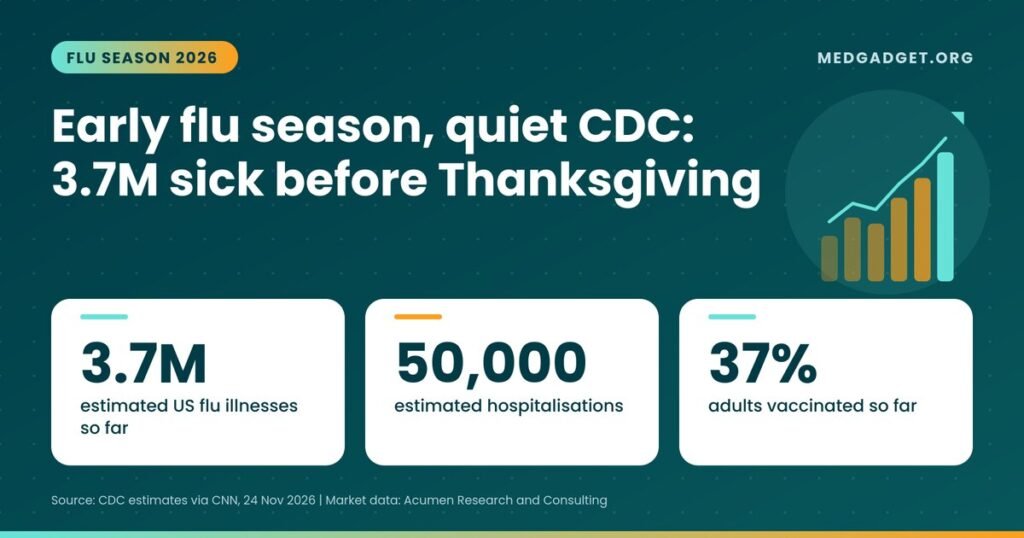

Anyone weighing a flu shot 2026 decision this Thanksgiving week is doing it with far less federal prompting than usual. The US flu season arrived weeks early, and CDC estimates cited by CNN on 24 November put the toll so far at about 3.7 million illnesses, 50,000 hospitalisations and 2,800 deaths. Yet the agency that has fronted flu vaccine messaging for decades has run no national campaign this autumn, leaving states, pharmacies and medical societies to fill the gap.
Key takeaways on flu shot 2026
- About 3.7 million people in the US have already had flu this season, with roughly 50,000 hospitalised and 2,800 deaths, according to CDC data reported by CNN.
- Around half of states report moderate to high flu activity, concentrated in the South and West.
- Early uptake is low: about 37% of adults, 32% of children and teens and 29% of pregnant women had been vaccinated when CDC began publishing 2026-27 coverage data last week.
- The CDC’s “Wild to Mild” flu vaccine ad campaign was halted in February 2025 and has not returned; the dedicated @CDCflu social account has been retired.
- HHS says the CDC still recommends flu vaccination. A shot takes about two weeks to build protection, so getting one now still helps for the rest of the season.
How bad is the flu season so far?
The season’s early start has been driven by influenza A(H1N1), which we covered when hospital admissions began climbing at their fastest pace since 2010 (see our report on the early H1N1 surge). The burden estimates below are the CDC’s latest cumulative figures as reported on 24 November. Ratios in the last column are by our calculation and are rough, because the CDC’s illness, hospitalisation and death estimates are modelled ranges rather than counts.
| Measure (2026-27 season to date) | CDC estimate | Context |
|---|---|---|
| Flu illnesses | ~3.7 million | Season began weeks earlier than usual |
| Hospitalisations | ~50,000 | About 1 in 74 illnesses, by our calculation |
| Deaths | ~2,800 | About 5.6% of hospitalisations, by our calculation |
| States with moderate to high activity | About half | Mostly South and West |
| Adults vaccinated | ~37% | Early-season reading; usually rises through winter |
| Children and teens vaccinated | ~32% | Early-season reading |
| Pregnant women vaccinated | ~29% | Early-season reading |
Holiday travel and indoor gatherings usually push transmission higher, so public health experts expect more cases after Thursday’s Thanksgiving holiday. Measles, which has caused nine deaths in Pennsylvania’s outbreak this year, adds a second respiratory threat during the same months.
What changed at the CDC
Several pieces of the usual autumn playbook are missing this year, based on CNN’s reporting and Senate committee records:
- Paid advertising: HHS Secretary Robert F. Kennedy Jr. ordered the “Wild to Mild” campaign stopped the day after he was sworn in, in February 2025, with only two days of paid ads left to run. It has not been revived.
- Social media: the @CDCflu account on X, which posted severity updates and vaccine reminders in 2025, has been shelved and followers redirected to the main @CDCgov account. A 16 November post on “respiratory illness season” advised asking doctors about testing and treatment without mentioning vaccines; a 20 November post listed vaccination among several protective steps.
- Briefings: the CDC normally holds a preseason news conference in late summer and a mid-season one around National Influenza Vaccination Week in early December. Neither pattern has been visible this year, and CDC Director Erica Schwartz did not take part in a briefing where officials have traditionally been vaccinated on camera.
HHS rejects the idea that it has gone quiet. Its senior press secretary said the CDC continues to monitor flu activity, share timely information and recommend vaccination as an important way to cut the risk of severe illness and hospitalisation. The agency also still publishes its weekly FluView surveillance report. Critics argue technical data are not the same as a public campaign. Mississippi state health officer Daniel Edney, who leads the Association of State and Territorial Health Officials, described the federal response as “crickets”.
Is it too late to get a flu shot?
No. Flu seasons in the US typically run into spring, and the vaccine still offers protection for the months ahead even when activity is already high. The practical points for readers:
- Timing: it takes about two weeks after vaccination for antibodies to develop, so a shot today will not cover Thanksgiving dinner but will cover December and January gatherings.
- Who benefits most: older adults, pregnant people, young children and people with chronic heart, lung, kidney or immune conditions face the highest risk of complications. Ask a pharmacist or clinician which vaccine type suits you.
- If you get sick: prescription antivirals such as oseltamivir (Tamiflu) work best when started within about 48 hours of symptoms, so high-risk patients should seek care early rather than waiting it out.
- Where to go: with federal outreach muted, state health departments and pharmacy chains are now the main sources of clinic listings and reminders.
Market context: vaccine demand under pressure
Seasonal flu shots are one of the largest recurring adult vaccine programmes, which is why uptake trends matter to manufacturers and pharmacy chains as well as to hospitals. Acumen Research and Consulting sized the global vaccines market at $59.4 billion in 2023 and projects it to reach $115.3 billion by 2032, a compound annual growth rate of 7.8%, with influenza among the indications it tracks and North America the largest regional market. The report page carries an older update stamp, so treat those figures as indicative. Weaker US flu uptake does not change the global picture overnight, but sustained declines in the largest regional market would put pressure on forecasts built on steady seasonal demand.
What to watch in December
- Post-Thanksgiving FluView reports, which will show whether hospitalisations accelerate after holiday travel.
- Whether the CDC marks National Influenza Vaccination Week in early December with any briefing or campaign.
- Updated vaccination coverage data, which will show whether late-season catch-up narrows the gap with previous years.
- State-level campaigns, which are increasingly the main source of public flu messaging.
FAQ
Does the CDC still recommend a flu shot in 2026?
Yes. HHS said this week that the CDC continues to recommend flu vaccination to reduce the risk of illness, hospitalisation and complications. What has changed is the volume of public promotion, not the formal recommendation.
How many people have had the flu this season?
CDC estimates cited on 24 November put it at about 3.7 million illnesses, 50,000 hospitalisations and 2,800 deaths since the season began.
Why did the flu season start so early this year?
An H1N1-dominated wave began spreading in autumn, weeks ahead of the usual December build-up. The CDC has not offered a single explanation for the timing, and surveillance data so far mainly describe which strain is circulating rather than why it arrived early.
Can I get a flu shot at a pharmacy without an appointment?
Most large US pharmacy chains offer walk-in or same-day flu vaccination for adults, and many cover children above a state-set minimum age. Check your pharmacy or state health department for local rules.
Sources: CNN reporting on CDC flu estimates and communications (24 November 2026, cnn.com); CDC FluView; market data from Acumen Research and Consulting. This article is for information only and is not medical advice; talk to a clinician about vaccination and treatment. More in Healthcare Services. Last updated 25 November 2026.