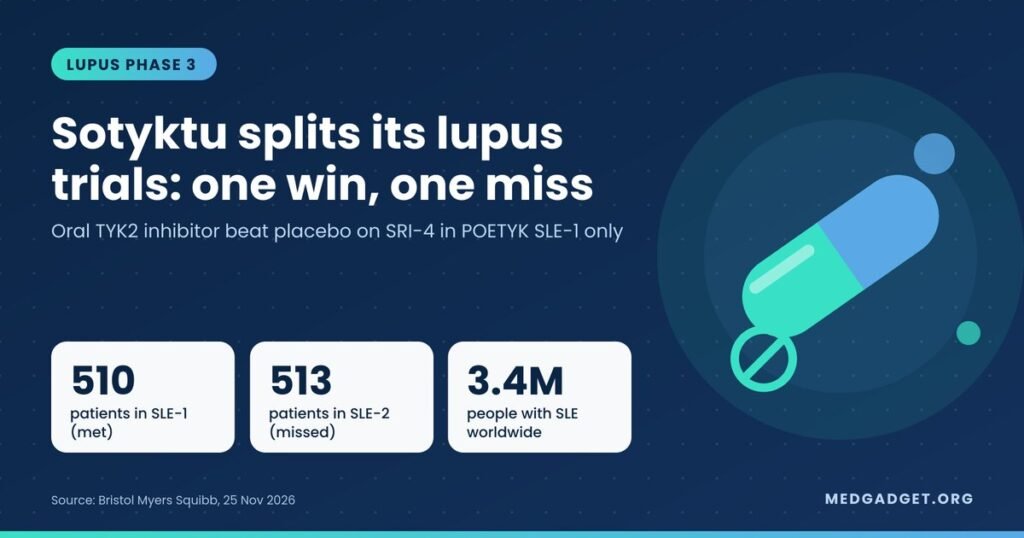

Sotyktu lupus results arrived on 25 November 2026 with a split verdict: Bristol Myers Squibb said its once-approved psoriasis pill, Sotyktu (deucravacitinib), met the primary goal in the 510-patient POETYK SLE-1 Phase 3 trial in systemic lupus erythematosus (SLE) but missed it in the 513-patient POETYK SLE-2 trial, where patients on placebo did unusually well. The company has not released response rates or p-values, and it has not committed to a filing date.
For the roughly 3.4 million people worldwide living with SLE, according to BMS, the readout matters because there is still no approved oral targeted therapy for the disease. For investors and clinicians, the key question is whether one positive and one negative pivotal trial is enough for regulators.
Key takeaways on Sotyktu lupus results
- POETYK SLE-1 (510 adults) met its primary endpoint: more patients on Sotyktu 3 mg twice daily reached an SRI-4 response at week 52 than on placebo.
- POETYK SLE-2 (513 adults) did not reach statistical significance, which BMS attributes to a higher placebo response; the drug arm performed in line with SLE-1.
- In SLE-1, three key secondary goals were statistically significant: BICLA response, SRI-4 with steroid taper, and fatigue (FACIT-Fatigue).
- Safety matched what is already known from psoriasis and psoriatic arthritis, with low discontinuation rates due to side effects.
- BMS will review all Phase 2 and Phase 3 lupus data and talk to health authorities; full results go to a future medical meeting.
Two identical trials, two different answers
The two studies were designed as twins. Both were global, randomized, double-blind and placebo-controlled; both enrolled adults with moderate-to-severe SLE who stayed on their usual background therapy; and both tested the same dose of deucravacitinib against placebo for 52 weeks. Patients who finish the blinded phase can roll into a 104-week open-label extension.
| Feature | POETYK SLE-1 | POETYK SLE-2 |
|---|---|---|
| Registry ID | NCT05617677 | NCT05620407 |
| Patients enrolled | 510 | 513 |
| Dose | Sotyktu 3 mg twice daily vs placebo | Sotyktu 3 mg twice daily vs placebo |
| Primary endpoint | SRI-4 response at week 52 | SRI-4 response at week 52 |
| Primary result | Met (statistically significant) | Not met (higher placebo response) |
| Key secondary endpoints | BICLA, SRI-4 with steroid taper, FACIT-Fatigue significant; others numerically better | Numerical improvement on all key secondaries |
SRI-4 (the SLE Responder Index) is a composite score that counts a patient as a responder only if overall disease activity falls meaningfully without new flares in any organ system and without the physician judging them worse. BICLA, the second composite that reached significance in SLE-1, is the measure AstraZeneca used to win approval for Saphnelo (anifrolumab), so a positive BICLA result gives BMS a second, regulator-familiar data point.
Not everything in SLE-1 was clean. Low disease activity (LLDAS) at week 52, a joint-response measure, skin response in patients with a CLASI score of 10 or more, and a steroid-taper-plus-SRI-4 endpoint all leaned in Sotyktu’s favour but did not reach significance.
Why lupus trials keep tripping on placebo
A high placebo response is the familiar villain in lupus drug development. Patients in these trials continue standard care (antimalarials, steroids, immunosuppressants), and the extra attention of a study often improves adherence and disease control in the control arm. Several lupus programmes have produced one win and one loss from paired trials in the past, and Saphnelo itself reached the market after its first Phase 3 study failed on SRI-4.
BMS is leaning on that history. Chief medical officer Cristian Massacesi said the combined results “reinforce our confidence in the POETYK SLE program.” Without the actual percentages, though, outside observers cannot judge how large the treatment effect was in SLE-1 or how far the placebo arm moved in SLE-2.
How deucravacitinib works and why lupus is a logical target
Sotyktu is an oral, selective inhibitor of TYK2, an enzyme that relays signals from IL-23, IL-12 and type 1 interferon. Instead of blocking the enzyme’s active site, it binds an allosteric regulatory domain, which is why BMS says it does not inhibit JAK1, JAK2 or JAK3 at therapeutic doses. Type 1 interferon overactivity is a hallmark of many SLE patients, which made lupus an obvious next indication after the drug’s approvals for moderate-to-severe plaque psoriasis and active psoriatic arthritis.
Current advanced SLE options are mostly injected or infused biologics, such as belimumab and anifrolumab. A pill that reduces disease activity and helps patients cut steroids would be a meaningful change in daily care, which is why Monash University rheumatologist Eric Morand, a trial investigator, framed Sotyktu as a possible first targeted oral approach for SLE if approved.
Safety: no new signals so far
BMS described Sotyktu as well tolerated in both lupus trials, with discontinuations due to adverse events described as low and a profile consistent with psoriasis and psoriatic arthritis. Detailed adverse event tables have not been published. The existing US label already carries warnings on hypersensitivity, infections including tuberculosis, malignancy, muscle enzyme elevation, lipid and liver test changes, and avoidance of live vaccines; lupus patients, who often take immunosuppressants, will be watched closely on infection risk.
Market context
Lupus remains a modest but steadily growing therapeutic market. According to Acumen Research and Consulting, the global systemic lupus erythematosus market was worth USD 1,951 million in 2021 and is projected to reach USD 3,517 million by 2030, a compound annual growth rate of 7%. Acumen found immunosuppressants held the largest drug-class share, with Asia-Pacific growing fastest. The report was last updated in November 2022, so treat these figures as indicative; by our calculation the forecast implies about USD 1.57 billion of added annual sales over the decade, a pool a first oral targeted therapy could claim a share of.
What happens next
- Regulatory talks: BMS will pool Phase 2 and Phase 3 data and seek health authority feedback. Whether the FDA accepts one positive pivotal trial plus supportive evidence is the central uncertainty.
- Full data: response rates, placebo rates and safety tables are due at an unnamed medical meeting.
- Sjogren’s disease: the Phase 3 POETYK Sjogren’s trial is expected to read out in 2027, another interferon-driven disease for the drug.
- Share reaction: BMY traded about 1% higher pre-market at USD 62.65, per RTTNews, suggesting investors had priced in risk.
For more on the company’s pipeline, see our breakdown of Bristol Myers Squibb’s Q3 2026 results, and for another oral immunology pill expanding its label, read about the Rinvoq vitiligo approval. More coverage is in our Pharmaceutical section.
FAQ
Is Sotyktu approved for lupus?
No. Sotyktu is approved for moderate-to-severe plaque psoriasis and active psoriatic arthritis. The lupus data are investigational, and BMS has not announced a filing date.
Did Sotyktu work in lupus trials?
It beat placebo on the SRI-4 primary endpoint in POETYK SLE-1 but not in POETYK SLE-2, where the placebo group responded more strongly. The drug’s own response looked similar across both trials, according to BMS.
What is SRI-4 in lupus?
The SLE Responder Index-4 counts a patient as responding when their SLEDAI disease activity score falls by at least four points without new major organ flares or worsening in the physician’s overall assessment.
When will full Sotyktu lupus data be released?
BMS says detailed results will be presented at a future medical meeting; no date has been given.
Sources: Bristol Myers Squibb press release (25 Nov 2026); ClinicalTrials.gov NCT05617677 and NCT05620407; RTTNews pre-market data. Market data: Acumen Research and Consulting, Systemic Lupus Erythematosus Market report. This article is for information only and is not medical or investment advice. Last updated 25 November 2026.