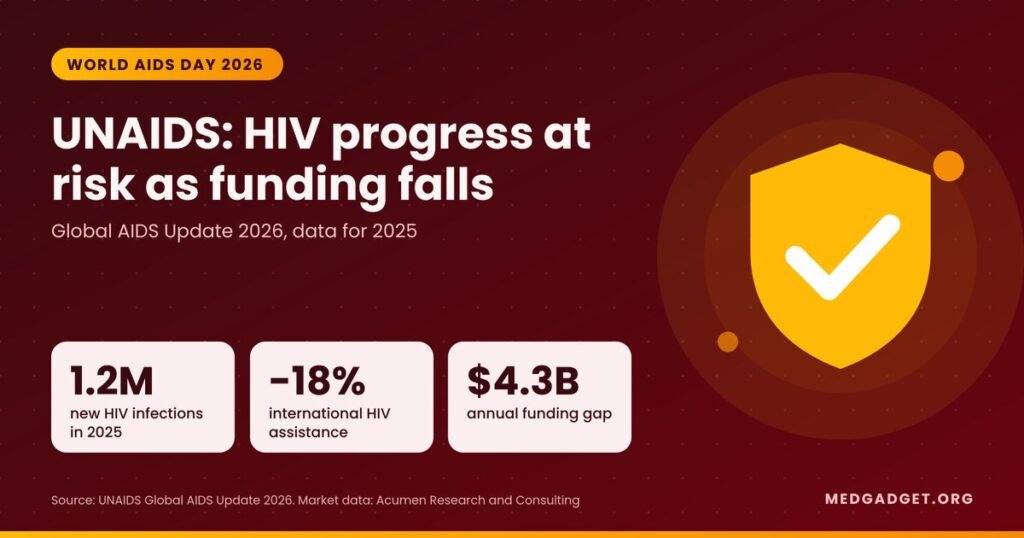

The UNAIDS Global AIDS Update 2026, published on 24 November 2026 ahead of World AIDS Day, finds that 1.2 million people acquired HIV in 2025 and about 570,000 died of AIDS-related causes, while international HIV funding fell 18% in a single year. The UN agency warns that the full damage from the 2025 aid cuts has not yet shown up in the numbers, and Reuters reported UNAIDS chief Winnie Byanyima as saying new infections could start climbing from historic lows as soon as next year.
Key takeaways on the UNAIDS Global AIDS Update 2026
- New HIV infections were estimated at 1.2 million in 2025, 42% below 2010, and AIDS-related deaths at about 570,000, 57% below 2010.
- Of 41.0 million people living with HIV, 32.1 million (78%) are on treatment, leaving 8.9 million without it.
- International HIV assistance dropped 18% in 2025; low- and middle-income countries lost more than US$1 billion and now face a US$4.3 billion annual funding gap.
- Prevention took the hardest hit: about 446,000 fewer people used oral PrEP in 2025, with steep falls among sex workers (59%) and people who inject drugs (58%).
- Twice-yearly lenacapavir PrEP has reached about 175,000 people in nine African countries, and generics priced near US$40 a year are expected from 2027.
Why this year’s report reads like a warning
On the surface, the 2025 figures still look like progress. Infections and deaths remain far below their peaks, and roughly four in five people with HIV are on antiretroviral therapy. The problem, as UNAIDS describes it in the report, titled “Ending AIDS starts with access”, is the direction of travel. Treatment programmes are cushioning the short-term impact, but prevention, testing and community services, the parts of the response that stop new infections, are shrinking fast.
The agency says the worst consequences of the 2025 cuts may still be ahead, because fewer people tested today means more undiagnosed transmission tomorrow. UNAIDS does not publish a single forecast of how many extra infections the cuts will cause, and readers should treat claims of a specific number with caution. What the report does quantify is the upside: meeting the 2030 targets would avert an estimated 3.2 million new infections and 1.3 million AIDS-related deaths by the end of the decade.
The 2025 numbers at a glance
| Indicator (2025) | UNAIDS estimate | Context |
|---|---|---|
| People living with HIV | 41.0 million | Range 35.3 to 47.5 million |
| People on treatment | 32.1 million | 78% coverage; 8.9 million untreated |
| New HIV infections | 1.2 million | 42% lower than 2010 |
| AIDS-related deaths | about 570,000 | 57% lower than 2010; about 1,560 a day by our calculation |
| Children (0-14) with HIV | 1.3 million | 45% not on treatment |
| People using PrEP | 2.6 million | Target of 20 million by 2030, so about 13% of goal by our calculation |
| People with advanced HIV disease | 3.4 million | About one in eight died within a year |
Where the money went
The funding picture is the core of the report. Overseas development assistance fell 23% in 2025, which UNAIDS calls the steepest year-on-year drop on record. US bilateral HIV contributions fell 26%, a big deal given that the United States has supplied more than 73% of donor-government HIV money for low- and middle-income countries. Global Fund disbursements fell 13%.
Some governments are stepping in. Domestic spending now makes up about 59% of HIV resources in low- and middle-income countries, and 55 countries raised their HIV budgets. But many of the hardest-hit countries remain heavily dependent on donors. According to UN News, external funding covers up to 98% of HIV resources in Nigeria, 94% in Mozambique and 80% in Uganda, and debt payments exceed government health spending two- or three-fold in many affected countries. That combination leaves little room to replace lost aid quickly.
Prevention is collapsing faster than treatment
The sharpest declines sit in services aimed at the groups most exposed to HIV. PrEP use fell 59% among sex workers, 58% among people who inject drugs, 23% among transgender people and 17% among gay men and other men who have sex with men. Global condom distribution slipped from 3 billion to 2.7 billion, and voluntary medical male circumcision procedures fell 53% across priority countries. Testing for advanced HIV disease dropped 35% across six countries.
Community organisations, which deliver much of this outreach, are also being hollowed out. One study cited by UNAIDS found more than three-quarters of surveyed civil society groups reported service disruptions, and over 80% were running at under half capacity by the end of 2025. “Community organizations are not an optional extra,” Byanyima said in the UN’s write-up of the report.
The trend is already visible in some countries outside Africa. The report notes that annual infections in Pakistan rose from about 30,000 to 44,000 since 2020, and in the Philippines from about 18,000 to 34,000.
Lenacapavir: the bright spot with a funding caveat
The twice-yearly injectable lenacapavir is the most promising new prevention tool in years. Rollout started late in 2025 in the first of 24 early-adopter countries, and about 175,000 people had begun the injection across nine sub-Saharan African countries by late 2026. Generic versions are expected from 2027 at roughly US$40 per person per year in eligible lower-income countries.
Context matters here: 175,000 is a fraction of the 2.6 million people using any PrEP, and the 20 million target for 2030. UN News reports that lenacapavir programmes have been particularly hard hit by cuts. Cheap generics only help if countries can pay for testing, delivery and follow-up visits. For background on how drug pricing shapes access in the US, see our coverage of the third round of Medicare negotiated drug prices.
Market context
Most of the world’s HIV treatment is daily oral antiretroviral therapy. Acumen Research and Consulting’s oral HIV treatment market report projected the global oral HIV treatment market to reach about US$2,944.5 million by 2027, growing at a CAGR of around 4.1% from 2020. The report was last updated in March 2021, so its figures predate long-acting prevention and the 2025 aid cuts and should be read as indicative only. Acumen also found that nucleoside analog reverse transcriptase inhibitors (NRTIs) held the largest share by drug class, with North America the dominant region. That geographic skew is a reminder that commercial market size says little about where the need is greatest: the bulk of people living with HIV are in donor-dependent countries.
What to watch before 2030
- World AIDS Day, 1 December: expect new national pledges and donor statements built around the “access” theme.
- Global Fund and US budgets: any further cuts would deepen the US$4.3 billion gap.
- Lenacapavir generics in 2027: the pace of uptake will show whether prevention can recover.
- 2026 surveillance data: the first full year after the cuts will show whether the feared rise in infections has started.
More health policy and outbreak coverage is in our Healthcare Services section, including the early H1N1 flu surge.
FAQ
How many people got HIV in 2025?
UNAIDS estimates 1.2 million new infections in 2025 (range 950,000 to 1.7 million), about 530,000 of them among adults in sub-Saharan Africa.
Will HIV infections rise in 2027?
UNAIDS warns infections could begin rising as funding cuts erode prevention and testing, but the report does not give a firm forecast. 2026 surveillance data will be the first real test.
How much has HIV funding been cut?
International HIV assistance fell 18% in 2025, US bilateral HIV funding fell 26%, and resources in low- and middle-income countries dropped by more than US$1 billion, leaving a US$4.3 billion annual gap.
What is the World AIDS Day 2026 theme?
The 2026 report and campaign run under the line “Ending AIDS starts with access”, focused on getting prevention and treatment to everyone who needs it.
Sources: UNAIDS Global AIDS Update 2026; UN News; Reuters. Market data: Acumen Research and Consulting. This article is for information only and is not medical or investment advice. Last updated 25 November 2026.