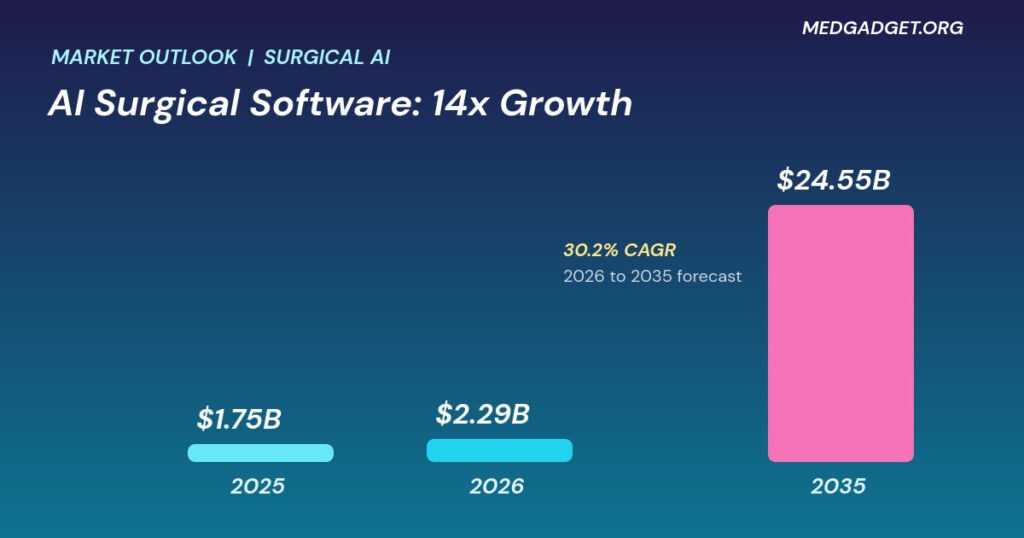

The AI-powered surgical software market is forecast to grow from $1.75 billion in 2025 to $24.55 billion by 2035, a compound annual growth rate (CAGR) of 30.2% between 2026 and 2035, according to a market report from Acumen Research and Consulting. The firm values the market at $2.29 billion in 2026, which would mean the sector is already growing about 31% this year.
Software that plans operations, guides instruments and reads the surgical field in real time is moving from pilot projects into hospital budgets. This article sets out what the report says, where the money is expected to go, and which claims readers should treat with caution.
AI-powered surgical software market: key numbers
- 2025 value: $1.75 billion.
- 2026 value: $2.29 billion.
- 2035 forecast: $24.55 billion.
- CAGR (2026–2035): 30.2%.
- Largest region: North America, with 45.0% of 2025 revenue.
- Fastest-growing region: Asia-Pacific, at a 34.7% CAGR.
By our calculation, the 2035 forecast is about 14 times the 2025 value. The stated growth rate is consistent with the start and end figures: moving from $2.29 billion in 2026 to $24.55 billion in 2035 over nine years works out at roughly 30%. These are market-research estimates and not audited sales.
What is driving the AI-powered surgical software market
The report points to four main drivers. The first is decision support: tools that combine imaging, patient data and signals captured during an operation to suggest a plan or flag risk. The second is integration with robotic surgical systems, where software increasingly decides how a robot moves and what the surgeon sees.
The third is personalised planning, in which a surgeon rehearses an operation on a model of the patient’s own anatomy. The fourth is demand for complex procedures, which push hospitals to adopt imaging-heavy digital tools. Our earlier coverage of an AI trial across 13 Ontario hospitals shows how quickly hospitals are testing clinical AI, although that trial concerned delirium and not surgery.
Where the spending goes: segments of the AI-powered surgical software market
The report splits the market several ways. By software type, in 2025 shares were:
- Surgical planning and simulation: 24%.
- Intraoperative AI and computer vision: 22%.
- Surgical navigation and guidance: 20%.
- AI clinical decision support: 15%.
- Surgical analytics and outcome intelligence: 13%.
- Other: 6%.
By deployment, on-premise systems held 43%, cloud-based tools 37% and hybrid set-ups 20%, with hybrid the fastest-growing at a 32.8% CAGR. Hospitals still keep sensitive operating-room data close, which helps explain why on-premise leads.
By technology, machine learning and deep learning accounted for 43%, computer vision for 30% and generative AI for 13%. By application, AI-assisted robotic surgery led with 25%, followed by intraoperative guidance and navigation at 20%. General surgery (22%), orthopaedics (18%) and neurosurgery (15%) were the biggest surgical specialties, and hospitals bought 62% of the software.
Regional outlook for the AI-powered surgical software market
North America held the largest share, at 45.0% of 2025 revenue. The report values the region at $0.79 billion in 2025 and $9.58 billion by 2035, a 28.1% CAGR, and says the US leads adoption while Canada’s uptake is uneven.
Europe is second, rising from $0.46 billion to more than $5.89 billion at a 29% CAGR, with Germany and the UK highlighted. Asia-Pacific starts smallest of the three at $0.39 billion but is forecast to reach $7.37 billion at a 34.7% CAGR, led by China, Japan, South Korea and India.
By our calculation from those figures, Asia-Pacific’s share would rise from about 22% of the market in 2025 to roughly 30% in 2035, while North America’s would slip from about 45% to 39%. These shares are our own arithmetic, and the three regions do not add up to the global total, which leaves the rest of the world.
Companies in the AI-powered surgical software market
The report lists Intuitive Surgical, Medtronic, Johnson & Johnson MedTech, Stryker, Zimmer Biomet, Brainlab, CMR Surgical, Proximie, Caresyntax and Activ Surgical among the leading players. It also cites recent deals as signs of momentum:
- September 2026: Medtronic announced a partnership with Cornerstone Robotics, involving an investment of about $700 million and distribution rights for the Sentire surgical system in selected international markets.
- June 2025: Johnson & Johnson joined NVIDIA and Amazon Web Services to launch the Polyphonic AI Fund for Surgery, with grants of up to $100,000.
- 2025: an AI orthopaedic planning platform developed in Beijing received EU CE certification.
These deal details come from the research report. We have not confirmed them with the companies, so treat them as claims until the companies publish their own announcements.
Risks that could slow the AI-powered surgical software market
- Clinical validation: software can perform differently across patient groups and hardware, so hospitals want proof before buying.
- Integration cost: connecting tools to electronic health records, imaging systems and older hospital IT is expensive.
- Regulation: rules cover safety, cybersecurity and software updates. The US Food and Drug Administration (FDA) keeps a public list of AI-enabled medical devices it has authorised, which shows how closely the sector is watched.
- Data bias and explainability: models trained on unrepresentative data may be less reliable for some patients, and surgeons need to understand high-risk recommendations.
- Adoption: tools that add steps without clear clinical value often go unused.
The World Health Organization has published guidance on the ethics and governance of artificial intelligence in health, which stresses transparency, safety and accountability, themes that apply directly to software used in the operating room.
Our assessment of the AI-powered surgical software market
In our assessment, the headline growth rate is plausible for a small base but should be read as a scenario and not a promise. A 30% CAGR sustained for nine years needs hospitals to keep paying for software on top of expensive robots and imaging, and it depends on regulators clearing products at pace. The strongest evidence in the report is the spread of adoption across planning, navigation and analytics, which suggests demand is not limited to one product.
For related coverage, see our reports on an autonomous dental implant robot in Singapore and endoscopic fusion surgery at Kauvery Hospital, or browse our medical device news section.
What to watch next in the AI-powered surgical software market
- Whether hospitals report measurable gains in outcomes, theatre time or complications from AI planning tools.
- New FDA clearances for intraoperative AI and computer vision.
- How fast Asia-Pacific buyers adopt cloud and hybrid deployments.
- Whether large device makers keep buying or partnering with software specialists.
Frequently asked questions
How big is the AI-powered surgical software market?
The report values it at $1.75 billion in 2025 and $2.29 billion in 2026, and forecasts $24.55 billion by 2035.
What is the growth rate of the AI-powered surgical software market?
The forecast CAGR is 30.2% for 2026 to 2035.
Which region leads the AI-powered surgical software market?
North America, with 45.0% of 2025 revenue. Asia-Pacific is forecast to grow fastest, at 34.7% a year.
What does AI-powered surgical software do?
It helps with planning operations, guiding instruments, recognising anatomy in live video, predicting risk and analysing outcomes. It supports surgeons and does not replace them.
Is the forecast guaranteed?
No. Market forecasts rest on assumptions about adoption, pricing and regulation, and they can change.
How we reported this: we based this article on the market report from Acumen Research and Consulting, and added context from FDA and WHO public pages. Company details come from the report and are unconfirmed by us. Figures labelled as ours are our own calculations. Last updated: 10 October 2026. This article is news and market reporting, and not medical or investment advice.