
The QIAGEN QIAstat-Dx bloodstream infection portfolio is now complete in the United States after the company won FDA clearance for a second panel that detects gram-negative bacteria and antibiotic resistance markers, according to a company announcement dated 27 September 2026. Together with a first panel cleared in August, the two tests give US laboratories a pair of one-hour options on the same instrument.
For hospitals, the practical point is speed. A patient with a suspected bloodstream infection can deteriorate within hours, and the sooner a laboratory can name the organism and flag resistance, the sooner doctors can narrow treatment. This article explains what the new panel covers, what the company claims, and what remains to be shown.
QIAstat-Dx bloodstream infection testing: key facts
- New panel: QIAstat-Dx BCID GN Plus AMR, cleared by the US FDA.
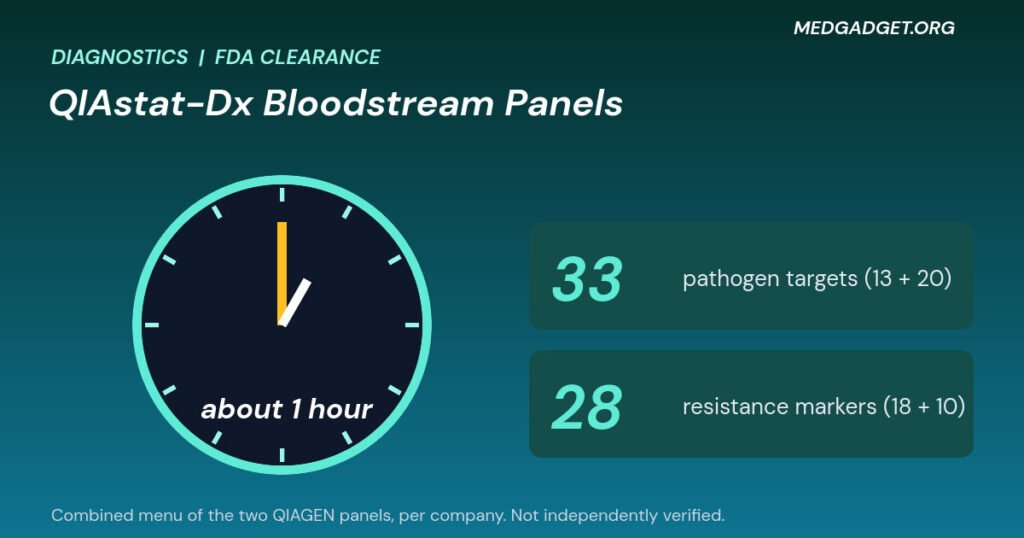
- What it detects: 13 gram-negative bacterial targets and 18 antimicrobial resistance markers.
- Earlier panel: QIAstat-Dx BCID GPF Plus AMR, covering gram-positive bacteria and fungi with 20 pathogen targets and 10 resistance markers.
- Speed: results in about one hour for both panels, per QIAGEN.
- Installed base: more than 5,200 cumulative placements worldwide by the end of 2025, in over 100 countries.
How the new QIAstat-Dx bloodstream infection panel works
The QIAstat-Dx system combines sample preparation, multiplex PCR and data analysis in one automated workflow. Multiplex PCR looks for the genetic fingerprints of many pathogens in a single run, instead of testing for one organism at a time. The new GN Plus AMR panel is aimed at gram-negative bacteria, a group that includes several of the organisms most associated with serious bloodstream infections and drug resistance.
The company release does not list the individual organisms or the resistance genes, and does not state the clearance pathway or the sample type. Panels of this kind are usually run on blood cultures that have already turned positive, but readers should confirm the intended specimen and claims in the FDA clearance and the instructions for use.
Two panels, one system: the QIAstat-Dx bloodstream infection menu
The earlier panel focused on gram-positive bacteria and fungi. With the second now cleared, QIAGEN says its US customers can screen for a broad range of causes of bloodstream infection on one platform. Adding the two panels’ numbers, as QIAGEN does, gives 33 pathogen targets and 28 resistance markers.
- GN Plus AMR: 13 targets plus 18 resistance markers.
- GPF Plus AMR: 20 targets plus 10 resistance markers.
- Combined: 33 pathogen targets and 28 resistance markers, by simple addition.
That sum is arithmetic and not a claim that every organism or marker is covered, and laboratories still need culture and susceptibility testing to confirm what the molecular result suggests.
Why speed matters for QIAstat-Dx bloodstream infection testing
Bloodstream infection can lead to sepsis, the body’s extreme response to an infection. The release, citing the Centers for Disease Control and Prevention (CDC), says about 1.7 million US adults develop sepsis each year and at least 350,000 die in hospital or are discharged to hospice. By our calculation, that is roughly one in five of those affected, though the CDC figure covers a broad group and not only bloodstream infections.
Traditional culture methods can take a day or more to identify an organism and its resistance. A test that answers in about an hour could help clinicians move from broad-spectrum antibiotics to targeted ones sooner. That is the company’s claim, and the real-world benefit will depend on hospital workflows, stewardship teams and how quickly results reach the bedside.
Antimicrobial resistance and the QIAstat-Dx bloodstream infection test
The resistance markers matter as much as the pathogen names. The World Health Organization (WHO) lists antimicrobial resistance among the top global public-health threats, because infections that do not respond to standard drugs lead to longer illness and more deaths. Detecting a resistance gene early can steer doctors away from drugs that are unlikely to work.
Related coverage on our site includes a new surveillance approach for hospital-acquired infections and positive preclinical data for new antimicrobial candidates, which show the other side of the same problem: finding resistant infections quickly and developing drugs to treat them.
What the QIAstat-Dx bloodstream infection portfolio means for laboratories
- One platform: labs already using QIAstat-Dx for respiratory, gastrointestinal and meningitis and encephalitis tests can add bloodstream testing without a new instrument.
- Menu choice: the two panels let labs pick by clinical question, such as suspected gram-negative infection versus gram-positive or fungal.
- Cost and reimbursement: not stated in the release, and likely to shape uptake.
- Evidence: hospitals will want published performance data before changing practice.
Our assessment of the QIAstat-Dx bloodstream infection clearance
In our assessment, the clearance is a meaningful commercial step for QIAGEN in a crowded field, because it turns a single-panel offering into a full portfolio. The clinical value will rest on how well the panels perform on real positive cultures and whether faster answers change treatment and outcomes. Neither is shown in the release, which relies on company statements. We have not seen the FDA summary of the clearance.
For more diagnostics news, browse our medical device section, or visit QIAGEN for company information.
What to watch next for QIAstat-Dx bloodstream infection testing
- Publication of clinical performance data for the GN Plus AMR panel.
- Details of the FDA clearance and the intended specimen type.
- US hospital adoption, pricing and reimbursement.
- Competing rapid bloodstream infection panels and how they compare.
Frequently asked questions
What is the QIAstat-Dx bloodstream infection panel?
It is a pair of FDA-cleared multiplex PCR panels that detect bacteria, fungi and antibiotic resistance markers linked to bloodstream infection, with results in about one hour.
What does the new GN Plus AMR panel detect?
13 gram-negative bacterial targets and 18 antimicrobial resistance markers, according to QIAGEN.
How fast are QIAstat-Dx bloodstream infection results?
About one hour for both panels, per the company.
Does QIAstat-Dx bloodstream infection testing replace blood cultures?
No. Laboratories still use culture and susceptibility testing to confirm results.
Who can use it?
US laboratories with a QIAstat-Dx system, subject to the FDA clearance and the product’s instructions for use.
How we reported this: we based this article on QIAGEN’s announcement of 27 September 2026 and public CDC and WHO pages. Performance claims are the company’s and have not been independently verified. Figures labelled as ours are our own calculations. Last updated: 12 October 2026. This article is news reporting and not medical advice.