
The FDA has approved Tecentriq stage III dMMR colon cancer treatment, clearing the immunotherapy atezolizumab to be given with chemotherapy after surgery for patients whose tumours are deficient in mismatch repair. Roche announced the approval on 9 October 2026 and describes it as the first adjuvant immunotherapy regimen for this group.
The decision is based on the ATOMIC trial, which found that adding Tecentriq cut the risk of recurrence or death by 50% compared with chemotherapy alone. This article explains who is eligible, how the regimen works, what the numbers do and do not show, and what is still unreported.
Tecentriq stage III dMMR colon cancer approval: the essentials
- Approved use: adjuvant treatment of stage III dMMR colon cancer, in combination with a fluoropyrimidine and oxaliplatin.
- Products: intravenous Tecentriq and subcutaneous Tecentriq Hybreza (atezolizumab and hyaluronidase-tqjs).
- Milestone: the twelfth US indication for Tecentriq, per Roche.
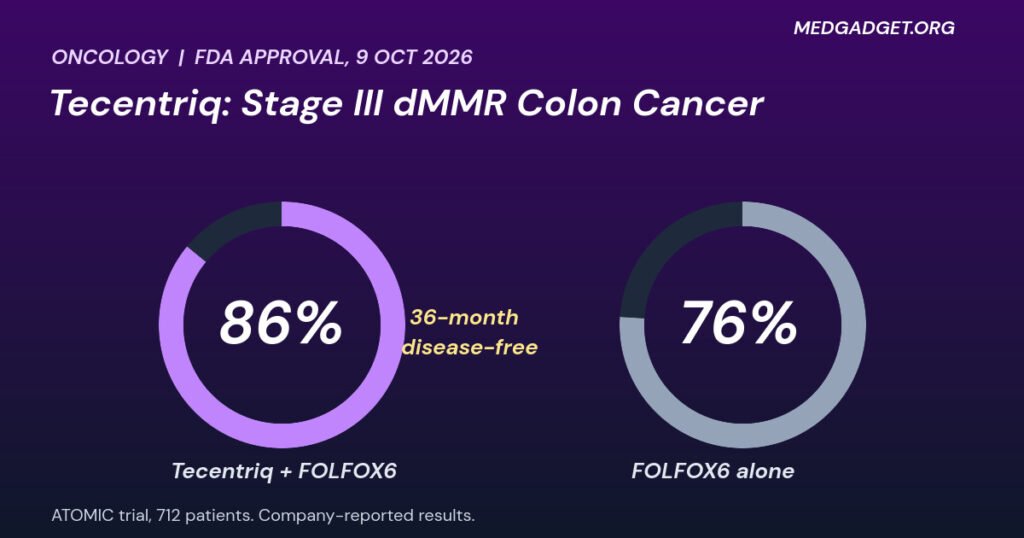
- Key result: 36-month disease-free survival of 86% with Tecentriq plus chemotherapy versus 76% with chemotherapy alone.
- Trial: ATOMIC (A021502), 712 patients, led by the Alliance for Clinical Trials in Oncology and sponsored by the US National Cancer Institute.
Who is eligible for Tecentriq stage III dMMR colon cancer treatment
“dMMR” stands for deficient mismatch repair. Normally, cells fix small errors made when DNA is copied. In dMMR tumours that repair system is broken, so errors build up and the tumour is often easier for the immune system to recognise. Roche says about 15% of colon cancer patients have dMMR or MSI-H tumours, and that nearly 25% of colon cancers are diagnosed at stage III.
Stage III means the cancer has reached nearby lymph nodes but not distant organs. Standard care is surgery followed by chemotherapy, yet Roche notes that nearly 30% of stage III patients have a recurrence within five years. The new approval targets that risk for the dMMR subgroup. Testing is done on tumour tissue, usually by immunohistochemistry, and Roche names its VENTANA MMR RxDx Panel as one such test.
How the Tecentriq stage III dMMR colon cancer regimen works
In the ATOMIC trial, the experimental arm received modified FOLFOX6 (folinic acid, fluorouracil and oxaliplatin) plus Tecentriq for 12 cycles, about six months. Patients then continued Tecentriq alone for 13 more cycles, about another six months. The control arm received FOLFOX6 alone for 12 cycles.
By our calculation, the Tecentriq arm therefore runs for about a year in total, which is twice as long as chemotherapy alone, though the second half is immunotherapy only. Patients and doctors will want to discuss the trade-off between added treatment time and the lower risk of recurrence.
What the ATOMIC results show for Tecentriq stage III dMMR colon cancer
ATOMIC was a randomised, open-label, multicentre Phase III trial. It enrolled 712 patients, split 1:1 between the two arms, with disease-free survival as the main goal. Roche reports a 50% reduction in the risk of recurrence or death with Tecentriq. The results were published in the New England Journal of Medicine in 2026.
- 36-month disease-free survival: 86% with Tecentriq plus FOLFOX6 versus 76% with FOLFOX6 alone.
- Absolute difference: 10 percentage points, by our calculation.
- Hazard ratio: not given in the Roche release; a 50% risk reduction implies roughly 0.50.
- Overall survival: not reported in the release.
A 10-point gain means that, in rough terms, about one extra patient in ten stays free of recurrence at three years. That is our own simple reading of the trial figures and not a statistic from the company, and it will change as follow-up lengthens.
Tecentriq stage III dMMR colon cancer: safety and what we do not yet know
Roche states that the safety profile was consistent with earlier studies of Tecentriq and FOLFOX6, but its release does not give adverse-event rates. Immunotherapies can cause immune-related side effects affecting the skin, bowel, liver, lungs and hormone glands, and patients should read the full prescribing information. We have not seen the FDA label.
- Rates of serious and immune-related side effects.
- Overall survival data, which are still maturing.
- Whether the benefit holds equally in all subgroups, such as lower-risk stage III disease.
- Cost and access, including in countries outside the US.
Tecentriq stage III dMMR colon cancer: intravenous and subcutaneous options
Roche says Tecentriq is the first PD-(L)1 cancer immunotherapy available in both intravenous and subcutaneous form. A subcutaneous injection is typically faster to give than an infusion, which can save chair time for patients and hospitals. The approval covers both products for this use.
Where Tecentriq stage III dMMR colon cancer treatment fits in colon cancer care
Colon cancer care is changing quickly, with more emphasis on tumour biology and earlier detection. Our coverage of an FDA-approved blood test for colorectal cancer screening and a new colorectal screening education hub looks at the detection side, while this approval looks at lowering recurrence after surgery. The wider cancer pipeline is also moving fast, as in our reports on Lilly’s Jaypirca in first-line CLL and Datroway with ivonescimab.
The National Cancer Institute offers patient-friendly information on colorectal cancer, and the FDA oncology approvals page lists recent FDA approvals in oncology.
Our assessment of the Tecentriq stage III dMMR colon cancer approval
In our assessment, this is a strong result for a defined group. A 10-point improvement in three-year disease-free survival is large in the adjuvant setting, and the approval gives patients with dMMR tumours a reason to be tested if they have not been. The main caveats are the open-label design, the lack of overall survival data and the limited safety detail in the release. The company’s figures are drawn from its Roche announcement and should be read alongside the full trial paper.
For more oncology approvals, browse our pharmaceutical news section.
What to watch next for Tecentriq stage III dMMR colon cancer
- Overall survival results from ATOMIC.
- Regulatory decisions in Europe, where Roche is pursuing further filings.
- Real-world uptake and the spread of dMMR testing.
- Long-term safety and quality-of-life data.
Frequently asked questions
What is the Tecentriq stage III dMMR colon cancer approval?
The FDA approved Tecentriq with a fluoropyrimidine and oxaliplatin as adjuvant treatment for stage III dMMR colon cancer, announced on 9 October 2026.
How effective is Tecentriq stage III dMMR colon cancer treatment?
In ATOMIC, adding Tecentriq reduced the risk of recurrence or death by 50% and raised 36-month disease-free survival from 76% to 86%.
What does dMMR mean?
Deficient mismatch repair, meaning the tumour cannot fix certain DNA copying errors.
How long is Tecentriq stage III dMMR colon cancer treatment?
In the trial, about six months of Tecentriq with chemotherapy followed by about six months of Tecentriq alone.
Is there a subcutaneous option?
Yes. Tecentriq Hybreza is the subcutaneous formulation.
How we reported this: we based this article on Roche’s announcement of 9 October 2026 and public NCI and FDA pages. Efficacy figures are the company’s. Figures labelled as ours are our own calculations. Last updated: 12 October 2026. This article is news reporting and not medical advice; patients should discuss treatment with their oncologist.