
The US Food and Drug Administration (FDA) has approved Jaypirca (pirtobrutinib), made by Eli Lilly, as a first-line treatment for adults with previously untreated chronic lymphocytic leukemia (CLL) or small lymphocytic lymphoma (SLL) who have no known 17p deletion. The approval, announced on 2 October 2026, moves the drug from later-line use into the first-line setting for eligible patients, according to the FDA announcement. It is based on the phase 3 BRUIN CLL-313 trial, in which Jaypirca reduced the risk of disease progression or death by 80% compared with chemoimmunotherapy.
Key Takeaways
- On 2 October 2026 the FDA approved Jaypirca (pirtobrutinib) for adults with previously untreated CLL or SLL with no known 17p deletion.
- In BRUIN CLL-313 (282 patients), progression-free survival favoured Jaypirca over bendamustine plus rituximab, with a hazard ratio of 0.20. Median progression-free survival was not estimable with Jaypirca and 33.5 months with chemoimmunotherapy.
- Lilly reports an overall response rate of 94% versus 81%. Serious adverse reactions occurred in 28% of patients.
- The dose is 200 mg taken by mouth once daily until disease progression or unacceptable toxicity.
- The trial compared Jaypirca with chemoimmunotherapy, not with another BTK inhibitor. A separate trial against ibrutinib, BRUIN CLL-314, is under way.
What Did the FDA Approve?
The FDA expanded the Jaypirca indication to adult patients with previously untreated CLL or SLL with no known 17p deletion. Jaypirca was previously approved for use after earlier treatment, so the new decision lets doctors consider it as the first medicine a patient receives. The drug has orphan drug designation, according to the FDA.
CLL and SLL are closely related cancers of B lymphocytes, a type of white blood cell. In CLL the cancer cells are mainly in the blood and bone marrow, while in SLL they are mainly in the lymph nodes. Treatment is often decided by the presence of genetic changes such as a 17p deletion, which is linked to poorer response to chemoimmunotherapy. Lilly says about 22,760 new CLL cases are diagnosed in the United States each year and that 92% to 95% of patients do not have a 17p deletion, so the new indication covers most patients.
Jaypirca First-Line CLL Approval at a Glance
| Item | Detail |
|---|---|
| Drug | Jaypirca (pirtobrutinib), Eli Lilly |
| Approval date | 2 October 2026 |
| New indication | Previously untreated CLL/SLL, adults, no known 17p deletion |
| Pivotal trial | BRUIN CLL-313 (NCT05023980), 282 patients |
| Comparator | Bendamustine plus rituximab, six cycles |
| Progression-free survival | HR 0.20; median not estimable vs 33.5 months |
| Overall response rate | 94% vs 81% (Lilly) |
| Dose | 200 mg orally once daily |
How Jaypirca Works
Jaypirca is a Bruton tyrosine kinase (BTK) inhibitor. BTK is a protein that helps leukemia cells survive and grow. According to Lilly, Jaypirca is a highly selective kinase inhibitor that uses a non-covalent binding mechanism, which differs from older covalent BTK inhibitors that bind permanently to the target. It is taken as a once-daily tablet, and treatment continues until the disease progresses or side effects become unacceptable.
BRUIN CLL-313 Trial Results
The approval rests on BRUIN CLL-313 (NCT05023980), a randomised, open-label, active-controlled trial in 282 patients with previously untreated CLL or SLL without a 17p deletion. Patients were assigned 1:1 to Jaypirca (141 patients) or to bendamustine plus a rituximab product for six cycles (141 patients), as described by The ASCO Post.
- Progression-free survival: hazard ratio 0.20 (95% confidence interval 0.11 to 0.37). Median progression-free survival was not estimable with Jaypirca versus 33.5 months with chemoimmunotherapy, after a median follow-up of 28 months.
- Response: Lilly reports an overall response rate of 94% with Jaypirca versus 81% with chemoimmunotherapy.
- Overall survival: median not reached in either arm. There were 3 deaths (2.1%) in the Jaypirca arm and 10 (7.1%) in the control arm, per The ASCO Post.
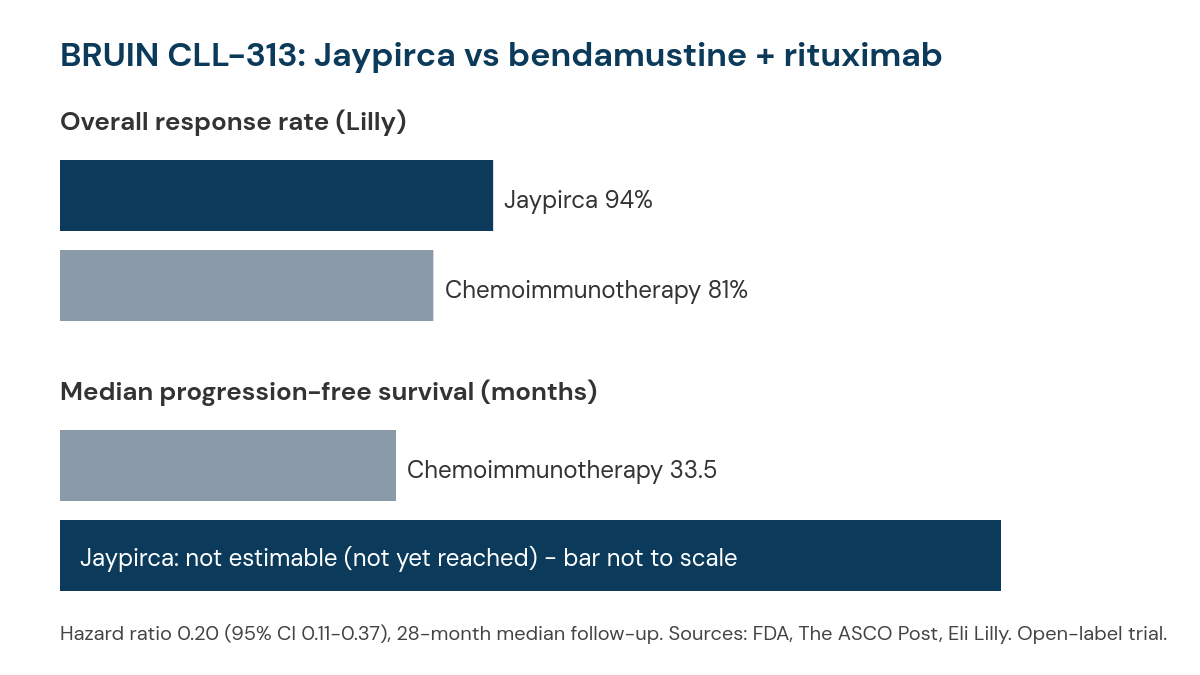
These numbers show a large benefit on progression-free survival, but the trial is open-label and follow-up is relatively short, so longer data will be needed on durability and overall survival. More details are available on ClinicalTrials.gov.
Safety and Side Effects
The most common adverse reactions, in at least 20% of patients, were upper respiratory tract infections (27%), rash (22%) and COVID-19 (21%). Serious adverse reactions occurred in 28% of patients, and the most common severe laboratory abnormality was a drop in neutrophil count. According to the Lilly press release, atrial fibrillation or flutter occurred in 1.4% of patients, dose reductions in 3.6% and permanent discontinuations in 4.3%.
The prescribing information warns about infections, bleeding, low blood counts, heart rhythm problems, second primary cancers, liver toxicity and harm to an unborn baby. Patients should discuss risks with their haematologist or oncologist; more patient information is available from the Leukemia & Lymphoma Society.
Why This Approval Matters
For CLL, BTK inhibitors have become a major treatment option, and the question of sequencing, meaning which drug to use first and which to save for later, is central. Moving Jaypirca into the first-line setting gives doctors another targeted option that is taken as a tablet rather than as a fixed-duration chemotherapy course. Because the comparator was chemoimmunotherapy, the trial does not show how Jaypirca compares with established first-line BTK inhibitors. Lilly is testing that question in BRUIN CLL-314 against ibrutinib.
The decision also adds to the busy blood-cancer treatment landscape, which we have covered in reports on the NICE recommendation of acalabrutinib-based treatments for blood cancers and on other oncology decisions such as the GSK’s Jemperli priority review. Related coverage includes the Foghorn and Lilly ending the FHD-909 programme and the FDA approval of the Freenome’s SimpleScreen blood test.
What Is Not Yet Known
- Head-to-head data: results against ibrutinib or other BTK inhibitors are not yet available.
- Long-term outcomes: overall survival and durability beyond a median follow-up of 28 months remain to be shown.
- Price and access: pricing and coverage for the new indication were not reported in the sources we reviewed.
- Guidelines: how treatment guidelines will place Jaypirca in the first-line setting has not been announced.
Our Assessment
In our assessment, the Jaypirca first-line CLL approval is a meaningful expansion backed by a strong progression-free survival result against chemoimmunotherapy, an older standard approach. The real-world impact will depend on how it compares with other BTK inhibitors and on cost and guideline placement. Patients should not change treatment without medical advice.
Frequently Asked Questions
What is Jaypirca approved for?
Adults with previously untreated CLL or SLL who have no known 17p deletion, in addition to its earlier approved uses.
When did the FDA approve Jaypirca for first-line CLL?
The FDA announced the approval on 2 October 2026.
What did the BRUIN CLL-313 trial show?
Jaypirca reduced the risk of progression or death by 80% compared with bendamustine plus rituximab (hazard ratio 0.20), with a 94% versus 81% overall response rate reported by Lilly.
How is Jaypirca taken?
The dose is 200 mg by mouth once daily until disease progression or unacceptable toxicity.
What are the common side effects?
Upper respiratory tract infections, rash and COVID-19 were the most common adverse reactions, and serious adverse reactions occurred in 28% of patients.
How we reported this: information comes from the FDA announcement and the Eli Lilly press release dated 2 October 2026, with additional detail from The ASCO Post. Response rate and safety figures from Lilly are company-reported. Last updated 3 October 2026. This article is for information only and is not medical advice.