
The Foghorn FHD-909 program is over. Foghorn Therapeutics and Eli Lilly said on October 1, 2026 that they will not advance the experimental oral SMARCA2 inhibitor beyond Phase 1 dose escalation, and Foghorn is cutting about 40% of its workforce. The companies concluded that the drug, also called LY4050784, did not deliver enough clinical efficacy in patients with SMARCA4-mutated cancers to justify an expansion phase.
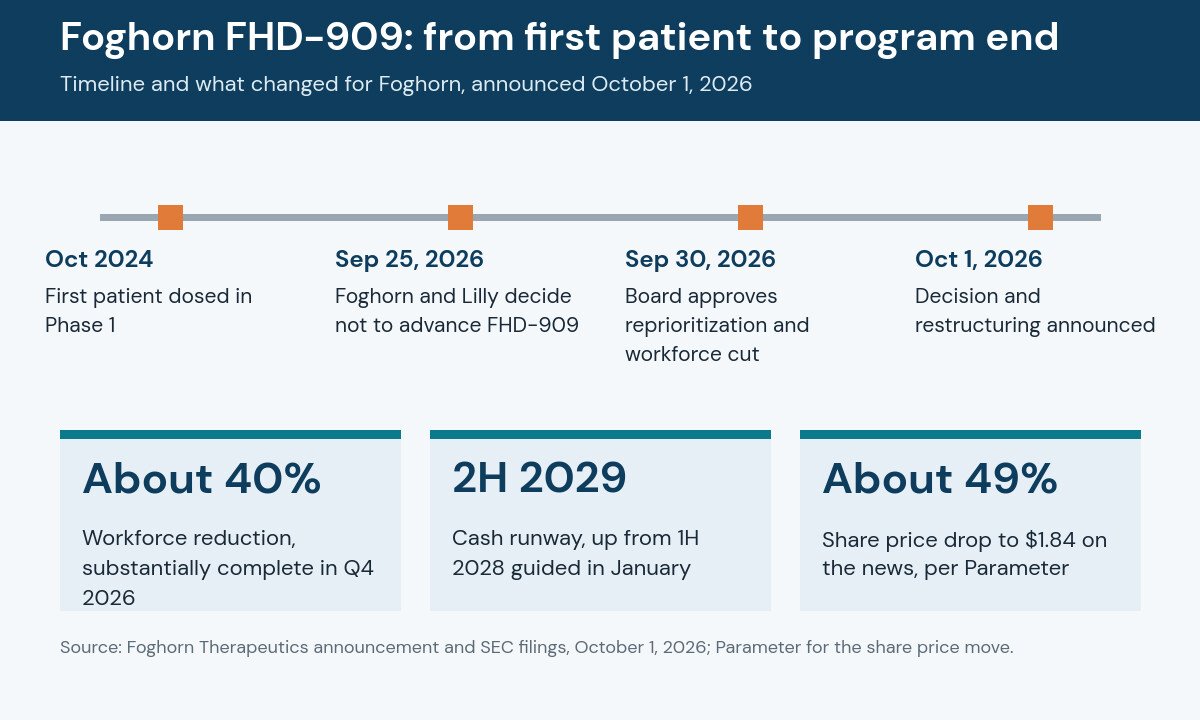
Foghorn says it will now focus on its proprietary programs and that the restructuring should fund them into the second half of 2029. Foghorn shares fell about 49% to $1.84, Parameter reported.
Key Takeaways: Foghorn FHD-909 Program Ends
- Foghorn and Lilly will not move FHD-909 into the clinical expansion phase, and they will not advance their selective SMARCA2 degrader program either.
- Foghorn said the drug hit SMARCA2 selectively with a favorable safety profile at exposures above its preclinical targets, but the biology did not translate into enough efficacy.
- About 40% of Foghorn’s workforce will be cut, with the reduction expected to be substantially complete in the fourth quarter of 2026.
- Cash runway now extends into the second half of 2029, up from the first half of 2028 guided in January.
- The announcement did not include response data, and the companies expect no further collaboration activity.
What Was FHD-909?
FHD-909 was a first-in-class, allosteric, oral small molecule designed to inhibit the ATPase activity of SMARCA2 (BRM) while sparing its close relative SMARCA4 (BRG1). The two proteins are the catalytic engines of the BAF chromatin-remodeling complex. The strategy relied on synthetic lethality: cancers that have lost SMARCA4 can depend on SMARCA2 to survive, so blocking SMARCA2 should kill those tumor cells and spare healthy ones.
Foghorn FHD-909 Timeline at a Glance
| Date | Event |
|---|---|
| October 2024 | First patient dosed in the Phase 1 trial |
| January 2026 | Foghorn reports about $208.9 million in cash and runway into the first half of 2028 |
| September 25, 2026 | Foghorn and Lilly decide not to advance FHD-909 |
| September 30, 2026 | Foghorn’s board approves a reprioritization and a workforce cut of about 40% |
| October 1, 2026 | Companies announce the decision, with runway extended into the second half of 2029 |
Why the Phase 1 Data Did Not Support Moving Forward
In its announcement, Foghorn said the Phase 1 data showed FHD-909 engaged SMARCA2 selectively with a favorable safety profile at exposures that exceeded its preclinical targets. Chief Executive Adrian Gottschalk said the company was disappointed because the SMARCA2/SMARCA4 synthetic-lethality biology had not translated into the level of efficacy needed to keep developing the drug.
According to Foghorn’s August 2026 investor presentation, the first-in-human trial had a dose-escalation phase in advanced solid tumors with any SMARCA4 alteration, followed by planned expansion cohorts that included second-line and later non-small cell lung cancer (NSCLC). No efficacy numbers have been published, so it is not known how many patients responded or how deep the responses were.
Inside Foghorn’s Restructuring
Foghorn said the 40% reduction aligns its operating structure with a narrower set of priorities. In a filing, it listed a selective EP300 degrader, an immunology and inflammation asset, a selective CBP degrader and its induced proximity platform as the focus, along with other proprietary programs.
The company has absorbed a setback like this before. AllSci reported that Foghorn discontinued its wholly owned clinical-stage drug FHD-286 in late 2024 after it failed in a leukemia trial, which left FHD-909 as its main clinical program. With FHD-909 gone, Foghorn’s priority programs are earlier-stage, and its selective CBP degrader had been tracking toward IND-enabling studies in 2026.
What Happens to the Lilly Collaboration
The companies said they do not anticipate further collaboration activities after deciding not to advance FHD-909 or the selective SMARCA2 degrader program. Under the collaboration, as Foghorn described it in a January 2025 update, the partners had a 50/50 U.S. co-development and co-commercialization agreement for the SMARCA2 program, agreements covering a selective inhibitor and a selective degrader, an additional undisclosed oncology target and three discovery programs. The latest announcement did not detail the status of the collaboration’s other components.
What the Setback Means for SMARCA2 Synthetic Lethality
SMARCA4 is mutated in up to about 10% of NSCLC and in up to 5% of solid tumors, according to Foghorn’s investor materials, so the opportunity looked meaningful and outcomes in SMARCA4-mutated lung cancer are poor. Foghorn and Lilly had also planned combination studies with pembrolizumab, which were conditional on dose escalation succeeding and now fall away.
In our assessment, the decision is a significant blow to the selective SMARCA2 inhibitor approach, because a drug that engaged its target safely at planned exposures still did not clear the efficacy bar. Dropping the degrader program as well suggests the partners did not see a path forward with that format either, though the lack of published data leaves open whether other molecules or combinations could perform differently.
What It Means for Patients and Researchers
The Foghorn FHD-909 drug was only available in clinical trials. Anyone enrolled should follow the guidance of their study team, and people with SMARCA4-mutated cancers can ask their oncologist about other research options or search ClinicalTrials.gov. For related coverage of oncology development and deals, read our reports on Summit’s HARMONi-GU1 trial, China’s new cancer treatment approvals and Sentynl’s alvelestat license deal, or browse our pharmaceutical news.
Frequently Asked Questions About Foghorn FHD-909
Why did Foghorn and Lilly stop developing FHD-909?
After reviewing Phase 1 dose-escalation data, they concluded that the SMARCA2/SMARCA4 synthetic-lethality approach did not produce the efficacy needed to advance the drug, even though it hit its target selectively with a favorable safety profile.
How many employees is Foghorn laying off?
Foghorn is reducing its workforce by approximately 40%, with the reduction expected to be substantially complete in the fourth quarter of 2026.
How long will Foghorn’s cash last now?
Foghorn says its cash should fund its priority programs into the second half of 2029, compared with the first half of 2028 it guided to in January.
What is Foghorn working on next?
Its priorities are a selective EP300 degrader, an immunology and inflammation program, a selective CBP degrader, its induced proximity platform and other proprietary programs.
Was the SMARCA2 degrader program also stopped?
Yes. The companies said they will not advance the selective SMARCA2 degrader program and do not anticipate further collaboration activities.
How we reported this: this article is based on Foghorn’s announcement and SEC filings, investor materials and trade coverage linked above. Foghorn has not published the Phase 1 efficacy data. Last updated October 2, 2026. It is for information only and is not medical or investment advice.