
The DaltonTx antibody discovery launch brings antibody design, structure prediction and validation tools into a single AI workflow. The London-based company announced on October 1, 2026 that it has added advanced antibody discovery capabilities to its Dalton platform, which it says can evaluate antibody repertoires of millions of sequences in a matter of hours.
According to the company’s announcement, researchers can use the platform to analyze, characterize and prioritize antibody candidates at scale, and to decide which ones to carry into experiments. DaltonTx describes itself as “the decision engine for drug discovery.”
Key Takeaways: DaltonTx Antibody Discovery
- DaltonTx added antibody discovery capabilities to its Dalton platform, combining design, structure prediction and validation tools in one workflow.
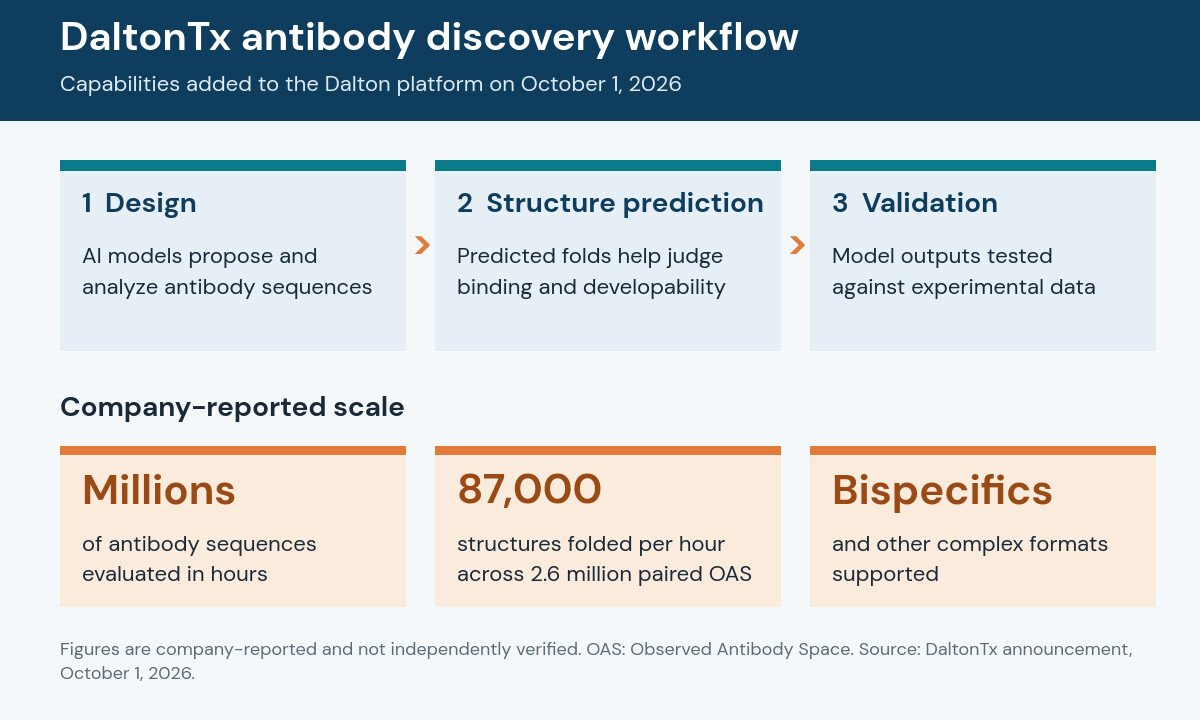
- The company says the platform can evaluate repertoires of millions of antibody sequences in hours and recently folded the entire 2.6 million paired OAS space at 87,000 structures per hour.
- It supports hit identification and optimization through to candidate discovery, including complex formats such as bispecifics.
- DaltonTx says it continuously tests AI-generated outputs against real experimental data to prioritize candidates more likely to succeed in development.
- The performance figures are company-reported, and no customer results for the antibody tools have been disclosed.
What Is the Dalton Platform?
Dalton is DaltonTx’s AI-enabled drug discovery platform for small molecules and biologics. It links molecules, assays, models, experimental results and human decisions in one learning system, so teams capture what worked, what failed and why. The antibody module extends that approach to antibody programs for biotechs, contract research organizations and pharmaceutical companies.
DaltonTx Antibody Discovery Capabilities at a Glance
| Capability | What DaltonTx says |
|---|---|
| Workflow | Antibody design, structure prediction and validation tools in a single platform |
| Scale | Repertoires of millions of sequences evaluated in hours |
| Structure throughput | Entire 2.6 million paired OAS space folded at 87,000 structures per hour |
| Scope | Hit identification and optimization through candidate discovery and design |
| Formats | Complex antibody formats such as bispecifics |
| Decision support | AI outputs tested continuously against real experimental data |
At 87,000 structures per hour, folding 2.6 million structures would take about 30 hours, our calculation from the company’s figures. OAS refers to the Observed Antibody Space, a large public collection of antibody sequences.
How the DaltonTx Antibody Workflow Works
The workflow starts with design and hit identification, where AI models propose or analyze antibody sequences. Structure prediction then estimates how those antibodies fold, which helps researchers judge binding and developability. Validation tools finally compare model outputs with experimental data, and the results feed back into the platform so later predictions improve.
DaltonTx says the aim is not just to generate candidates that look plausible on paper but to rank them by how likely they are to succeed in development. CEO Garry Pairaudeau said researchers now have an unprecedented range of AI models and tools for antibody discovery, but turning their outputs into confident scientific decisions remains the challenge the platform is built to address.
Who Is Behind DaltonTx
DaltonTx was founded on research from the University of Oxford and is led by veterans of AI discovery efforts at AstraZeneca and Exscientia. Pairaudeau spent 20 years in AstraZeneca R&D and was chief technology officer at Exscientia, pharmaphorum reported. Co-founder Charlotte Deane is a professor of structural bioinformatics at Oxford and the company’s chief AI officer.
The company raised a £4 million seed round from redalpine, IQ Capital Partners and Seedcamp, with support from Oxford University Innovation. It launched the Dalton platform in June 2026 alongside a collaboration with contract research organization Sygnature Discovery, and pharmaphorum said Bonito Biosciences also signed up as a client.
Why Antibody Discovery Needs Better Decision Tools
Deane said antibodies are the most successful class of medicines, yet they are still discovered largely by trial and error, and that no platform has before put the necessary tools in the hands of every biotech, CRO and pharmaceutical company. The launch lands in an increasingly crowded market for AI drug discovery toolkits, as pharmaphorum noted, so differentiation will depend on how well predictions translate into wet-lab results.
What to Watch Next
In our assessment, the key questions are independent validation and customer proof. The announcement does not name customers using the antibody capabilities, publish benchmark comparisons against other tools, or report experimental hit rates. Speed and scale are useful, but antibody programs are judged on binding, developability and clinical results, so predictions will still need experimental confirmation.
What It Means for Researchers and Biotechs
For teams without large in-house computational groups, an integrated platform could reduce the work of stitching together separate AI models and analysis tools. Smaller biotechs and CROs are the stated audience alongside large pharma. For related coverage of AI in drug discovery, read our reports on the H1 and Novo Nordisk AI collaboration, Massive Bio joining the OpenAI Partner Network and IDT and Aldevron’s Cas9 mRNA offering, or browse our biotechnology news.
Frequently Asked Questions About DaltonTx Antibody Discovery
What did DaltonTx launch?
DaltonTx launched advanced antibody discovery capabilities within its Dalton platform, combining antibody design, structure prediction and validation tools in a single workflow.
How fast is the DaltonTx platform?
The company says it can evaluate antibody repertoires of millions of sequences in hours and recently folded the entire 2.6 million paired OAS space at a rate of 87,000 structures per hour.
Which antibody formats does it support?
DaltonTx says researchers can use it from hit identification and optimization through candidate discovery and design, including complex formats such as bispecifics.
Who founded DaltonTx?
DaltonTx was founded on University of Oxford research and is led by former AstraZeneca and Exscientia scientists, including CEO Garry Pairaudeau and Professor Charlotte Deane.
Is the Dalton platform only for antibodies?
No. Dalton works across the drug discovery process for both small molecules and biologics, and the antibody capabilities are the latest addition.
How we reported this: this article is based on DaltonTx’s announcement and earlier company and trade coverage linked above. Performance figures are company-reported and have not been independently verified. Last updated October 2, 2026. It is for information only.