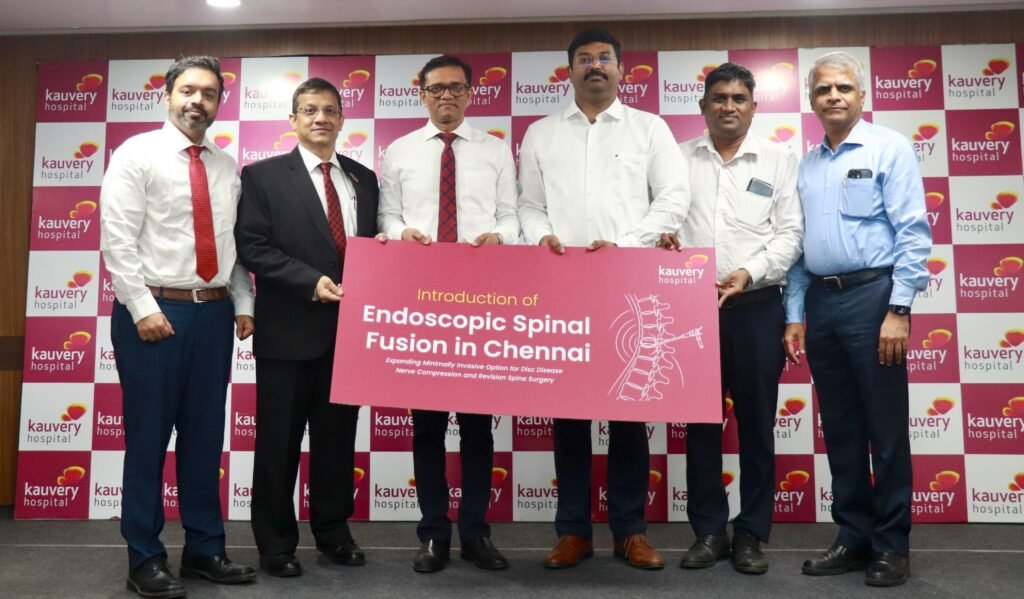

Kauvery Hospital, Alwarpet has added endoscopic fusion surgery to its spinal care services, giving selected patients an alternative approach for procedures that traditionally require more extensive surgical access. The technique is intended for patients who require spinal fusion but may benefit from a smaller surgical opening and reduced disruption to surrounding tissues.
Key takeaways: Kauvery Hospital
- In the endoscopic fusion procedure, a high-definition camera and specialised instruments are inserted through an incision measuring approximately 8 mm.
- The approximately 8 mm incision is substantially smaller than the access used in many conventional spinal procedures.
- The addition of endoscopic fusion at Kauvery Hospital comes as minimally invasive techniques continue to gain attention across surgical specialties.
The introduction reflects the continuing shift toward less invasive approaches in spine surgery, where hospitals and surgeons are increasingly evaluating techniques that can address complex spinal conditions while limiting the physical impact of an operation. Endoscopic fusion combines spinal decompression and fusion through a small working channel rather than relying on the larger access typically associated with conventional open procedures.
The development also highlights the growing role of endoscopy devices in modern surgical care. In the endoscopic fusion procedure, a high-definition camera and specialised instruments are inserted through an incision measuring approximately 8 mm. This gives the surgeon continuous visual access to the surgical area while allowing key steps of the fusion procedure to be performed through the narrow access point.
For patients, the smaller surgical footprint can be particularly relevant when a conventional fusion procedure would require greater disruption of muscles, bone or ligaments. However, the technique is intended for selected cases, and suitability depends on the patient’s spinal condition, anatomy and clinical requirements.
Kauvery Hospital’s adoption of the procedure adds another minimally invasive option to its spine surgery capabilities. The technique is designed to combine the objectives of spinal fusion with the limited tissue access associated with endoscopic surgery, potentially changing how certain patients are managed when fusion is clinically required.
Procedure Uses Small Access Point for Spinal Fusion
Endoscopic fusion surgery involves several stages that are performed through the working channel under direct visualisation. The surgeon first accesses the affected area using an endoscope equipped with a high-definition camera. The camera provides a magnified view of the surgical field, allowing the surgeon to identify the relevant structures while working through the small incision.
The affected nerves are then decompressed to relieve pressure around the spinal structures. Once adequate decompression has been achieved, the surgeon prepares the disc space for fusion. An interbody implant is subsequently placed into the prepared space, followed by fixation to provide stability to the treated spinal segment.
A defining feature of the procedure is the effort to preserve surrounding anatomical structures. Rather than creating a larger surgical pathway, the endoscopic approach uses the working channel to reach the treatment area. The procedure aims to minimise unnecessary disruption to muscles, bone and ligaments surrounding the spine.
The approximately 8 mm incision is substantially smaller than the access used in many conventional spinal procedures. This difference is central to the approach and is one reason endoscopic techniques have attracted attention within minimally invasive spine surgery.
For hospitals, the introduction of such procedures also reflects changes in the way surgical services are being developed. Advances in imaging, endoscopic equipment and specialised surgical instruments are allowing physicians to perform increasingly complex interventions through smaller access points. The availability of appropriate technology and trained surgical teams remains important for successful implementation.
Endoscopic fusion should not be viewed as a universal replacement for conventional spinal fusion. Different spinal conditions require different treatment approaches, and the choice of procedure is determined by clinical factors. Instead, the technique provides another option for patients who are considered appropriate candidates following medical evaluation.
Minimally Invasive Approach Expands Spine Surgery Options
The addition of endoscopic fusion at Kauvery Hospital comes as minimally invasive techniques continue to gain attention across surgical specialties. In spine care, the objective is not simply to make an incision smaller, but to provide surgeons with sufficient access and visual control to complete the required procedure while limiting unnecessary tissue disruption.
Endoscopic surgery uses a combination of specialised cameras, working channels and surgical instruments. Improvements in these technologies have expanded the ability of surgeons to perform procedures under continuous visual guidance. For healthcare providers, this has created opportunities to develop more specialised minimally invasive surgical programmes.
The approach may also be relevant to the broader economics of hospital care. Surgical techniques that can reduce tissue disruption may influence postoperative management, recovery requirements and resource utilisation, although outcomes vary according to the patient, procedure and clinical setting. Hospitals therefore continue to assess minimally invasive technologies based on both clinical suitability and operational requirements.
For patients requiring spinal fusion, the availability of an endoscopic option provides another treatment pathway to consider with their surgeon. The small access point and continuous visualisation are central characteristics of the procedure, while the actual suitability depends on the underlying spinal problem and the patient’s individual circumstances.
Kauvery Hospital’s move also reflects the wider development of specialised spine care in India’s private healthcare sector. Hospitals are investing in advanced surgical capabilities as demand grows for procedures that combine clinical precision with less invasive approaches. Endoscopic fusion represents one area where developments in surgical technology are changing how spinal procedures can be performed.
As hospitals continue to adopt advanced endoscopy devices and minimally invasive surgical systems, the focus will increasingly remain on selecting the right technology for the right clinical indication. For appropriately selected spine patients, Kauvery Hospital’s endoscopic fusion programme adds another option to the range of surgical approaches available for spinal fusion.
Related reading: