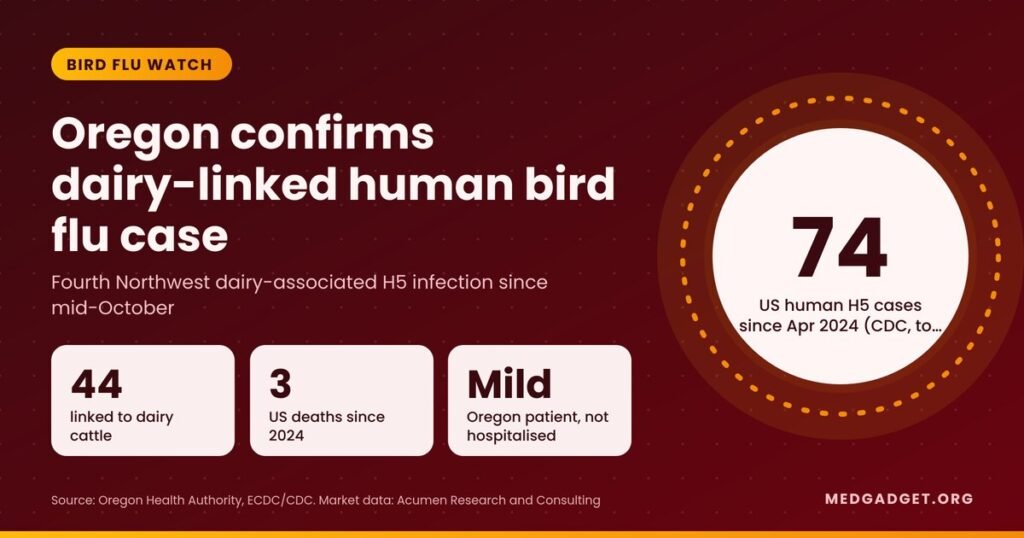

The Oregon bird flu case confirmed by the Oregon Health Authority (OHA) on 19 November 2026 involves a Morrow County resident who caught highly pathogenic avian influenza (HPAI) during an outbreak among cattle at a local dairy, had mild symptoms, was not hospitalised and was treated with the antiviral oseltamivir. It is Oregon’s first human case of 2026 and comes less than three weeks after a Yakima County, Washington, dairy-exposed patient became the first person in the US to die of H5N1 this year.
Key takeaways on the Oregon bird flu case
- The patient was exposed at a Morrow County dairy farm with infected cattle, not at a poultry operation.
- Illness was mild; the person was not admitted to hospital and received oseltamivir (Tamiflu). Household members were offered the same drug as a precaution.
- Officials say there is no known person-to-person spread and describe community risk as extremely low.
- Washington’s Yakima County has reported three dairy-linked H5 infections since mid-October, including a fatal case on 1 November.
- Before these latest cases, CDC counted 74 human H5 infections in 13 states since April 2024, 44 of them linked to dairy cattle.
- The pattern points to dairy herds in the Pacific Northwest as the main human exposure risk this autumn.
What Oregon health officials confirmed
The Oregon State Public Health Laboratory confirmed the infection, and OHA announced it on Thursday, 19 November. According to local reporting of the OHA statement, the person worked around or was otherwise exposed to cattle at a Morrow County dairy where the virus was circulating. Officials did not release the patient’s age or sex, and the public announcement described the virus as HPAI without naming a subtype or genotype. Further characterisation typically happens at CDC, so readers should treat any claim about the exact strain as unconfirmed until CDC publishes it.
OHA’s respiratory pathogens medical director, Dr. Melissa Sutton, framed the detection as a sign that monitoring is doing its job: “This is not cause for alarm.” Morrow County health staff offered oseltamivir to people living with the patient, a standard step to reduce the chance of secondary infection. Oregon’s only previous human case, in 2024, was linked to a poultry farm.
How the Oregon infection fits the 2026 picture
The Oregon detection is the fourth dairy-associated human case reported in the Pacific Northwest since mid-October. The European Centre for Disease Prevention and Control’s 9 November update, which draws on CDC and Yakima County data, describes the Washington cluster in detail. Sequencing of two Yakima viruses showed H5N1 clade 2.3.4.4b, genotype B3.13, the lineage that has circulated in US dairy cattle since 2024, with no sign of reassortment with seasonal flu.
| Case | Reported | Exposure | Outcome |
|---|---|---|---|
| Yakima County, WA (case 1) | 15 Oct 2026 | Dairy, occupational | Mild, isolated at home |
| Yakima County, WA (case 2) | Late Oct 2026 | Dairy with infected cattle | Hospitalised, died 1 Nov; had underlying conditions |
| Yakima County, WA (case 3) | Week ending 31 Oct | Dairy | Conjunctivitis, mild; subtype pending at CDC |
| Morrow County, OR | 19 Nov 2026 | Dairy with infected cattle | Mild, not hospitalised, oseltamivir |
For context, CDC’s national tally as of 5 November (before the two most recent Yakima cases and the Oregon case) stood at 74 human H5 infections in 13 states since April 2024. By exposure, 44 were linked to dairy herds, 24 to poultry farms or culling, three to other animals and three had no identified source. By our calculation, dairy exposure accounts for about 59% of all US human cases in that period. Three US deaths have now been recorded: Louisiana in January 2025, a Washington H5N5 case in November 2025, and the Yakima H5N1 case this month.
Is bird flu spreading between people?
No human-to-human transmission has been identified in Oregon, Washington or anywhere else in the US outbreak. CDC continues to rate the risk to the general public as low, while rating the risk for people in direct contact with infected animals, raw milk or contaminated surfaces as moderate to high. After the Yakima death, a CDC spokesperson said sequencing found no changes expected to make the virus spread more easily or cause more severe disease. One Yakima sample did pick up a mutation in the M1 gene whose effect is unclear, which is the kind of signal virologists watch, not a finding of increased risk.
Practical steps for farm workers and consumers
- Dairy and poultry workers: use the eye protection, gloves and respirators that state health departments and employers supply, and report red eyes, fever or cough promptly so testing and antivirals can start early.
- Milk: pasteurisation inactivates the virus; raw milk from affected regions carries a real infection risk for people and pets.
- Eggs and poultry: cooking to safe internal temperatures kills the virus. Our coverage of the Cal-Maine Florida outbreak explains how layer flocks are handled.
- Seasonal flu shot: it does not protect against H5, but it lowers the chance of being co-infected with seasonal and avian strains, which is how new mixed viruses could arise. This season is already heavy, as our report on the early H1N1 surge shows.
Market context: antivirals remain the front line
Human H5 cases in the US are being managed with existing neuraminidase inhibitors such as oseltamivir, which keeps attention on antiviral supply and stockpiles. A dated but indicative antiviral drugs market report from Acumen Research and Consulting (last updated March 2021) projected the global antiviral market to grow at around 3.7% a year to roughly US$74.7 billion by 2027, with North America holding the largest revenue share. Those figures predate the dairy outbreak and should be read as background, not as a forecast of H5-specific demand.
What we still do not know
Key gaps remain: the subtype and genotype of the Oregon virus, how many Morrow County herds are affected, whether co-workers were tested, and how the virus reached Oregon dairy cattle. CDC’s bird flu situation summary is the place to watch for an updated national count that includes the Oregon case. Expect more detections where milk testing finds infected herds, because active monitoring of exposed workers tends to uncover mild cases that would otherwise be missed.
FAQ
Where was the Oregon bird flu case?
Morrow County in north-eastern Oregon. The person was exposed during an avian influenza outbreak among cattle at a dairy farm there.
Is the Oregon bird flu patient seriously ill?
No. Health officials reported mild symptoms, no hospital admission and treatment with oseltamivir.
How many people have died of bird flu in the US?
Three deaths have been recorded since 2024: Louisiana (January 2025), Washington (November 2025, H5N5) and Yakima County, Washington (1 November 2026, H5N1).
Is it safe to drink milk during the bird flu outbreak?
Pasteurised milk is considered safe because heat treatment inactivates the virus. Health agencies advise against drinking raw milk, especially from regions with infected herds.
More public health coverage: Healthcare Services.
Sources: Oregon Health Authority statement (19 Nov 2026) as reported by KPTV/AP; ECDC avian influenza human cases update (9 Nov 2026) citing CDC and Yakima Health District; CDC bird flu situation summary. Market data: Acumen Research and Consulting, Antiviral Drugs Market report (dated, indicative). This article is for information only and is not medical advice. Last updated 24 November 2026.