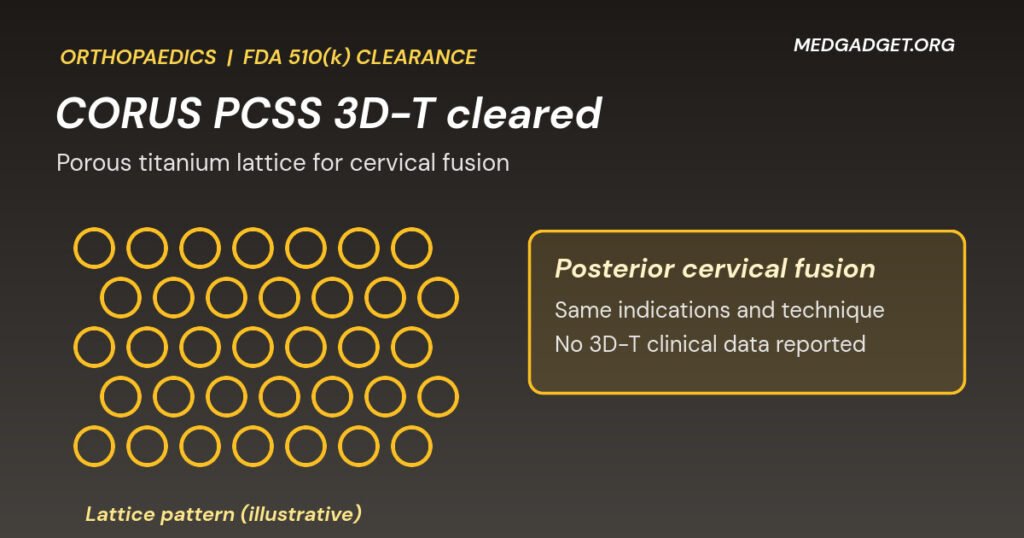

The CORUS PCSS 3D-T FDA clearance adds a 3D-printed porous titanium design to an existing system for fusing the neck from the back. On 13 October 2026, Providence Medical Technology announced that the US Food and Drug Administration had granted 510(k) clearance for the CORUS Posterior Cervical Stabilization System 3D-T, known as CORUS PCSS 3D-T. The company describes it as the next generation of its CORUS PCSS implant, with the same core design, indications and surgical technique.
The change is the material: a lattice of porous titanium meant to encourage bone to grow into the implant. The announcement contains no clinical results for the new version, so the clearance should be read as a regulatory step, not as proof of better fusion. This article explains what was cleared, what the evidence is and what to keep in mind.
Key takeaways
- The FDA cleared CORUS PCSS 3D-T through the 510(k) pathway on the basis of the company’s submission.
- It is a posterior cervical stabilisation device with integrated screw fixation, used as an adjunct to fusion in cervical degenerative disc disease.
- The main change is a 3D-manufactured porous titanium lattice designed to mimic cancellous bone.
- No clinical data for the 3D-T version were reported; the evidence cited belongs to the earlier CORUS PCSS.
- The system will be shown for the first time at the NASS annual meeting from 14 to 17 October 2026.
What the CORUS PCSS 3D-T FDA clearance covers
The company describes CORUS PCSS 3D-T as a 3D-manufactured, nonsegmental posterior spinal instrument with integrated screw fixation. Its indication is to immobilise and stabilise spinal segments as an adjunct to posterior cervical fusion in patients with cervical degenerative disc disease. Surgeons place it on both sides of the spine through a posterior approach. The company says it comes in a sterile-packaged, single-use instrument set, which it describes as the only one indicated for posterior cervical fusion; we have not verified that claim.
A 510(k) clearance means the FDA found the device substantially equivalent to a legally marketed predicate. It is a lower bar than Premarket Approval and often does not require new clinical trial data. That is why the absence of 3D-T clinical results in the announcement is not unusual, though it does limit what can be said about benefit.
The porous titanium lattice in the CORUS PCSS 3D-T FDA clearance
The headline feature is a proprietary porous titanium structure that the company says mimics cancellous (spongy) bone. According to the company, its porosity and pore sizes align with published bone-ingrowth research, and the lattice is intended to distribute load evenly, provide structural support during fusion, hold packed bone graft and conform to different anatomies.
A surgeon quoted in the release says the 3D-T has 1.5 times the surface area and eight times the surface roughness of the original machined implant. Those are company-supplied figures. More surface and roughness are thought to help bone attach, but whether that translates into higher fusion rates in patients has to be shown in clinical studies. The release describes the structure as 3D-manufactured, and its title refers to 3D printing, but it does not describe the process.
What evidence supports the CORUS PCSS 3D-T FDA clearance?
The company points to the predecessor, CORUS PCSS. It cites a Level 1 randomised trial in which adding the device to multilevel anterior fusion produced higher fusion rates at 12 and 24 months and a substantially lower two-year surgical revision rate than anterior fusion alone. Interim results were published in the journal Spine in May 2025. Those findings relate to the earlier machined version, not the 3D-T, and the sponsor reports them.
Patients considering any spinal implant should discuss the evidence with their surgeon. The announcement does not discuss risks, complications or contraindications, which for cervical fusion surgery can include infection, nerve injury, failure of the bone to fuse and the need for further surgery.
Why the CORUS PCSS 3D-T FDA clearance matters for cervical fusion
Cervical degenerative disc disease is a wear-related condition of the neck that can cause pain, stiffness and, when nerves or the spinal cord are compressed, numbness or weakness. When surgery is needed, fusing the affected levels is a common approach, and surgeons can approach from the front, the back or both. Posterior devices are used to add stability, particularly in multilevel surgery. Better bone ingrowth could, in principle, reduce failed fusions, which is the problem new materials try to address.
The commercial context is that 3D-printed porous implants have become a feature of spinal device competition. For another spine technology story, see our report on Kauvery Hospital’s endoscopic fusion surgery for selected spine patients, or browse our medical device coverage.
Our assessment of the CORUS PCSS 3D-T FDA clearance
In our assessment, the CORUS PCSS 3D-T FDA clearance is an incremental upgrade rather than a new category. The company keeps the indications and technique unchanged and changes the surface and structure of the implant. That lowers the learning burden for surgeons, and it is a sensible response to the market’s preference for porous titanium. The test will be whether fusion rates and revision rates improve in practice, and for that the first step is data, which the company has yet to publish for this version. We would also look for independent studies, since most evidence so far comes from the sponsor.
What to watch after the CORUS PCSS 3D-T FDA clearance
- The first public showing at the North American Spine Society meeting, Booth 913, from 14 to 17 October.
- A commercial launch date, which the announcement does not give.
- Clinical or biomechanical data specific to the 3D-T design.
- Independent comparisons with other porous titanium cervical systems.
Frequently asked questions about the CORUS PCSS 3D-T FDA clearance
What is CORUS PCSS 3D-T?
A posterior cervical stabilisation system with integrated screws and a porous titanium lattice, used as an adjunct to fusion in cervical degenerative disc disease.
Does the CORUS PCSS 3D-T FDA clearance mean it works better than earlier versions?
No. A 510(k) clearance shows substantial equivalence to an existing device. The company has not yet reported clinical data for the 3D-T.
What is different from the original CORUS PCSS?
The 3D-manufactured porous titanium lattice, which the company says is designed to support bone ingrowth. Indications and surgical technique are unchanged.
When will it be available?
No commercial launch date was given. It will be shown publicly at the NASS annual meeting from 14 to 17 October 2026.
Who makes it?
Providence Medical Technology, based in San Antonio, Texas.
How we reported this: we relied on Providence Medical Technology’s 13 October 2026 announcement, which is a company statement. Last updated: 14 October 2026. This article is news reporting and not medical advice.