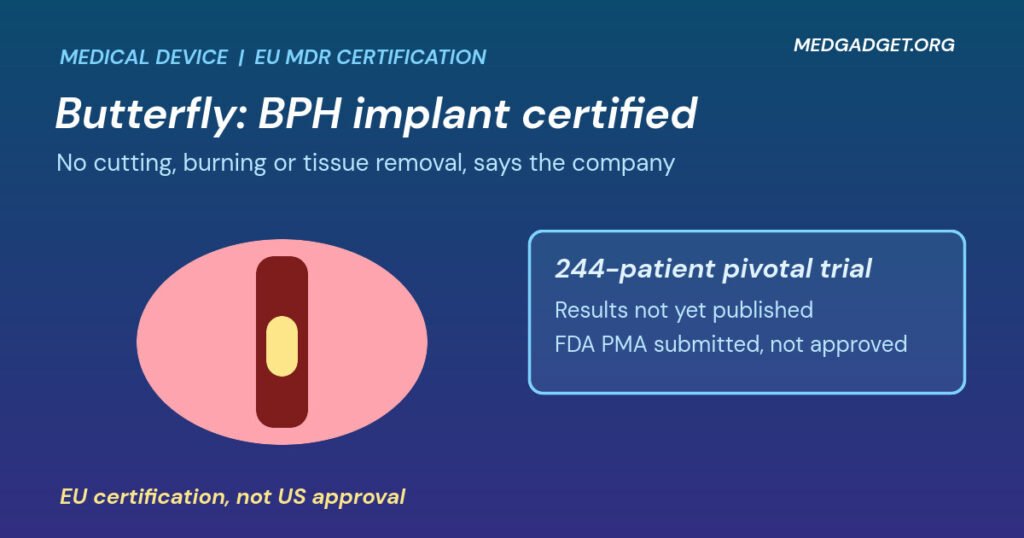

The Butterfly Medical prostate device EU approval brings a small implant for an enlarged prostate closer to European patients. On 13 October 2026, Butterfly Medical announced that the Butterfly Prostatic Retraction Device had received certification under the European Union’s Medical Device Regulation (EU) 2017/745 for treating the urinary symptoms of benign prostatic hyperplasia (BPH).
The company describes the device as an anatomically designed implant that improves urine flow without cutting, burning or removing prostate tissue. Certification allows it to be sold in EU markets. It does not settle how well it works compared with other options, and the device is not yet approved in the United States.
Key takeaways
- The Butterfly Prostatic Retraction Device is certified under the EU Medical Device Regulation for BPH symptoms.
- The company completed a 244-patient pivotal trial, but the announcement did not publish results.
- A Premarket Approval application has been submitted to the US FDA; there is no US approval yet.
- Listed risks include urinary discomfort, urgency, frequency, bleeding and possible removal of the device.
What the Butterfly Medical prostate device EU approval covers
The EU Medical Device Regulation sets the requirements for safety, performance and clinical evidence that devices must meet to carry a CE mark. Implants are regulated more strictly than many devices, and a notified body reviews the evidence. The announcement does not name the body that issued the certificate, nor does it give the date the certificate takes effect.
The company describes the product as “next-generation”, but the announcement does not explain how it differs from earlier versions. Earlier coverage of the company’s device described a small implant placed in the urethra to hold open the passage through the prostate. We could not match that description to this certification, so we treat it as background only.
Understanding BPH and the Butterfly Medical prostate device EU approval
BPH is a non-cancerous enlargement of the prostate that is common in older men. As the gland grows it can squeeze the urethra, causing a weak stream, frequent urination, urgency and waking at night to urinate. The National Institute of Diabetes and Digestive and Kidney Diseases notes that treatment ranges from watchful waiting and medicines to minimally invasive procedures and surgery.
Many men stop or avoid drugs because of side effects, and standard surgery can carry risks such as sexual side effects or incontinence. That is the gap implants and other minimally invasive options aim to fill. A device that avoids removing tissue could suit men who want to preserve sexual function, but the case for it rests on trial evidence that has not yet been made public.
Suitability will also depend on the individual. Prostate size, the shape of the gland, symptom severity and other health conditions all influence which treatment is sensible, and the announcement does not say which men the implant is meant for. Anyone with urinary symptoms should have them checked by a doctor, because similar symptoms can have other causes, including infection and, less often, cancer.
What the pivotal trial behind the Butterfly Medical prostate device EU approval could tell us
Butterfly says it completed a pivotal trial of 244 patients. The release does not give outcomes. In BPH studies, researchers usually look at improvement in the International Prostate Symptom Score, urine flow and sexual function, and track complications and device removals over time. Until those figures appear, claims about benefit remain the company’s.
- Was symptom improvement large and lasting?
- How many men needed the implant removed?
- Were ejaculatory and erectile function preserved?
- How did results compare with existing minimally invasive procedures?
A trial of this size can show whether the device helps and how often problems occur. It is less able to reveal rare complications or long-term durability, which usually emerge only after wider use and years of follow-up. That is why post-market surveillance, a requirement under the EU regulation, matters for implants.
The US picture after the Butterfly Medical prostate device EU approval
The company says a Premarket Approval application has been submitted to the FDA. That is the most rigorous US pathway for devices, and no decision has been announced. Butterfly will give a company update at the AdvaMed MedTech Conference in Boston on 20 October 2026. Earlier this year the company announced an upsized $21 million Series C financing to support its BPH programme. See Butterfly Medical for its own description of the device. For other prostate stories, see our report on Foresee’s Camcevi approval in China and our report on targeted prostate cancer screening for the NHS, or browse our medical device coverage.
Our assessment of the Butterfly Medical prostate device EU approval
In our assessment, the Butterfly Medical prostate device EU approval is a genuine regulatory milestone, and it is also the first point at which doctors and patients in Europe can see how the device performs in routine use. Certification shows that regulators judged the evidence adequate for CE marking. It does not show that the implant is better than established treatments, and the company has not yet shared the trial data that would allow such a comparison. The listed risks, including bleeding and possible removal, matter in a condition that is not usually life-threatening.
What to watch next after the Butterfly Medical prostate device EU approval
- Publication of the pivotal trial data.
- The first European commercial launches and pricing.
- The FDA decision on the Premarket Approval application.
- Longer-term follow-up on durability and removals.
Frequently asked questions about the Butterfly Medical prostate device EU approval
What does the Butterfly Medical prostate device EU approval cover?
The Butterfly Prostatic Retraction Device received certification under the EU Medical Device Regulation for treating BPH symptoms.
Does the Butterfly Medical prostate device EU approval apply in the US?
No. A Premarket Approval application has been submitted to the FDA, but there is no US approval.
How does the implant work?
The company says it is an anatomically designed implant that improves urine flow without cutting, burning or removing tissue.
What are the risks?
Urinary discomfort, urgency, frequency, bleeding and possible removal of the device are listed.
Are trial results available?
The company completed a 244-patient pivotal trial but has not published the results in this announcement.
How we reported this: we relied on Butterfly Medical’s 13 October 2026 announcement, which is a company statement. Last updated: 14 October 2026. This article is news reporting and not medical advice.