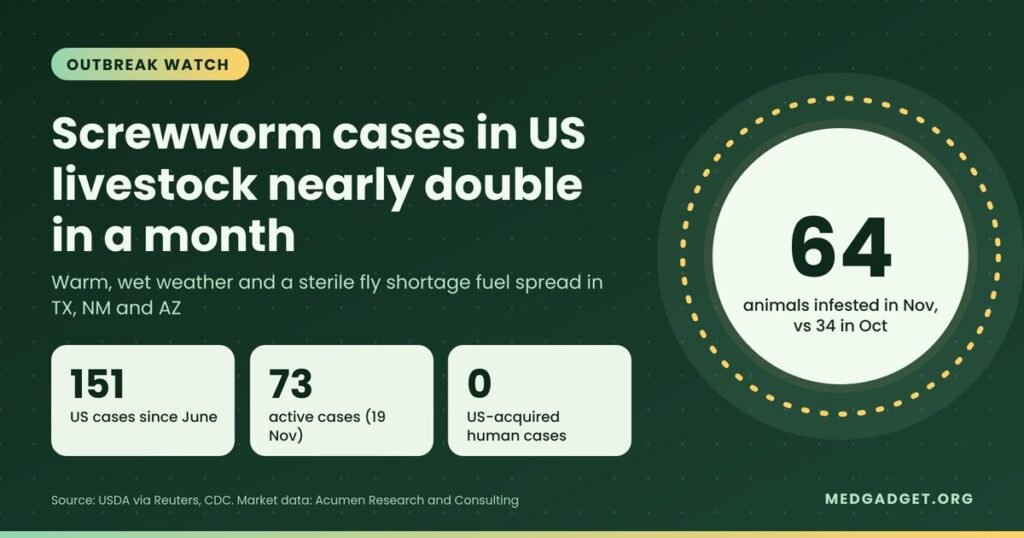

New World screwworm cases in the US have nearly doubled in a month: USDA data show 64 domesticated animals were found infested in November 2026, up from 34 in October and just 3 in September, as unusually warm, wet weather lets the flesh-eating fly spread across Texas, New Mexico and Arizona. As of 19 November, 151 animal cases had been confirmed since the first US detection on 3 June, with 73 still active, Reuters reported on 20 November.
Key takeaways on New World screwworm cases in the US
- November infestations (64) are running about 88% above October (34) and more than 20 times September (3), by our calculation.
- Total confirmed US animal cases reached 151 (149 domestic animals plus 2 wild elk) across Texas, New Mexico and Arizona; 73 were active on 19 November.
- Cattle make up half of all cases, but sheep, horses, dogs, goats, a chicken and a cat have also been infested.
- CDC says there have been no locally acquired human cases in the US and the risk to people remains very low.
- USDA is short of sterile flies, the main control tool, and is releasing every available fly while a new South Texas production plant is built.
Why the parasite is spreading now
The New World screwworm (Cochliomyia hominivorax) is a fly whose larvae burrow into the living flesh of warm-blooded animals through wounds, navels of newborn calves or other openings. Unlike ordinary blowfly maggots, they feed on healthy tissue, which is why untreated infestations can kill livestock within days.
USDA officials and state veterinarians told Reuters the late-autumn surge tracks unusually wet and warm conditions across the Southwest, with El Niño rainfall and late-season tropical storm moisture reaching Arizona and northern Mexico. Those are near-ideal conditions for fly breeding. Experts quoted in the report also warned that winter temperatures are unlikely to be cold enough to kill the pest in parts of Texas, New Mexico and Arizona, so the usual seasonal lull may not arrive.
The pest had been eradicated from the US for decades before spreading north through Central America and Mexico. Cattle imports from Mexico, halted in 2025, resumed at Arizona and New Mexico ports in August 2026; Reuters reported that those imports were not the cause of the current spike.
The numbers: cases by month, state and species
| Measure | Figure | Source / note |
|---|---|---|
| New infestations, September 2026 | 3 | USDA via Reuters |
| New infestations, October 2026 | 34 | USDA via Reuters |
| New infestations, November 2026 (to date) | 64 | USDA via Reuters |
| Total animal cases since 3 June 2026 | 151 (149 domestic, 2 elk) | USDA data as of 19 Nov |
| Active cases | 73 (vs 2 at end of September) | USDA data as of 19 Nov |
| Texas / New Mexico / Arizona | 96 / 46 / 9 | Cumulative, USDA data compiled by trackers |
| Texas share of all cases | About 64% | By our calculation |
| Locally acquired human cases in the US | 0 | CDC, 18 Nov 2026 |
By species, cumulative USDA detections break down as cattle 76, sheep 25, horses 20, dogs 19, goats 7, elk 2, plus one chicken and one domestic cat. The spread across household pets matters for the wider public: dogs with untreated wounds are just as vulnerable as calves. Cases are scattered across roughly 40 counties, from Zavala County, Texas, where the first case was found in June, to Greenlee and Cochise counties in Arizona, where the parasite arrived in late October.
Is screwworm a risk to people?
Humans can be infested, but the CDC situation summary (reviewed 18 November) states there have been no reports of US-acquired human infestations in the current outbreak. The only recent US human case was travel-associated, confirmed in August 2025 in a person who had returned from El Salvador. CDC’s assessment is that “the risk of NWS in people remains very low.”
The picture further south is very different. Central America and Mexico have reported more than 209,400 animal cases and more than 2,900 human cases during this outbreak, according to CDC. Travellers to affected areas should keep wounds clean and covered, and anyone with a non-healing sore, a sensation of movement in a wound or a foul-smelling lesion after travel should see a clinician promptly. People in affected US counties who handle livestock or pets should check animals’ wounds daily and report suspected cases to their state veterinarian.
How USDA is fighting back: sterile flies and a new plant
The proven tool against screwworm is the sterile insect technique: mass-reared male flies are sterilised and released so wild females mate without producing offspring. It is how the US eradicated the pest in the 20th century. The problem now is supply. Reuters reported that USDA is releasing all available sterile flies over the southwestern US and along Mexico’s northern border, yet output still falls short.
Two fixes are in motion. The US Army Corps of Engineers is building a sterile fly facility in South Texas due to open in 2027, and USDA is backing a genetically engineered strain, tested in Panama, that produces only male flies. USDA Under Secretary Dudley Hoskins told Reuters that approach could double sterile fly production. Until then, ranchers rely on wound treatment, insecticides, frequent inspection and movement checks. One South Texas rancher summed up the mood of the region bluntly: “The swarm has not reached Texas yet.”
Market context: what animal health spending looks like
Screwworm control draws on veterinary parasiticides, diagnostics and surveillance, all part of the wider animal health sector. According to Acumen Research and Consulting, the global animal health market was valued at USD 41.3 billion in 2021 and is forecast to reach USD 67.3 billion by 2030, a 5.8% compound annual growth rate, with production animals holding the largest share. That report was last updated in August 2022, so treat the figures as indicative rather than current. Outbreaks such as screwworm, alongside the avian flu waves hitting poultry farms, are the kind of events that push governments and producers to spend more on prevention.
What to watch next
- Whether December case counts fall as temperatures drop, or keep climbing as experts fear.
- Any first detection in a new state, or a first locally acquired human case, which would change CDC’s risk assessment.
- Timelines for the South Texas sterile fly plant and the male-only fly strain.
- Any new restrictions on cattle movement or Mexican cattle imports, which would hit beef supply and prices.
For more on the outbreaks shaping US public health this year, see our coverage of US measles cases reaching 5,838 and the Cal-Maine bird flu cull in Florida.
FAQ
How many screwworm cases are there in the US?
USDA data as of 19 November 2026 show 151 confirmed animal cases since June (96 in Texas, 46 in New Mexico, 9 in Arizona), with 73 active.
Can humans get screwworm in the US?
It is possible but rare. CDC reports no locally acquired human cases in the current US outbreak and rates the risk to people as very low.
Is beef safe to eat during the screwworm outbreak?
Screwworm infests live animals and is not a food safety issue for properly inspected meat. The main consumer impact is on cattle supply and potentially prices.
Why are screwworm cases rising in November?
Officials link the rise to unusually warm, wet weather in the Southwest and a shortage of sterile flies used to suppress the population.
Sources: Reuters (20 Nov 2026) citing USDA data; USDA APHIS confirmed-case data as of 19 Nov 2026; CDC New World Screwworm situation summary. Market data: Acumen Research and Consulting. This article is for information only and is not medical or veterinary advice. Last updated 21 November 2026.
More in Life Science.