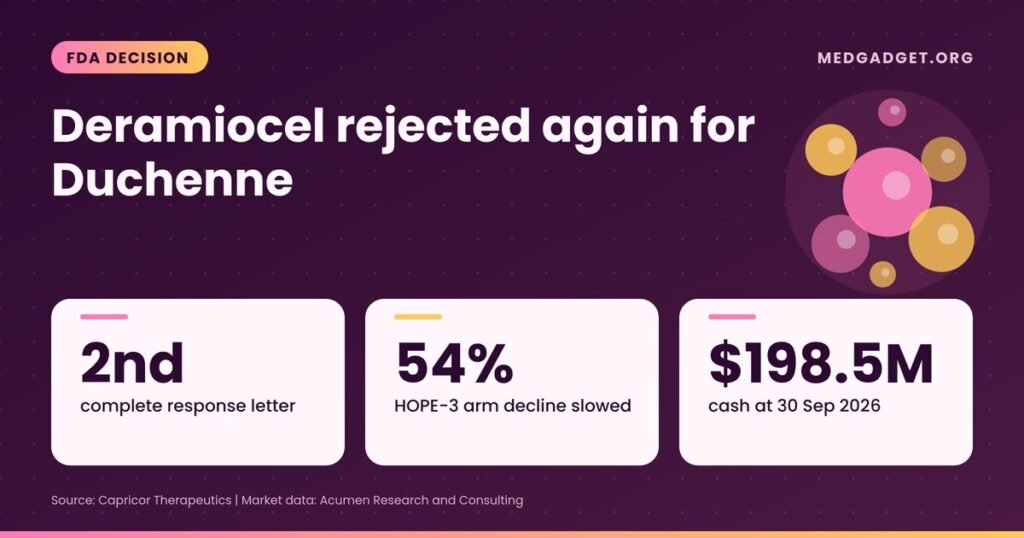

The deramiocel FDA rejection landed late on Friday, 20 November 2026, when Capricor Therapeutics said the US Food and Drug Administration had issued a complete response letter (CRL) for its resubmitted Biologics License Application. Deramiocel is an off-the-shelf cell therapy for Duchenne muscular dystrophy (DMD), and this is the second time the agency has declined it, after a first CRL in July 2025. The decision arrived two days before the 22 November target date and leaves Duchenne families without a new option they had hoped would reach the market this year.
Key takeaways on deramiocel FDA rejection
- The FDA told Capricor its data are not sufficient to establish substantial evidence of effectiveness, and it cited other clinical deficiencies that the company has not detailed.
- This is the second CRL. The first, in July 2025, raised the same effectiveness standard plus manufacturing (CMC) questions.
- The resubmission leaned on HOPE-3, a 106-patient Phase 3 trial that Capricor says met its primary arm-function endpoint (54% slowing, p=0.029).
- Capricor reported $198.5 million in cash and securities at 30 September 2026, enough for at least 12 months by its own estimate.
- The company will discuss next steps on a call on Monday, 23 November, at 8:30 a.m. ET.
What the FDA actually said
Capricor’s regulatory update is short. It says the letter found the submitted data inadequate to show substantial evidence of effectiveness, the legal bar every new biologic must clear, and that it flagged “certain other clinical deficiencies.” The release does not say whether manufacturing questions from 2025 were resolved, whether the agency wants another trial, or whether a shorter path such as accelerated approval was discussed. Capricor said it is reviewing the letter and will share a plan after that evaluation.
The FDA does not publish CRLs on the day it sends them, so for now the company’s summary is the only official account. That matters, because the two sides have read the same data very differently over the past year.
How deramiocel is meant to work
Deramiocel (formerly CAP-1002) is made from cardiosphere-derived cells, a type of stromal cell grown from donated human heart tissue. It is allogeneic, meaning one donor batch can treat many patients without matching. The cells are given by intravenous infusion every three months. Capricor’s hypothesis is that they act mainly by releasing signalling particles called exosomes that dampen inflammation and scarring in heart and skeletal muscle, rather than by replacing lost tissue.
That target is important. Most boys and young men with Duchenne now die of heart failure, and existing DMD drugs, including exon-skipping therapies and the gene therapy Elevidys, focus mainly on skeletal muscle. A treatment aimed at Duchenne cardiomyopathy would fill a real gap, which is why patient groups backed the filing.
The HOPE-3 data behind the resubmission
Capricor’s December 2025 topline release described HOPE-3 as a randomized, double-blind, placebo-controlled trial at 20 US sites. Patients received 150 million cells or placebo every three months for a year.
| HOPE-3 measure | Result reported by Capricor | Patients analysed |
|---|---|---|
| Primary: PUL v2.0 (upper-limb function) | 54% slowing of decline vs placebo, p=0.029 | 105 |
| Key secondary: LVEF on cardiac MRI | 91% slowing of decline vs placebo, p=0.041 | 83 |
| Safety | Described as favourable, consistent with earlier studies | 106 randomized |
Note that both efficacy figures are expressed as percentage slowing of decline, not as absolute point changes. A large percentage can reflect a small absolute difference when the placebo group declines only modestly over 12 months, which is common in shorter Duchenne trials. Capricor has not, in the materials we reviewed, published the absolute LVEF change in each arm alongside the headline.
Why regulators and the company disagree
Capricor says both of its randomized trials, HOPE-2 and HOPE-3, hit their primary endpoints. Critics read the record differently. STAT News, in its report on the decision, described the rejection as long expected and argued that the trials did not convincingly show the therapy protects heart function or preserves arm strength. The FDA’s own wording, as relayed by Capricor, points the same way: the issue is the weight of evidence, not safety.
In our reading, three things likely fed that view. HOPE-3 is small, so a single p-value just under 0.05 is fragile. The cardiac analysis covered only 83 of 106 patients with usable MRI scans. And the primary endpoint is arm function, while the main medical case for the drug is the heart. The FDA has also become more cautious on Duchenne after safety problems with Elevidys in 2025, and this month it set up a new CBER Safety Council to watch biologics after approval.
Timeline of a long review
- March 2025: FDA grants priority review to the original BLA for DMD cardiomyopathy.
- 11 July 2025: First CRL, citing lack of substantial evidence and outstanding CMC items.
- 3 December 2025: HOPE-3 topline results released.
- March 2026: Resubmission accepted and a new action date set.
- Summer 2026: FDA advisory committee meeting; on 13 August the review clock is extended.
- 20 November 2026: Second CRL announced.
Market context and the cell therapy field
Deramiocel is one of a few non-cancer cell therapies trying to reach the US market, and its setback will be read across the sector. According to Acumen Research and Consulting, the global cell therapy technologies market was worth about $3.11 billion in 2021 and is projected to reach roughly $9.97 billion by 2030, a 14.1% compound annual growth rate. Acumen found T-cells held the largest share, with Asia-Pacific the fastest-growing region. That report was last updated in September 2022, so treat the figures as indicative. By our calculation, the forecast implies the market roughly triples across the decade, but almost all of that value today comes from oncology products rather than therapies like deramiocel.
What happens next for patients and Capricor
Capricor has a few routes: request a meeting to clarify what evidence would satisfy the agency, pursue a formal dispute, run a further trial, or focus on other markets through its distribution partner. Each takes time. The company cut about 10% of staff earlier this month and says it is reviewing costs to extend its cash runway. Families whose children are in Capricor’s open-label extension studies should ask their trial sites how dosing continues, since the CRL does not by itself end those programmes. For a recent example of how the FDA has handled close calls this autumn, see our coverage of the ivonescimab rejection, or browse more biotech news.
FAQ
Why did the FDA reject deramiocel?
According to Capricor, the FDA said the data do not establish substantial evidence of effectiveness and noted other clinical deficiencies. The full letter has not been made public.
Is deramiocel available for Duchenne patients?
No. It is not approved in the US. It is available only to patients enrolled in Capricor’s clinical studies or their extensions.
How many times has Capricor received a CRL for deramiocel?
Two. The first came in July 2025 and the second on 20 November 2026, after a resubmission built on the HOPE-3 Phase 3 trial.
What did the HOPE-3 trial show?
Capricor reported a 54% slowing of upper-limb decline (p=0.029) and a 91% slowing of decline in heart pumping function (p=0.041) versus placebo over 12 months. The FDA did not consider this enough for approval.
Sources: Capricor Therapeutics press releases (20 November 2026, 3 December 2025, 11 July 2025); STAT News. Market data: Acumen Research and Consulting, Cell Therapy Technologies Market report. This article is for information only and is not medical or investment advice. Last updated 21 November 2026.