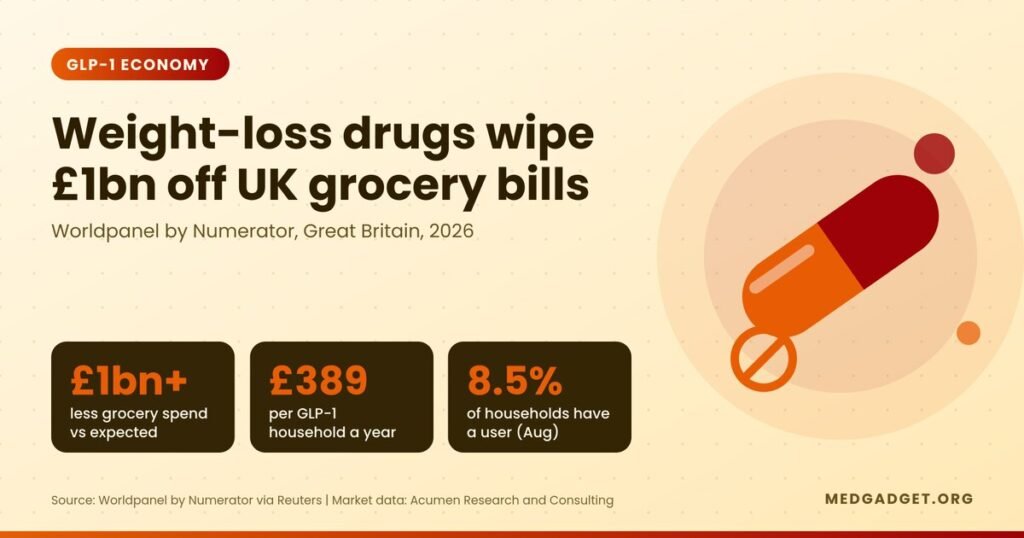

Worldpanel by Numerator’s latest tracker of weight-loss drugs grocery spending in Great Britain, reported on 19 November 2026, finds that households with a GLP-1 user spent more than £1 billion less on groceries than expected in the year after starting treatment. That works out to £389 per household per year and 415 million fewer items in shopping baskets. At the same time, the share of British households with someone on a GLP-1 medicine such as Mounjaro or Wegovy rose from 6.3% in February to 8.5% in August 2026.
Key takeaways on weight-loss drugs grocery spending
- GLP-1 households spent over £1 billion less on groceries than predicted in their first year of treatment, about £389 each.
- Roughly 2.6 million adults in Great Britain were using a weight-loss medicine in August 2026, about 700,000 more than in February.
- Men now make up 32% of users, up from 23% six months earlier.
- Oral GLP-1 tablets already account for 11.2% of users.
- Alcohol and crisps took the biggest hit, while frozen ready meal volumes rose 30% among users.
- Worldpanel expects more than 10% of British households to include a user during 2027.
The numbers at a glance
Worldpanel measures what panel households actually buy and compares those that start a GLP-1 with similar households that do not. The latest figures draw on a survey sample of 9,629 households.
| Measure | February 2026 | August 2026 |
|---|---|---|
| Households with a GLP-1 user | 6.3% | 8.5% |
| Adults taking a weight-loss medicine | about 1.9 million (by our calculation) | about 2.6 million |
| Male users | 440,000 (23%) | 830,000 (32%) |
| Share of users on tablets | not reported | 11.2% |
| Grocery shortfall vs expected, first year | over £1 billion in total, £389 per household | |
By our calculation, £389 a year is about £32 a month, or roughly £7.50 a week, per household. For a single family that is modest. Spread across more than two million homes, it becomes a structural shift for food retailers and brands.
Who is taking GLP-1s in Britain now
The speed of uptake is the headline inside the headline. Worldpanel’s senior consultant Nishita Pattni told trade title The Grocer that the rise between February and August came close to the increase seen over the whole of the previous year. Most UK users pay privately through online pharmacies, since NHS access to tirzepatide (Mounjaro) is being rolled out in phases and restricted to people with the highest clinical need.
Two shifts stand out. First, men are catching up: the number of male users nearly doubled in six months to 830,000. Second, tablets are arriving fast. In August 2026 the UK medicines regulator, the MHRA, authorised Lilly’s oral GLP-1 orforglipron for weight management and type 2 diabetes, making Britain the first European country to approve it. Within weeks, pills already accounted for more than one in ten users, which suggests needle-free options are pulling in people who would not have started an injection.
What GLP-1 households buy less of, and more of
GLP-1 receptor agonists slow stomach emptying and act on appetite centres in the brain, so users tend to feel full sooner and report fewer food cravings. The basket data reflect that:
- Alcohol and crisps: spending fell 15% more in user households than in comparable non-user homes.
- Frozen ready meals: volumes rose 30% among users, consistent with smaller, portion-controlled meals.
- Overall items: 415 million fewer grocery items were bought than expected.
Drinks retailers are already flagging the possibility of a quieter Christmas for beer, wine and spirits. Food makers face a different question: whether to reformulate toward smaller packs and higher protein, which some US brands have started to do.
Why this matters beyond the supermarket
Shopping data are one of the few large-scale, real-world signals of how people on these medicines change daily habits. They point in the same direction as clinical expectations: lower intake of energy-dense snacks and alcohol. That is relevant for health systems weighing whether GLP-1s pay for themselves. In the US, an Aetna claims analysis found that GLP-1 treatment broke even below about $350 a month once fewer hospital visits were counted, a debate we covered in our report on the CVS GLP-1 break-even study.
Pricing is also moving. Manufacturers are cutting cash prices and adding direct-to-consumer channels, as seen with Novo Nordisk’s relaunched Novocare Wegovy membership. Cheaper access and tablets could push UK household penetration past Worldpanel’s 10% forecast.
Market context
According to Acumen Research and Consulting, the global anti-obesity drugs market was worth USD 2.1 billion in 2022 and is projected to reach USD 8.2 billion by 2032, a compound annual growth rate of 14.6%. Acumen identifies prescription products as the largest segment and Asia-Pacific as the fastest-growing region. That forecast was last updated in September 2023, before the most recent wave of price cuts and oral launches, so treat it as a baseline rather than a ceiling.
What the data cannot tell us
- Panel data record purchases, not consumption or health outcomes. They do not show whether users ate better, only what they bought.
- The “£1 billion” is a modelled gap against what households would have been expected to spend, not a measured fall in total UK grocery sales.
- Effects in the first year may fade if people stop treatment, which many do within 12 months, and regain appetite.
- Worldpanel does not break the data down by drug, dose or whether the user obtained it through the NHS or privately.
Frequently asked questions
How much less do people on weight-loss jabs spend on food?
In Great Britain, households with a GLP-1 user spent about £389 less on groceries in the first year than comparable households were expected to, according to Worldpanel by Numerator.
How many people in the UK are on Mounjaro or Wegovy?
Worldpanel estimates about 2.6 million adults in Great Britain were using a GLP-1 weight-loss medicine in August 2026, living in 8.5% of households. It does not split the total by brand.
Which foods do GLP-1 users buy less of?
Alcohol and crisps showed the sharpest relative declines, falling 15% more than in non-user households. Frozen ready meals were an exception, with volumes up 30%.
Are weight-loss pills available in the UK?
Yes. The MHRA authorised orforglipron in August 2026, and tablets made up 11.2% of GLP-1 users by that month. Any weight-loss medicine should be prescribed after a clinical assessment.
Sources: Worldpanel by Numerator GB GLP-1 tracker as reported by Reuters and EconoTimes (19 November 2026). Market data: Acumen Research and Consulting. More in Pharmaceutical. Not medical or investment advice. Last updated 19 November 2026.