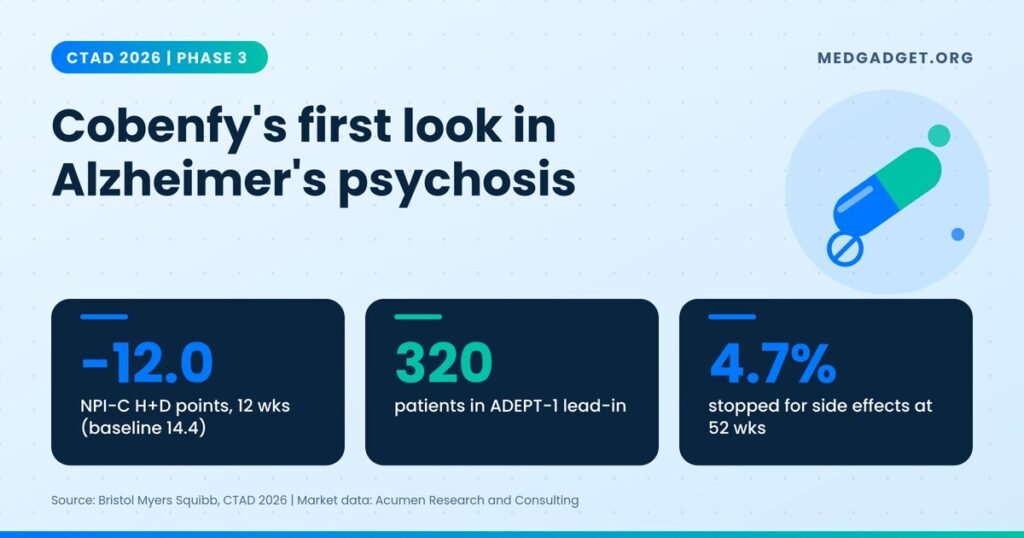

Cobenfy Alzheimer’s psychosis data arrived for the first time on 18 November 2026, when Bristol Myers Squibb presented open-label Phase 3 results at the Clinical Trials on Alzheimer’s Disease (CTAD) conference in Boston. In the 12-week lead-in of ADEPT-1, 320 people with Alzheimer’s-related hallucinations and delusions saw their symptom score fall by an average of 12.0 points from a baseline of 14.4, and a 52-week extension (ADEPT-3, 401 participants) reported no new safety signals. The catch: none of these numbers come from a placebo comparison yet.
Key takeaways on Cobenfy Alzheimer’s psychosis
- Cobenfy (xanomeline and trospium, also called KarXT) is already FDA-approved for schizophrenia in adults; its use in Alzheimer’s psychosis is still investigational.
- ADEPT-1 open-label period: NPI-C hallucinations and delusions score fell 12.0 points (baseline 14.4); CGI-Severity fell 1.9 points (baseline 4.5).
- ADEPT-3 52-week extension: adverse events in 65.1% of participants, serious adverse events in 7.7%, and 4.7% stopped because of side effects.
- All results are descriptive and unblinded. The placebo-controlled answers will come from the randomized phase of ADEPT-1 and from ADEPT-2 and ADEPT-4.
- BMS estimates that 30% to 50% of people with Alzheimer’s experience hallucinations or delusions at some point.
What Bristol Myers Squibb showed at CTAD
The ADEPT program is BMS’s attempt to turn its schizophrenia launch into a much larger neuropsychiatry franchise. Two datasets were shared. The first is the open-label run-in of ADEPT-1, a global relapse-prevention study in which everyone takes the drug for 12 weeks and responders are then randomized to stay on it or switch to placebo for 26 weeks. The primary endpoint, time to relapse, sits in that randomized phase and remains blinded. The second dataset is ADEPT-3, a 52-week open-label extension that enrolls people who finished ADEPT-1, ADEPT-2 or ADEPT-4 and is designed mainly to track long-term safety.
Reuters described the data as preliminary, and that word matters. BMS has already pushed back the efficacy readout from ADEPT-2 after it found irregularities at some trial sites and enrolled additional patients, a delay that has hung over the stock and the wider muscarinic class.
The numbers side by side
| Measure | ADEPT-1 (12-week open-label) | ADEPT-3 (52-week extension) |
|---|---|---|
| Participants analysed | 320 | 401 |
| Completed the period | 273 (85.3%) | 273 (68.1%) |
| NPI-C H+D baseline / mean change | 14.4 / -12.0 | 8.9 / -5.1 |
| CGI-S baseline / mean change | 4.5 / -1.9 | 3.4 / -0.8 |
| Any treatment-emergent adverse event | 56.6% | 65.1% |
| Serious adverse events | 5.0% | 7.7% |
| Stopped due to adverse events | 4.4% | 4.7% |
By our calculation, the ADEPT-1 change equals roughly an 83% reduction from baseline in the hallucinations and delusions score, and the ADEPT-3 change roughly 57%. Those percentages look striking, but in psychosis trials open-label improvement routinely overstates drug effect because of expectation, regression to the mean and the extra attention patients and carers receive.
Why a muscarinic drug is interesting in dementia
Most antipsychotics block dopamine D2 receptors, and in older people with dementia that class carries well-known risks, including sedation, falls, movement problems and a higher risk of death. Cobenfy works differently. Xanomeline stimulates M1 and M4 muscarinic receptors in the brain, which indirectly dampens overactive dopamine signalling, while trospium blocks muscarinic receptors outside the brain to blunt side effects such as nausea and sweating. M1 activation is also linked to memory pathways, which is why xanomeline was originally studied in Alzheimer’s disease in the 1990s before gut side effects stalled it.
Treatment options for this group are thin. As far as we can determine, no medicine is FDA-approved specifically for hallucinations and delusions in Alzheimer’s disease; doctors rely on off-label antipsychotics or non-drug approaches. A tolerable, non-dopamine-blocking option would fill a real gap for families who manage these symptoms at home or in care facilities. Readers following the class can see our coverage of Neurosterix’s M4 drug NTX-253 and BMS’s broader pipeline in our Q3 2026 results analysis.
Safety: what to read into the extension data
The headline safety number, 65.1% of ADEPT-3 participants reporting an adverse event over a year, is not unusual for an elderly, multi-morbid population followed for 52 weeks. More reassuring is the low discontinuation rate for side effects (4.7%). Two caveats apply. First, about a third of ADEPT-3 participants did not complete 52 weeks, and those still on treatment at the data cut were excluded from the analysis, so the population is filtered. Second, BMS did not break out specific events such as falls, cognitive change, urinary retention or heart-rate increases in the summary, which are the issues geriatricians will ask about first given the drug’s anticholinergic component.
Market context
Alzheimer’s care is a growing commercial target beyond amyloid drugs. Acumen Research and Consulting projected the global Alzheimer’s disease treatment market to reach around US$5.6 billion by 2027, growing at about 12.8% a year from 2020. That forecast predates the newest launches and should be treated as indicative, but it shows why a symptomatic psychosis indication matters to BMS: it would address a large share of patients regardless of which disease-modifying drug they take.
What happens next
- Randomized withdrawal results from ADEPT-1: whether patients switched to placebo relapse sooner is the first true efficacy test.
- ADEPT-2 and ADEPT-4: placebo-controlled acute studies; BMS has not given a new public readout date in the CTAD materials.
- ADEPT-5: a study of twice-daily dosing, which could matter for adherence in people with cognitive impairment.
- Regulatory path: no Alzheimer’s filing plan was announced; any submission would follow positive controlled data.
FAQ
Is Cobenfy approved for Alzheimer’s disease?
No. Cobenfy is FDA-approved only for schizophrenia in adults. Its use for psychosis linked to Alzheimer’s is being tested in the Phase 3 ADEPT program and is not approved anywhere.
Did Cobenfy beat placebo in Alzheimer’s psychosis?
That has not been shown yet. The November 2026 results come from open-label periods without a placebo group. Placebo-controlled data from ADEPT-1, ADEPT-2 and ADEPT-4 are still blinded.
How common is psychosis in Alzheimer’s?
Bristol Myers Squibb estimates that 30% to 50% of people with Alzheimer’s disease experience hallucinations or delusions during the course of the illness, often adding to carer burden and earlier moves into residential care.
What are the main side effects seen so far?
In the 52-week extension, 65.1% reported some adverse event, 7.7% had a serious event and 4.7% stopped treatment because of side effects. Detailed event-by-event data have not been released.
Sources: Bristol Myers Squibb CTAD 2026 presentation (18 November 2026) as reported by Reuters; trial registry ADEPT-2 (NCT06126224). Market data: Acumen Research and Consulting. More in our Pharmaceutical section. This article is for information only and is not medical or investment advice. Last updated 19 November 2026.