
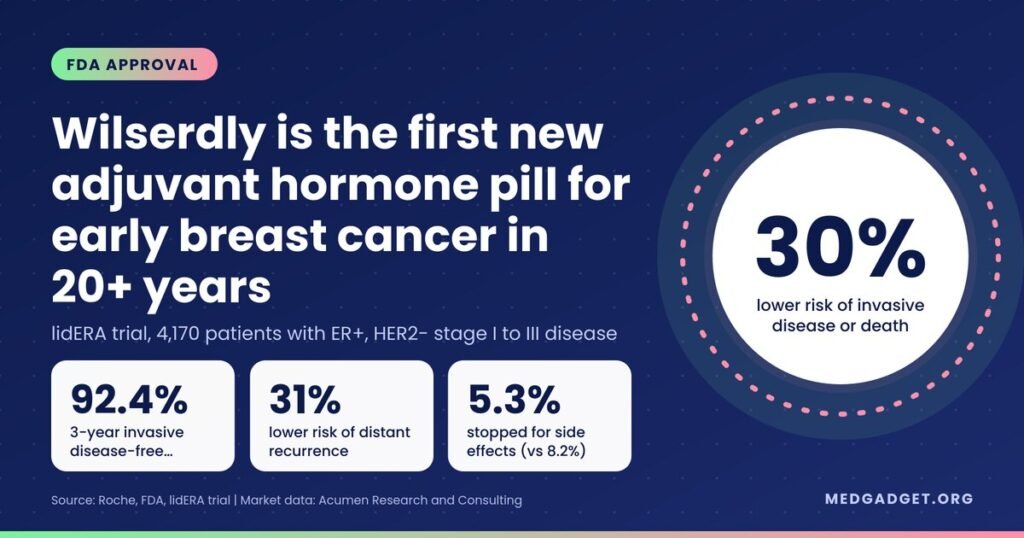

Wilserdly early breast cancer treatment is now a reality in the US: on 23 November 2026 the FDA approved Roche’s once-daily pill Wilserdly (giredestrant) as adjuvant endocrine therapy for adults with ER-positive, HER2-negative stage I to III breast cancer at intermediate or high risk of recurrence after surgery. In the 4,170-patient lidERA trial it cut the risk of invasive disease recurrence or death by 30% versus standard hormone therapy, and the FDA describes it as the first new endocrine therapy for early-stage breast cancer in more than 20 years.
Key takeaways on Wilserdly early breast cancer approval
- Approved 23 November 2026 for post-surgery (adjuvant) use in ER+, HER2- stage I to III breast cancer at intermediate-to-high recurrence risk.
- lidERA: hazard ratio 0.70 for invasive disease-free survival versus tamoxifen or an aromatase inhibitor (p=0.0014).
- At three years, 92.4% of patients on giredestrant were free of invasive disease versus 89.6% on standard therapy.
- Fewer patients stopped treatment (5.3% vs 8.2%), a meaningful point for a drug taken for years.
- Overall survival data are still immature; longer follow-up is a postmarketing commitment.
- This is Wilserdly’s second US approval in a week, following its advanced-disease clearance on 16 November.
Why a new adjuvant hormone pill matters
Most breast cancers are fuelled by oestrogen. Roche estimates that around 70% of the 2.3 million breast cancers diagnosed worldwide each year are ER-positive, and more than 90% of those are caught at stage I to III, when surgery aims to cure. After the operation, patients usually take tamoxifen or an aromatase inhibitor for five years or longer to keep the cancer from coming back.
Those drugs work, but not perfectly. Up to a third of patients with ER-positive disease eventually relapse during or after adjuvant hormone therapy, and many stop or interrupt treatment because of side effects such as joint pain and hot flushes. Both problems have been stuck for two decades. Giredestrant is an oral selective oestrogen receptor degrader (SERD): rather than lowering oestrogen or blocking the receptor, it binds the receptor and marks it for destruction, aiming for a deeper shutdown of the signal.
What lidERA showed: the numbers
lidERA was an open-label Phase 3 study comparing giredestrant with the physician’s choice of standard endocrine therapy. Stage III disease made up 40% of the population, stage II 47% and stage I 13%, so this was a genuinely higher-risk group. Results below come from the prespecified interim analysis at a median follow-up of 32.3 months.
| Measure | Giredestrant | Standard endocrine therapy |
|---|---|---|
| Patients randomised | 2,084 | 2,086 |
| Invasive disease or death events | 140 | 196 |
| 3-year invasive disease-free survival | 92.4% | 89.6% |
| iDFS hazard ratio (95% CI) | 0.70 (0.57 to 0.87) | |
| Distant recurrence-free interval HR | 0.69 (0.54 to 0.89) | |
| Overall survival HR (immature) | 0.79 (0.56 to 1.12) | |
| Stopped treatment for side effects | 5.3% | 8.2% |
Put in absolute terms, the 2.8-point gap at three years means roughly 28 fewer patients per 1,000 have a recurrence or die in that window. By our calculation, that is a number needed to treat of about 36 over three years. The 31% reduction in distant recurrence is arguably the more important signal, because metastatic spread is what makes breast cancer lethal. The survival curve is trending the right way, but the confidence interval still crosses 1, so a survival benefit is not yet proven.
Side effects and who should take it
Tolerability looked similar to standard therapy on the complaints patients notice most: joint pain affected 48.0% on giredestrant versus 47.1% on comparator, and hot flushes 27.4% versus 28.8%. The label lists musculoskeletal pain, fatigue, headache, nausea, slow heart rate (bradycardia), dizziness and peripheral neuropathy among its toxicities, along with laboratory abnormalities. The drug can harm a developing fetus, and premenopausal women and men are expected to receive ovarian or hormonal suppression alongside it, as with aromatase inhibitors.
The indication is limited to intermediate-to-high-risk disease, so people with small, low-risk tumours are not the target population. Anyone already on tamoxifen or an aromatase inhibitor should discuss any switch with their oncologist; the trial tested giredestrant from the start of adjuvant therapy, not as a mid-course change.
How this fits Roche’s broader SERD strategy
Just a week earlier, the FDA approved Wilserdly with everolimus for ESR1-mutated advanced breast cancer, which we covered in our report on the first Wilserdly approval. Giredestrant is now the first SERD cleared in both early and advanced settings. That matters commercially: earlier oral SERDs reached the market only for advanced disease, where treatment courses are shorter. Adjuvant use stretches over years and reaches far more patients. The early-stage decision also arrived about a week ahead of the 30 November target date set under priority review.
Market context
Hormonal therapy is one of the core segments of a fast-growing oncology drug market. According to Acumen Research and Consulting, the global cancer therapeutics market was worth USD 193.7 billion in 2024 and is projected to reach USD 381.5 billion by 2033, a compound annual growth rate of 7.9%. Acumen notes that targeted therapy holds the largest share and North America leads by region. The report page carries an older original publication date, so treat these figures as indicative.
What to watch next
- Overall survival: mature lidERA survival data will decide whether giredestrant becomes the default adjuvant choice.
- Europe and other markets: regulatory reviews outside the US are the next milestone.
- Guidelines: how quickly treatment guidelines place giredestrant alongside or ahead of aromatase inhibitors.
- Price and coverage: a multi-year pill will face payer scrutiny against cheap generic hormone therapies.
Frequently asked questions
What is Wilserdly approved for in early breast cancer?
It is approved as adjuvant endocrine therapy after surgery for adults with ER-positive, HER2-negative stage I to III breast cancer who are at intermediate or high risk of recurrence.
How well does giredestrant work compared with tamoxifen or aromatase inhibitors?
In lidERA it lowered the risk of invasive disease recurrence or death by 30% (HR 0.70). Three-year invasive disease-free survival was 92.4% versus 89.6%.
Is Wilserdly the same drug approved for advanced breast cancer?
Yes. The same drug was approved on 16 November 2026 with everolimus for ESR1-mutated advanced disease. The 23 November approval adds a separate early-stage, post-surgery indication.
Does Wilserdly help people live longer?
Not yet shown. Overall survival data are immature (HR 0.79, not statistically significant), and the FDA requires longer follow-up.
More coverage: Roche Q3 2026 results and our pharmaceutical news section.
Sources: Roche press release, 23 Nov 2026; FDA approval announcement; lidERA results presented at SABCS 2025 (NCT04961996). Market data: Acumen Research and Consulting. This article is for information only and is not medical or investment advice. Last updated 24 November 2026.