
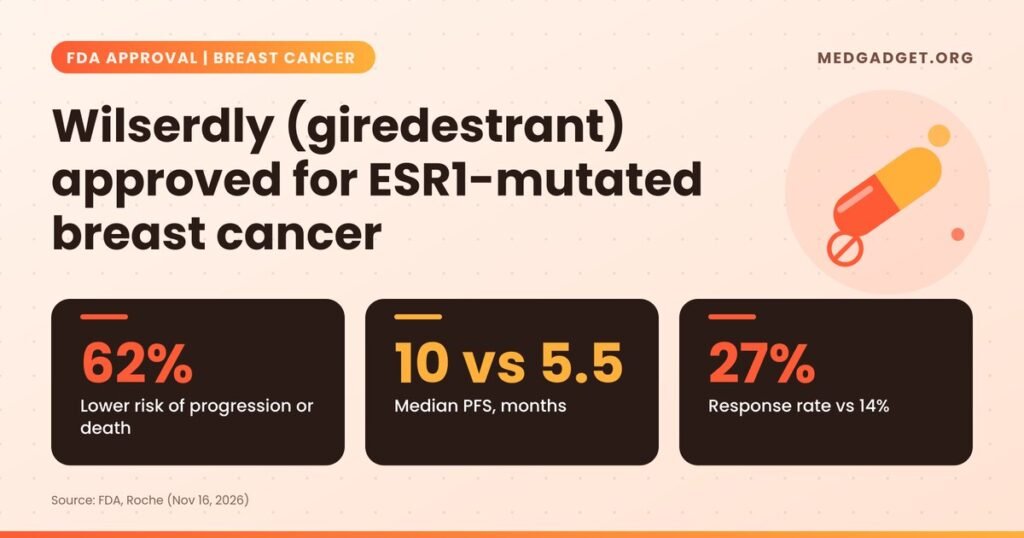

The Wilserdly FDA approval arrived on November 16, 2026, when the US Food and Drug Administration cleared Genentech’s oral drug giredestrant (brand name Wilserdly), taken with the existing pill everolimus, for adults with ER-positive, HER2-negative advanced or metastatic breast cancer that carries an ESR1 mutation. In the phase 3 evERA trial, the combination cut the risk of cancer progression or death by 62% versus a standard hormone-therapy combination in the ESR1-mutated group, and the agency acted four weeks ahead of its goal date.
Key takeaways on the Wilserdly FDA approval
- Wilserdly (giredestrant, 30 mg once daily) is approved with everolimus for ESR1-mutated, ER-positive, HER2-negative advanced breast cancer after prior hormone-based therapy.
- Median progression-free survival was 10 months versus 5.5 months in the ESR1-mutated population (hazard ratio 0.38).
- An ESR1 mutation must be confirmed with an FDA-authorized test; FoundationOne Liquid CDx, a blood test, was authorized as the companion diagnostic.
- Overall survival data are not yet mature, and the label warns about slow heart rate (bradycardia) and harm to a developing fetus.
- A second FDA decision, on giredestrant after surgery for early breast cancer, is due by November 30, 2026.
Who the new label covers
The approval is narrow by design. Patients must have hormone receptor-positive (ER-positive), HER2-negative disease that is locally advanced or has spread, and their tumor must carry a mutation in ESR1, the gene that encodes the estrogen receptor. They also need a history of endocrine treatment failure: either the cancer came back during or after hormone therapy given after surgery, or it grew on at least one hormone-based regimen in the metastatic setting.
Why does ESR1 matter? Years of estrogen-blocking treatment, especially aromatase inhibitors, push some tumors to develop ESR1 mutations that keep the receptor switched on even without estrogen. Roche says up to 40% of people with HR-positive metastatic breast cancer develop these mutations, which is why liquid biopsy testing at progression has become routine in many cancer centers. Giredestrant is a selective estrogen receptor degrader (SERD): it blocks the receptor and marks it for destruction, and it is designed to work against the mutated form.
What the evERA trial showed
evERA Breast Cancer (NCT05306340) was a randomized, open-label phase 3 study of 373 adults whose disease had progressed after a CDK4/6 inhibitor and hormone therapy, the most common first-line approach today. Of those, 207 had ESR1-mutated tumors. Everyone received everolimus 10 mg daily, an mTOR inhibitor used for years in this setting. The difference was the hormone backbone: giredestrant 30 mg daily, or the doctor’s choice of exemestane, fulvestrant or tamoxifen.
| Outcome (ESR1-mutated group) | Giredestrant + everolimus | Standard endocrine therapy + everolimus |
|---|---|---|
| Median progression-free survival | 10.0 months | 5.5 months |
| Hazard ratio for progression or death | 0.38 (95% CI 0.27 to 0.54; p<0.0001) | |
| Objective response rate | 27% | 14% |
| Overall survival | Immature at the time of analysis | |
By our calculation, the 4.5-month gain in median progression-free survival means the giredestrant arm stayed free of progression about 80% longer at the midpoint, and tumor shrinkage was seen in nearly twice as many patients. Those are meaningful numbers in a heavily pretreated group, where options after a CDK4/6 inhibitor tend to buy only a few months each.
Side effects and warnings patients should know
Much of the side-effect burden comes from everolimus, which is known for mouth sores and lung inflammation. The FDA listed stomatitis, rash, fatigue, diarrhea, musculoskeletal pain, pneumonitis and nausea as the most common adverse reactions, each seen in at least 20% of patients. Common laboratory changes included lower blood counts, electrolyte shifts and raised liver enzymes and creatinine.
Two warnings appear on the label for giredestrant itself: bradycardia, a slowing of the heart rate, and embryo-fetal toxicity. Patients who are pregnant or could become pregnant will need counseling on contraception. Anyone considering the regimen should discuss these risks, and their own heart history, with their oncologist; this article does not offer dosing or treatment advice.
How Wilserdly fits among oral SERDs
Wilserdly is not the first pill in this class. Elacestrant (Orserdu) was approved in 2023 and Lilly’s imlunestrant (Inluriyo) in 2025, both for ESR1-mutated advanced breast cancer, and AstraZeneca is developing camizestrant. What sets the new label apart is the partner drug. Roche describes Wilserdly as the first next-generation all-oral SERD combination to beat a standard endocrine combination head to head after CDK4/6 treatment, a company characterization rather than an FDA finding. For patients, the practical upshot is a two-pill regimen with no monthly fulvestrant injections.
Roche’s Levi Garraway called it “a targeted, all-oral regimen that significantly delays disease progression.” The review ran through Project Orbis with Health Canada and Israel’s health ministry, so decisions in those countries may follow. Pricing and launch timing were not disclosed in the approval materials. For context on how the FDA weighs survival evidence in oncology this month, see our analysis of the ivonescimab FDA rejection, and our look at Roche’s Q3 2026 results for why new launches matter to the company.
Market context
Targeted drugs like giredestrant sit in the largest and fastest-growing part of oncology spending. According to Acumen Research and Consulting, the global cancer therapeutics market was worth USD 193.7 billion in 2024 and is projected to reach USD 381.5 billion by 2033, a compound annual growth rate of 7.9% from 2025 to 2033. Acumen identifies targeted therapy as the leading treatment segment and North America as the dominant region. The report page carries an older original publication stamp, so treat these figures as indicative.
What to watch next
- November 30, 2026: FDA decision on giredestrant as adjuvant therapy for stage I to III ER-positive, HER2-negative breast cancer, based on the lidERA trial and reviewed under Priority Review.
- Overall survival: mature evERA survival data will show whether the progression benefit translates into longer life.
- Other filings: Roche says submissions outside the US are underway; pionERA and heredERA readouts are still pending.
Frequently asked questions
What is Wilserdly used for?
Wilserdly (giredestrant) is approved with everolimus for adults with ER-positive, HER2-negative, ESR1-mutated advanced or metastatic breast cancer that progressed on or after hormone-based therapy.
How do I know if I have an ESR1 mutation?
An FDA-authorized test is required. FoundationOne Liquid CDx, which analyzes tumor DNA in a blood sample, was authorized alongside the drug. Ask your oncologist whether testing at progression is appropriate.
Is giredestrant a pill or an injection?
It is an oral tablet taken once daily, with or without food, alongside everolimus tablets, so the regimen is entirely oral.
Does Wilserdly help people live longer?
Not yet known. evERA showed longer progression-free survival, but overall survival data were immature when the FDA reviewed the application.
Sources: FDA approval notice; Roche press release. Market data: Acumen Research and Consulting. More in our Pharmaceutical section. This article is for information only and is not medical or investment advice. Last updated November 17, 2026.