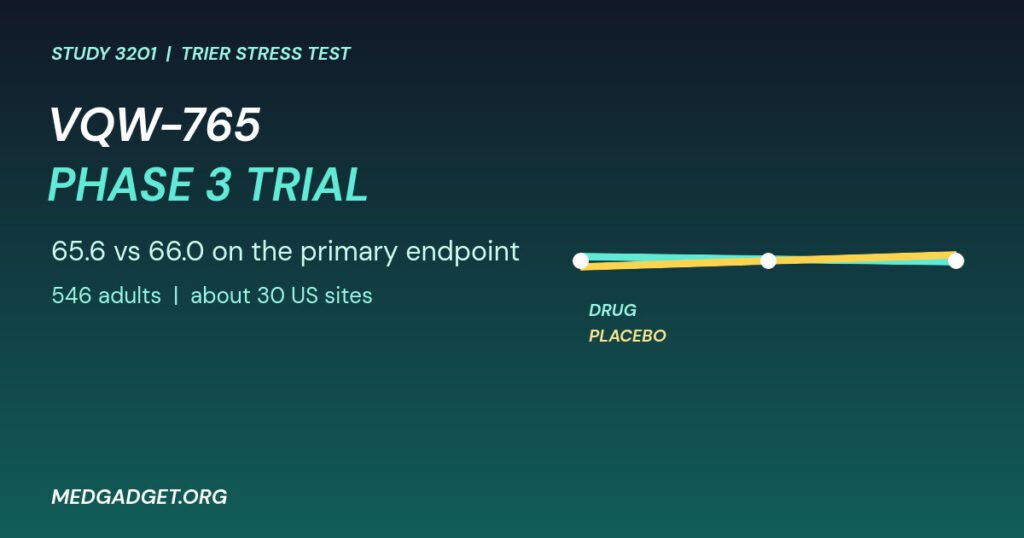

The VQW-765 Phase 3 trial tested whether a single pill taken before a stressful event could blunt anxiety in people with social anxiety disorder, and on the primary measure it found no difference from placebo. In its release of 14 October 2026, Vanda Pharmaceuticals reported that the 546-participant study missed its primary endpoint, with scores of 65.6 for VQW-765 and 66.0 for placebo on a 0 to 100 distress scale, and that a key secondary endpoint in the full population was also missed. The company has put the programme on hold. This report reads the trial design and the numbers closely.
The aim is to show how the study was built, where the primary and secondary results sit, and why the gap between Phase 2 and Phase 3 matters.
VQW-765 Phase 3 trial: key takeaways
- Design: randomised, double-blind, placebo-controlled, single oral dose, one to one.
- Primary endpoint: distress during the performance phase of a stress test, in female participants. Result: 65.6 versus 66.0, p = 0.8899.
- Key secondary endpoint: all participants. Result: 64.7 versus 63.8, p = 0.6605.
- Safety: described by the company as safe and well tolerated.
- Status: development on hold pending review of the full dataset.
How the VQW-765 Phase 3 trial was built
Study 3201 (NCT07221578) enrolled 546 adults aged 18 to 65 at about 30 US sites. Participants had elevated baseline scores on the Liebowitz Social Anxiety Scale and the Public Speaking Anxiety Scale. Each received a single oral dose of VQW-765 or placebo, randomised one to one, and then took the Trier Social Stress Test: an anticipation phase followed by an interview-style presentation to a panel that does not respond. Distress was rated on the Subjective Units of Distress Scale from 0 to 100. The design tests on-demand treatment of acute anxiety, not daily maintenance treatment.
Primary and secondary results of the VQW-765 Phase 3 trial
The primary analysis covered females in the performance phase. VQW-765 averaged 65.6 (standard error 1.90) and placebo 66.0 (1.96), a least-squares mean difference of minus 0.4 (95 percent confidence interval minus 5.32 to 4.62; p = 0.8899). The key secondary analysis covered males and females together: 64.7 (1.50) against 63.8 (1.51), a difference of 0.9 (confidence interval minus 3.00 to 4.73; p = 0.6605). By our arithmetic, the primary difference equals about 0.6 percent of the placebo score. The intervals are wide enough to include differences of several points either way, but the central estimates are essentially zero.
How to read the confidence intervals in the VQW-765 Phase 3 trial
A confidence interval shows the range of true differences that the data are reasonably consistent with. For the primary endpoint, the interval runs from about minus 5.3 to plus 4.6 points on a 100-point scale, which includes zero and is fairly narrow relative to the scale. That means the trial can rule out a large benefit with reasonable confidence but cannot exclude a small one. The p-value of 0.8899 says the observed difference is entirely compatible with chance. None of this is a judgement on the drug’s chemistry; it is a description of what this particular experiment could and could not detect.
Why the primary endpoint was set in females
The release states the primary endpoint in female participants and the key secondary in the full population, but it does not explain the reason. We do not speculate on it. What a reader can say is that the pre-specified order meant the trial was judged first on one group, and that the full population then failed as well, so there is no sign of a benefit hidden by the choice of group.
Phase 2 versus the VQW-765 Phase 3 trial
The company says its Phase 2 study in people with performance anxiety showed numerically lower stress with VQW-765 than with placebo during the same type of test. That earlier work is described in a published Phase II trial in the British Journal of Psychiatry. A numerical difference is not the same as a statistically significant one, and Phase 3 was designed to confirm it. Mihael Polymeropoulos, president, chief executive and chairman, said the company was “disappointed that Study 3201 did not confirm the earlier Phase II findings,” and thanked participants, investigators and site staff.
What a numerical difference means
Early-phase trials are usually smaller and look for signals. A numerical difference in a small study can arise by chance, and the usual purpose of Phase 3 is to test whether it persists in a larger, more rigorous setting. Here the larger study showed no such difference. This is why regulators and investors alike treat Phase 2 results as hypotheses, and why Phase 3 outcomes carry more weight.
What is not yet public from the VQW-765 Phase 3 trial
- Arm sizes, since the release does not state them; by our arithmetic an even split gives about 273 per arm.
- Detailed safety tables.
- Results by subgroup, site or baseline severity.
- An explanation for the difference from Phase 2.
Risks and caveats for the VQW-765 Phase 3 trial
- All figures are from the company’s release; no peer-reviewed Phase 3 paper exists yet.
- Confidence intervals as printed in the release should be checked against the full report when it appears.
- A single trial design does not settle every possible use of a drug, but the company has paused the programme.
- The result does not say that existing social anxiety treatments are ineffective.
In our assessment, the VQW-765 Phase 3 trial is a clear negative: on both the primary and key secondary measures the groups were nearly indistinguishable, which leaves little room to argue for a near miss. See also West Nile Virus Cases Hit Record Levels in Europe in 2026 as Deaths Reach 130. More is in our pharmaceutical coverage.
What to watch next for the VQW-765 Phase 3 trial
- The full Study 3201 data, whether in a presentation or a paper.
- Any decision on the programme’s future.
- Updates to the trial registry entry.
- Whether other alpha-7 receptor drugs report results.
Frequently asked questions
What did the VQW-765 Phase 3 trial measure?
Distress on a 0 to 100 scale during a public-speaking stress test after a single dose.
How many people took part?
546 adults at about 30 US sites.
What were the results?
65.6 for VQW-765 and 66.0 for placebo on the primary endpoint in females.
Is the drug safe?
The company says it was safe and well tolerated, consistent with earlier studies.
How we reported this: we relied on Vanda’s release of 14 October 2026 and the trial registry. The 0.6 percent and 273 figures are our own arithmetic. Last updated: 16 October 2026. This article is news reporting and not medical advice.