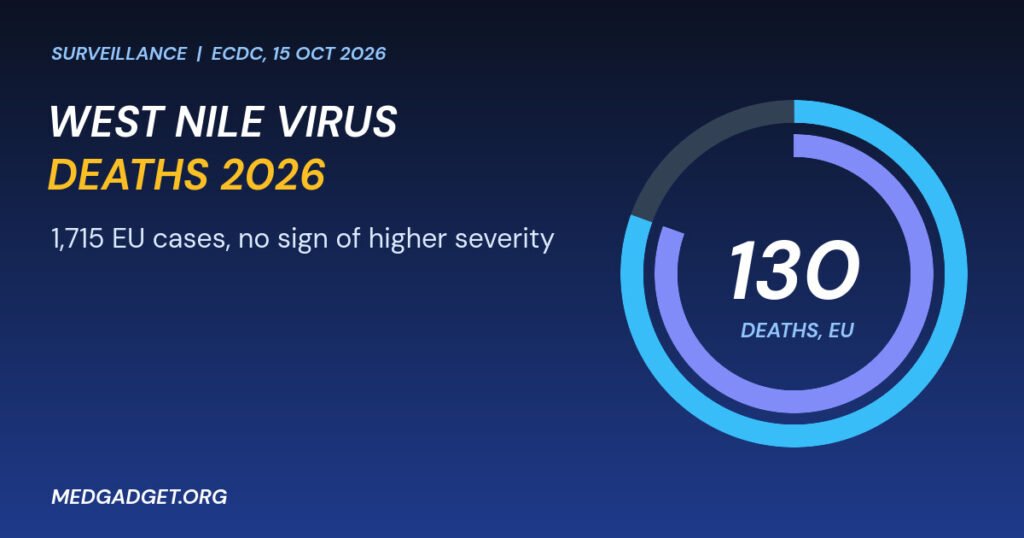

West Nile virus deaths 2026 have reached 130 in the European Union so far this season, according to the European Centre for Disease Prevention and Control (ECDC), which on 15 October reported a record 1,715 locally acquired human cases in EU countries as of 7 October. Behind the headline total sit a few numbers that matter more for readers: where the deaths have occurred, who is most at risk, and why the agency says there is no sign that the illness itself has become more severe. These are reported surveillance totals, not a prediction.
This report concentrates on mortality and severity: what the agency says, what earlier season data add, and what the figures cannot tell us.
West Nile virus deaths 2026: key takeaways
- Deaths: 130 reported in EU countries so far this season, per ECDC (data as of 7 October).
- Cases: 1,715 locally acquired human cases, the highest ever reported for the EU.
- Severity: ECDC says there is no sign of increased severity; shares hospitalised, with neurological symptoms or dying are below the previous decade’s levels.
- Risk: older adults and people with weakened immune systems face higher risk.
- Outlook: transmission may continue at a lower level, and more cases are expected.
What ECDC reports on West Nile virus deaths 2026
The October release says 130 deaths had been reported so far this season. It does not break the deaths down by country, so we do not attribute them to individual countries from that document. What it does say is that Italy reported the most cases at 748, that Greece and France each recorded their highest-ever human case numbers, that the Netherlands reported 59 cases, and that Belgium reported 15, its first locally acquired human infections.
By our arithmetic, 130 deaths among 1,715 cases is a crude ratio of about 7.6 percent. That is not a true case fatality rate: deaths and cases are counted at different times, many infections go undiagnosed, and the figure mixes countries with different testing practices. We show it only to explain why the more careful percentages from the surveillance agencies should be preferred.
West Nile virus deaths 2026 by country earlier in the season
The EFSA–ECDC monthly report, with data submitted up to 3 September 2026, gives a country breakdown for a wider Europe that includes candidate countries. It counted 61 deaths at that point: Italy 25, Greece 24, North Macedonia 7, Romania 2, Spain 2 and the Netherlands 1. Italy had 516 cases and Greece 284 in that report. These figures are older and cover a wider set of countries than the October release, so they cannot be added to or compared directly with the 130 deaths, but they show that the deaths were concentrated in the two countries with the most cases.
Why severity looks lower even as cases rise in West Nile virus deaths 2026
The October release states that the shares of cases hospitalised, with neurological symptoms or dying remain below the previous decade’s levels. The September report puts numbers on that: 78 percent of cases hospitalised against a ten-year average of 87 percent, 60 percent with neurological symptoms against 65 percent, and a preliminary case fatality rate of about 6 percent against 10 percent. Most cases were men aged 65 and over. A higher case count with a lower share of severe outcomes can still produce more deaths in absolute terms, which is why both numbers matter.
Reading the numbers responsibly
Three habits help when reading any surveillance story. First, check the date: the October figures are as of 7 October, and the agencies expect more cases to be reported afterwards. Second, check the geography: an EU-country total, a Europe-wide total that includes neighbouring and candidate countries, and a single-country total are different things. Third, check the denominator: a death count is only meaningful next to the number of people infected and the share who were tested. Headlines that skip these steps can make a season sound either calmer or more alarming than the agencies themselves describe it.
Who is most at risk from West Nile virus deaths 2026 trends
The World Health Organization says about 80 percent of infections cause no symptoms, about one in five causes fever and other symptoms, and fewer than 1 percent lead to severe neurological illness such as encephalitis or meningitis. There is no vaccine for people. ECDC advises older adults and people with weakened immune systems to take extra care, which fits the age profile seen in the September data.
How to lower your risk as West Nile virus deaths 2026 rise
- Use mosquito repellent, as ECDC advises.
- Wear loose, long clothing in the evening and at night.
- Use window screens, mosquito nets or air conditioning where appropriate.
- Seek medical advice promptly for severe symptoms such as high fever, severe headache, confusion or weakness, particularly in older adults.
Risks and caveats on West Nile virus deaths 2026 figures
- Counts are provisional and may be revised as reports arrive.
- The 130 deaths refer to EU countries; wider European totals are reported separately.
- Deaths are counted among reported cases, which are a fraction of all infections.
- The figures show what has happened, not what will happen, and they do not show uniform spread. Not every infection is severe.
In our assessment, the most useful reading of the data is that this is a record year for infections but not, on ECDC’s evidence, a year of more dangerous illness. For related coverage of surveillance and public health, see FDA Clears Phase 2 Trial of AK0406, a Long-Acting Influenza Prevention Drug and more in our healthcare services section. The agency also maintains a weekly surveillance report.
What to watch next on West Nile virus deaths 2026
- Updated death counts in ECDC weekly reports during the transmission season.
- A country-level breakdown of deaths for the full EU picture.
- Final severity percentages for the season.
- Whether late-season cases change the picture, as ECDC expects more cases.
Frequently asked questions
How many people have died of West Nile virus in Europe in 2026?
ECDC reported 130 deaths in EU countries so far this season, with data as of 7 October 2026.
Are West Nile virus deaths 2026 higher because the virus is deadlier?
ECDC says there is no sign of increased severity. More infections have been reported.
Who is most at risk?
Older adults and people with weakened immune systems.
Is there a vaccine to prevent West Nile virus deaths 2026?
The WHO says there is no vaccine for people.
How we reported this: we relied on the ECDC release of 15 October 2026, the EFSA–ECDC monthly report and WHO background. The 7.6 percent ratio is our own arithmetic. Last updated: 16 October 2026. This article is news reporting and not medical advice.