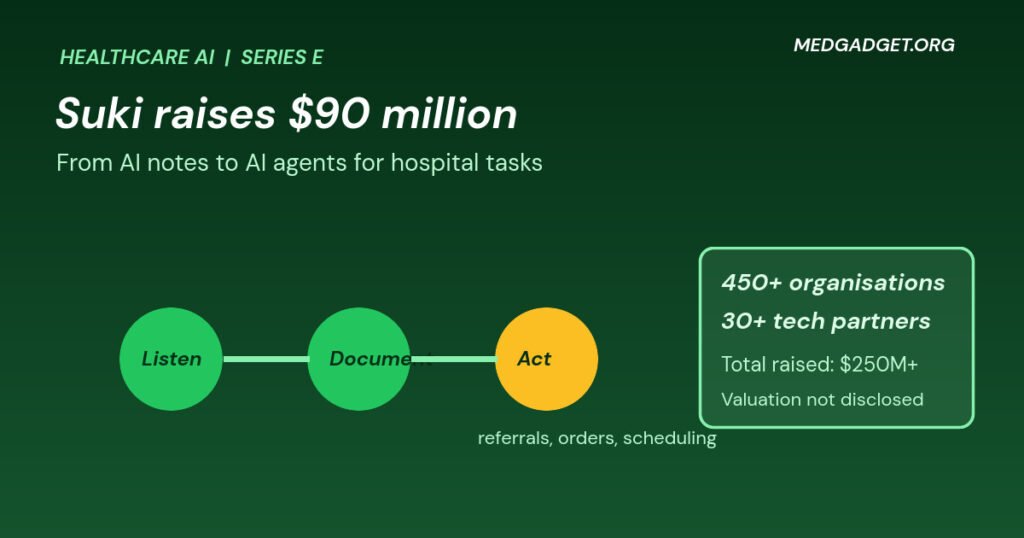

The Suki $90 million funding round is one of the larger bets this year on AI that does more than write clinical notes. Suki, the maker of an AI assistant for doctors, announced a $90 million Series E on 12 October 2026, with the money earmarked for building AI agents that take over tasks that follow a patient visit, such as referrals, prior authorisations, orders and scheduling. Reports name Healthier Capital as the lead investor.
We could not find a primary company release, so the figures below come from trade summaries of the announcement. Company growth claims are the company’s own, and one revenue estimate was not confirmed by Suki. Here is what is reported, what it suggests and what to be cautious about.
Key takeaways
- Suki raised a $90 million Series E, bringing its total funding to more than $250 million, according to reports.
- Healthier Capital is reported as lead; Crosslink Capital and Hercules Capital are named as new investors.
- The money will fund AI agents for post-visit tasks and deeper work with more than 30 health technology partners.
- Suki says its tools are used by more than 450 healthcare organisations.
- No valuation was disclosed.
Who invested in the Suki $90 million funding round
Reports name Healthier Capital, Crosslink Capital and Hercules Capital as new investors, with existing backers including Venrock, Flare Capital Partners, Hedosophia, Philips Ventures and Zoom Ventures. Aman Mahajan, a partner at Healthier Capital, is reported to be joining Suki’s board. The company has now raised more than $250 million across five rounds, according to reports.
A source cited in one report put Suki’s 2026 revenue at $60 million to $80 million. The company did not confirm that figure, so we treat it as an unverified estimate. Suki itself says its revenue doubled in 2025 and that it expects similar growth this year, and that the number of patient encounters supported by its tools grew more than 190% year on year in 2026. These are company claims.
What the Suki $90 million funding builds on
Suki began with ambient clinical documentation: software that listens to a doctor’s conversation with a patient and drafts the note. It has since added automated order entry, billing code suggestions, patient summaries and a tool called Suki Ask, which answers clinical questions using chart data and a research database from Wolters Kluwer. Reports say Suki’s technology also powers ambient features inside partner products, with Optum, Zoom and athenahealth among those named.
The company says its clinician-facing app is used by more than 450 healthcare organisations, and that more than 30 technology partners embed its AI. Suki’s chief executive, Punit Soni, has described the aim as depth with partners rather than adding many more, and has pitched a single operating system for clinical, financial and operational work in place of many disconnected point tools.
What the Suki $90 million funding will build: AI agents
The new money is for agents that handle work after the visit and treatment plan are settled. Reports list referrals, prior authorisations for new medications, filling orders and scheduling follow-up visits. The agents are meant to use data from Suki’s existing tools. This shifts the product from drafting text for a doctor to completing administrative tasks, which is where much clinician time is lost.
It also raises the stakes. A wrong note can be corrected before signing, but a wrongly placed order or a missed referral reaches patients and payers. The announcement does not say how the agents will be supervised, what error rates they will target or how they will connect to electronic health records.
The field around the Suki $90 million funding
Suki competes with other ambient AI companies that are also moving beyond documentation. Reports mention Ambience Healthcare, which raised $243 million last year, and Abridge, which secured $300 million. Soni argued that very large rounds can set unrealistic expectations and said a company should raise only as much as it needs. For related coverage, see our report on Johns Hopkins Medicine’s partnership with OpenEvidence and our report on OpenEvidence’s four medical AI models, or browse our healthcare IT coverage.
Issues to watch in clinical AI
- Accuracy and oversight when AI completes tasks, not just drafts them.
- Privacy and data handling under HIPAA and local rules.
- Integration with electronic health records, where much of the value and friction lies.
- Evidence that time saved is real and that clinician burnout falls.
The Office of the National Coordinator for Health Information Technology publishes policy and guidance on health data and interoperability that affect how such tools connect to records. None of this is addressed in the announcement.
Our assessment of the Suki $90 million funding
In our assessment, the Suki $90 million funding is a clear sign that investors expect ambient scribes to become a platform business and not a feature. The strategic logic is sound: once software listens to every visit, it holds the information needed to automate follow-up work. The risk is competition, since larger rivals have raised more, and the burden of proving that agents are safe and save money. Revenue estimates that the company has not confirmed should be treated carefully.
What to watch after the Suki $90 million funding
- Launch dates and pilots for the first agents.
- Customer results showing time saved and error rates.
- Further partner integrations in electronic health records.
- Rival funding and acquisitions in clinical AI.
Frequently asked questions about the Suki $90 million funding
How much did Suki raise?
$90 million in a Series E, announced on 12 October 2026.
Who led the Suki $90 million funding round?
Reports name Healthier Capital as lead investor.
What will Suki do with the money?
Build AI agents for post-visit tasks such as referrals, prior authorisations and scheduling, and deepen partner integrations.
How many customers does Suki have?
The company says more than 450 healthcare organisations use its app, and more than 30 technology partners embed its AI.
What is Suki’s valuation?
It was not disclosed.
How we reported this: we relied on trade summaries of Suki’s 12 October 2026 announcement because we could not access a primary release. Company figures are the company’s own claims. Last updated: 14 October 2026. This article is news reporting and not investment or medical advice.