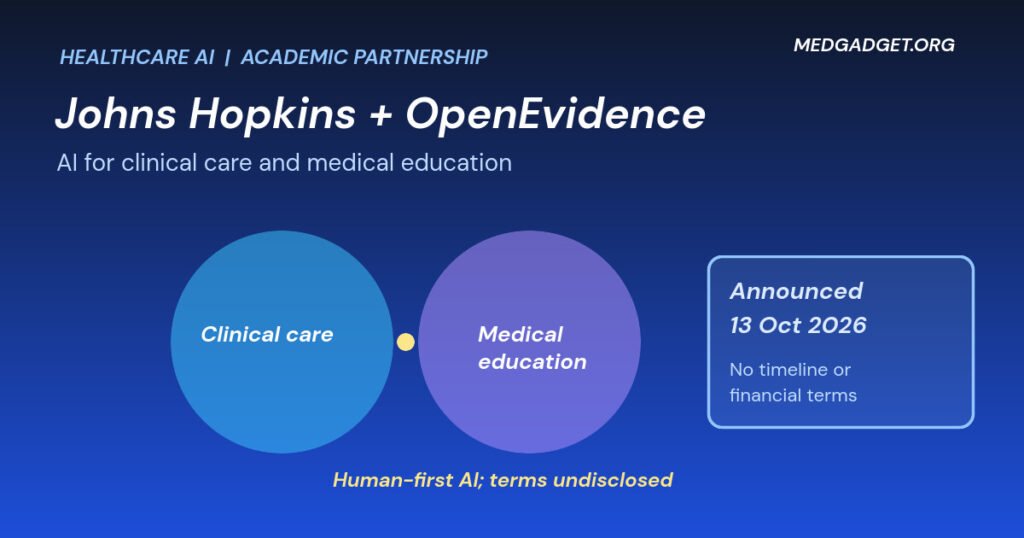

The Johns Hopkins OpenEvidence AI partnership will bring a widely used medical AI tool into the planning of both patient care and physician training at one of the best-known academic health systems in the United States. On 13 October 2026, Johns Hopkins Medicine and OpenEvidence announced a collaboration to design what they call the future of medicine and medical education in the age of artificial intelligence.
The announcement describes goals rather than products. It gives no launch date, scope, financial terms or deliverables. This article sets out what was said, what the claims rest on and the questions that will decide whether the partnership matters.
Key takeaways
- Johns Hopkins Medicine and OpenEvidence will work together on clinical care tools and on a new model of medical education.
- The clinical work aims at “human-first” AI that surfaces and synthesises evidence tailored to a patient’s history and Hopkins best practices.
- The education work aims to reinforce core medical reasoning while building adaptive AI systems for learners.
- Rollout timeline, scope and financial terms were not disclosed.
What the Johns Hopkins OpenEvidence AI partnership includes
According to the announcement, the partners will pursue two tracks. In clinical care, they will develop AI systems that pull together the best available evidence and adapt it to a patient’s medical history and to Hopkins’ established best practices, to help clinicians reason through the information and decide. The release stresses that the systems are meant to be “human-first”, meaning clinicians stay in charge of the decision.
In education, the partners plan to design an educational model that strengthens pathophysiology, evidence-based medicine, first-principles reasoning, and diagnostic and interpersonal skills. They also plan adaptive AI systems intended to prepare physicians to lead and keep learning in an AI-driven environment. The announcement does not mention research as a track.
Who said what
Sanjay Desai, vice dean for education at Johns Hopkins Medicine, said AI invites medicine back to the bedside with new tools. Sara Murray, the system’s chief medical informatics and AI officer, said the goal is to give clinicians tools for more informed, precise and patient-focused care. Travis Zack, OpenEvidence’s chief medical officer, said the future of medicine should be shaped deliberately and keep patients at the centre. These are statements of intent from the partners.
About OpenEvidence
OpenEvidence describes itself as the most popular AI for doctors in the United States and says most US physicians use it daily. It also says independent studies show more US physicians use it than all other AI platforms combined, though the release does not name the studies. It says its answers are sourced, cited and grounded in peer-reviewed literature, and that the service is free for verified US clinicians. All of these are the company’s claims and we have not verified them. For our coverage of the company’s product line, see our report on OpenEvidence’s four medical AI models with different levels of research depth.
Why the Johns Hopkins OpenEvidence AI partnership matters
Most clinical AI tools reach doctors as consumer-style products that individual physicians adopt on their own. A partnership with a health system changes that. It could allow the tool to be tuned to local protocols, tested in a structured way and built into teaching. It also gives the AI company access to clinical expertise and, potentially, to feedback about where answers fall short.
The risks are equally clear. Tools that summarise evidence can be wrong or out of date, can sound more certain than the underlying studies justify and can bias trainees toward fast answers in place of reasoning. The announcement’s emphasis on first-principles reasoning and “human-first” design suggests the partners know this, but it does not say how they will measure it.
Questions the Johns Hopkins OpenEvidence AI partnership must answer
- How will accuracy and safety be evaluated before tools reach patients?
- Will patient data be used, and under what privacy and governance rules?
- Will the clinical tools count as regulated decision support? The FDA publishes clinical decision support software guidance that sets out which software falls under device rules.
- How will the education model be tested to show that trainees reason better, not just faster?
- Who owns the tools and any data that emerge from the work?
Until those answers are public, the partnership is best read as a statement of direction. For other recent AI and care stories, see our report on Temple University and Aide Health’s AI diabetes care model, or browse our healthcare IT coverage.
Our assessment of the Johns Hopkins OpenEvidence AI partnership
In our assessment, the Johns Hopkins OpenEvidence AI partnership is significant mainly for who is involved. A leading medical school and a market-leading clinical AI tool are agreeing to build together, and that sets an example other academic centres may follow. But the announcement contains no results, no timeline and no safeguards that we can assess. It would be premature to conclude that it will improve care or education. The test will be published evaluations showing that the tools help clinicians make better decisions and help trainees learn, and that they do so safely.
What to watch after the Johns Hopkins OpenEvidence AI partnership
- The first products or pilots that come out of the collaboration.
- Published evaluation of accuracy, safety and educational impact.
- Disclosure of data-sharing and governance arrangements.
- Similar agreements between OpenEvidence and other health systems.
Frequently asked questions about the Johns Hopkins OpenEvidence AI partnership
What is the Johns Hopkins OpenEvidence AI partnership?
A collaboration to design AI tools for clinical care and a new model of medical education, announced on 13 October 2026.
Are there financial terms in the Johns Hopkins OpenEvidence AI partnership?
None were disclosed.
What is OpenEvidence?
An AI platform for clinicians that says it gives sourced, cited answers grounded in peer-reviewed literature. It says it is free for verified US clinicians.
Will the Johns Hopkins OpenEvidence AI partnership let AI make clinical decisions?
The partners say the systems are “human-first” and meant to help clinicians reason, not replace them.
When will the tools launch?
No timeline has been given.
How we reported this: we relied on the partners’ 13 October 2026 announcement, which is a company statement carried by a distribution service. Last updated: 14 October 2026. This article is news reporting and not medical advice.