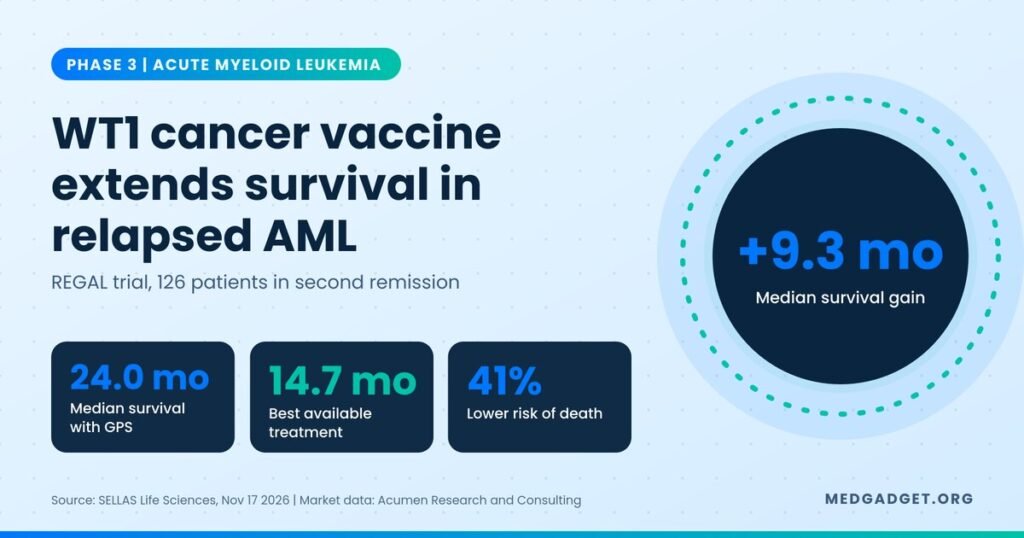

Sellas REGAL trial results announced on November 17, 2026 show that galinpepimut-S (GPS), an off-the-shelf peptide cancer vaccine, helped people with relapsed acute myeloid leukemia (AML) in second remission live a median of 24.0 months, compared with 14.7 months for those given the best available treatment. The hazard ratio for death was 0.59, a 41% reduction in risk, with a two-sided p-value of 0.035. SELLAS Life Sciences plans to meet the FDA and file a Biologics License Application in the first half of 2027.
The readout pushed the company’s ticker, SLS, onto Google’s US trending searches on Tuesday. Below we explain what the trial tested, how strong the evidence is, and what still has to happen before any patient can get the vaccine outside a study.
Key takeaways on the Sellas REGAL trial
- REGAL randomized 126 AML patients in second or later remission who could not have a stem cell transplant, 1:1 to GPS or investigator’s choice of therapy.
- Median overall survival was 24.0 months with GPS versus 14.7 months with best available treatment, a gap of 9.3 months by our calculation.
- The hazard ratio of 0.59 means a 41% lower risk of death at any point during follow-up; the analysis was triggered by the prespecified 80th death.
- Side effects were mostly mild to moderate, with injection-site reactions the most common; no new safety signals were reported.
- Confidence intervals, secondary endpoints and subgroup data have not yet been released; full data are promised at a major medical meeting.
The numbers at a glance
| Measure | Galinpepimut-S | Best available treatment |
|---|---|---|
| Patients randomized (total 126) | About 63 | About 63 |
| Median overall survival | 24.0 months | 14.7 months |
| Hazard ratio for death | 0.59 (two-sided p = 0.035) | |
| Deaths at analysis | 80 (prespecified trigger) | |
| Relative gain in median survival | About 63% longer (by our calculation) | |
Arm sizes are approximate because the company reported only the total and the 1:1 ratio.
Who the vaccine is for
REGAL (NCT04229979) enrolled a hard-to-treat group. These are adults whose AML came back after initial treatment, who then reached a second or later complete remission (CR2 or CRp2) after salvage therapy, but who were not eligible for, or could not undergo, an allogeneic stem cell transplant. A transplant is the main route to long-term control in relapsed AML, so patients who cannot have one usually face another relapse within months.
In the control arm, doctors could choose observation, a hypomethylating agent, venetoclax, low-dose cytarabine, or combinations of these. That reflects real-world practice, but it also means the comparator was not a single fixed regimen.
How galinpepimut-S works
GPS is made of four synthetic peptides taken from the Wilms’ tumor 1 (WT1) protein, which is found at high levels in many leukemia cells and in few healthy adult tissues. Injected under the skin, the peptides are meant to train both helper (CD4+) and killer (CD8+) T cells to recognise WT1 and keep residual leukemia in check. SELLAS licensed the technology from Memorial Sloan Kettering Cancer Center.
Because the patients in REGAL were already in remission, the idea is maintenance: use the immune system to delay relapse rather than to shrink a large tumor. Therapeutic cancer vaccines have a long record of failures in late-stage trials, which is part of why a positive overall survival result is drawing attention. Overall survival is also the endpoint regulators value most. Earlier this week the FDA turned down a lung cancer drug largely because its survival data fell short, as we covered in our report on the ivonescimab FDA rejection.
How strong is the evidence?
A 9-month median survival gain in this setting is clinically meaningful, and the result hit statistical significance on the primary endpoint. Still, several points deserve caution until the full dataset is out:
- Small trial. With 126 patients and 80 deaths, a few events can move the estimate. A p-value of 0.035 clears the usual 0.05 bar but not by a wide margin.
- Open-label design. Patients and doctors knew which treatment was given. Survival is an objective endpoint, but later treatment choices could differ between arms.
- Missing detail. The release did not give the confidence interval, leukemia-free survival, or how many patients in each arm later received other therapies.
- Mixed control arm. Varied comparator regimens make it harder to say how GPS compares with any one standard option.
The FDA will look closely at these issues. A single randomized trial can support approval in a serious disease with few options, but the agency will want the full secondary endpoint and safety analyses first.
Safety profile so far
SELLAS described GPS as generally well tolerated, with treatment-related adverse events mostly grade 1 or 2. Local reactions at the injection site were the most frequent. The company said it saw no new safety signals compared with earlier studies. Detailed adverse event tables have not been published.
Market context
Therapeutic cancer vaccines remain a small slice of a growing field. According to Acumen Research and Consulting, the global cancer vaccines market was worth USD 10.2 billion in 2023 and is projected to reach USD 34.4 billion by 2032, a compound annual growth rate of 14.7%. Acumen notes that preventive vaccines, such as those against HPV, held the largest share in 2023, and that Asia-Pacific is expected to grow fastest. A first approved WT1 vaccine for AML would add to the much smaller treatment-vaccine segment.
What to watch next
- Full data presentation: SELLAS says detailed results will go to an upcoming major medical conference and a peer-reviewed journal.
- FDA meeting: the company will discuss an accelerated filing strategy, with a BLA targeted for the first half of 2027.
- SLS009 (tambiciclib): the company’s CDK9 inhibitor has Phase 2 combination data in high-risk AML slated for ASH 2026 in December.
For more coverage of new cancer drugs, see our report on the Wilserdly FDA approval and our biotechnology section.
Frequently asked questions
What is galinpepimut-S?
Galinpepimut-S (GPS) is an experimental cancer vaccine from SELLAS Life Sciences made of four WT1 peptides. It is designed to prompt T cells to attack leukemia cells that carry the WT1 protein.
Did the Sellas REGAL trial succeed?
Yes. The company reported that REGAL met its primary endpoint, with median overall survival of 24.0 months on GPS versus 14.7 months on best available treatment (hazard ratio 0.59, p = 0.035).
When could galinpepimut-S be approved?
SELLAS plans to submit a BLA in the first half of 2027. If the FDA accepts it, a decision would typically follow within about 6 to 12 months, depending on review type. No approval date has been set.
Can AML patients get the vaccine now?
Not outside clinical studies. GPS is investigational and has not been approved by the FDA or any other regulator. Patients should discuss trial options with their haematologist.
Sources: SELLAS Life Sciences press release (November 17, 2026); ClinicalTrials.gov NCT04229979. Market data: Acumen Research and Consulting, Cancer Vaccines Market report. This article is for information only and is not medical or investment advice. Last updated November 17, 2026.