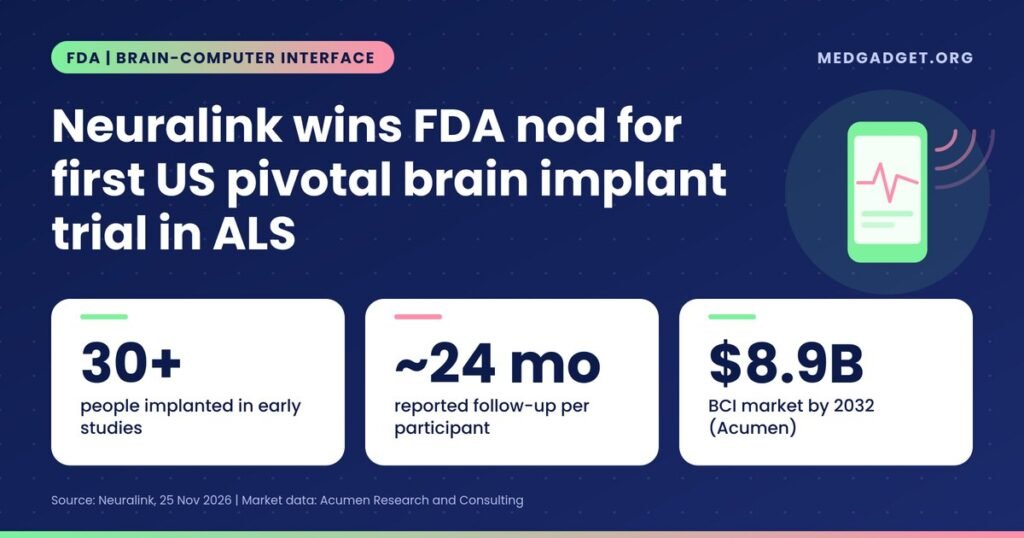

The Neuralink pivotal trial is now cleared to begin. On November 25, 2026, Elon Musk’s brain-chip company said the US Food and Drug Administration had approved its LINK Pivotal Study, a late-stage trial of an implanted brain-computer interface (BCI) in people with severe paralysis caused by amyotrophic lateral sclerosis (ALS). Neuralink calls it the first pivotal trial of an implantable BCI in the United States. Enrollment is open, but the company has not said how many people it will enroll or which hospitals will take part.
Key takeaways on the Neuralink pivotal trial
- The FDA decision lets Neuralink start a pivotal study. It does not approve the implant for sale, and the device remains investigational.
- The trial is for people with severe paralysis due to ALS. Reports citing Neuralink’s trial information say it is open to adults in the US.
- The core question is whether controlling computers and phones by thought is safe and useful enough to improve day-to-day independence.
- More than 30 people have already received the implant in early feasibility studies in the US, Canada and the UK.
- Follow-up is reported at about 24 months per participant, partly remote. Target enrollment and the site list have not been disclosed.
What the FDA green light does and does not mean
Medical devices usually move through two clinical stages before a company asks regulators to allow sales. Early feasibility studies test whether a device works at all in a handful of people. A pivotal study is the larger, more formal trial whose results are meant to support a marketing application. Neuralink has spent the past two and a half years in the first stage. With the LINK study it moves into the second.
In its announcement, Neuralink said the study will evaluate the safety and effectiveness of its BCI system and called it “an important step toward bringing implantable BCI technology to market.” That wording matters. A successful pivotal trial is a precondition for an FDA marketing decision, not a guarantee of one, and the agency has not published any details of its own on the decision.
The LINK study at a glance
| Item | What is known | Source |
|---|---|---|
| Announced | November 25, 2026 | Neuralink |
| Condition | Severe paralysis due to ALS | Neuralink |
| Main focus | Thought control of digital devices; functional independence | Neuralink |
| Safety focus | Long-term safety and reliability across multiple sites | Neuralink |
| Implant and surgery | N1 implant placed by the R1 surgical robot | Trial information, as reported |
| Follow-up | About 24 months, some visits remote | As reported |
| Prior experience | 30+ participants in US, Canada, UK | Neuralink |
| Planned enrollment | Not disclosed | Not disclosed |
How the Neuralink implant works
The N1 implant is a coin-sized device that sits flush in an opening in the skull. Ultra-fine, flexible electrode threads extend from it into the motor cortex, the part of the brain that plans movement. The implant has no external wires or battery pack: it sends data wirelessly and is charged wirelessly through the scalp. Because the threads are too fine to place reliably by hand, they are inserted by Neuralink’s R1 surgical robot, with the patient under general anaesthesia, according to the company’s trial information as reported by Interesting Engineering.
Once healed, a participant imagines moving their hand. Software decodes the resulting neural activity and turns it into cursor movement and left, right and middle clicks on a computer or phone. Neuralink calls this application Telepathy. For someone with advanced ALS, who may be unable to speak, type or use a mouse, that cursor can become the main route to messaging, browsing and controlling other devices.
Why ALS is the first target
Neuralink’s early studies also enrolled people with spinal cord injury and brainstem stroke, according to The Next Web. Starting the pivotal phase in ALS is a logical choice. ALS progressively destroys the motor neurons that control muscles while usually leaving the motor cortex able to generate movement intentions, so a cortical implant still has a signal to read. The need is also urgent and measurable: losing the ability to communicate is one of the most feared stages of the disease, and gains in independent device use are relatively easy to quantify in a trial.
Our reading is that a narrow, high-need population also gives regulators a clearer benefit-risk picture, which is often how first-of-a-kind implants reach the market before expanding to other indications.
Risks and open questions
Any BCI of this type requires brain surgery, with the usual risks of infection, bleeding and anaesthesia. Durability is the other big question. Neuralink’s first participant had major technical problems with the implant in 2024, as reported at the time by The New York Times and recounted by The Next Web, and the company adjusted its approach afterwards. The pivotal study is explicitly designed to look at long-term reliability, which suggests the FDA wants multi-year evidence rather than short demonstrations.
Several details are still missing: the number of participants, the trial sites, the exact primary endpoint and how success will be scored. Neuralink’s post did not mention any FDA designation such as Breakthrough Device status, and it gave no timeline for a marketing application or any indication of price.
Market context and the BCI race
According to Acumen Research and Consulting, the global brain-computer interface market was worth USD 1.9 billion in 2022 and is projected to reach USD 8.9 billion by 2032, a compound annual growth rate of 16.8%. Acumen found that non-invasive BCIs, such as EEG headsets, held the largest share and that North America dominated the market. Implanted systems like Neuralink’s are still a small slice of revenue today; a positive pivotal readout would be the first real test of whether that can change.
Competition is building. Paradromics implanted its first patient earlier this year and China has approved a commercial implant, according to The Next Web, while Synchron paused enrollment in its second-generation Stentrode trial this month over lead performance. Sight-restoring neural implants are also advancing: see our report on Science Corp’s PRIMA retinal implant. For more device coverage, browse our medical device section.
What to watch next
- A public trial registration listing the endpoints, enrollment target and sites.
- The first implant performed under the pivotal protocol.
- Any interim safety data, and whether Neuralink publishes its feasibility results in a peer-reviewed journal.
Frequently asked questions
Is the Neuralink implant FDA approved?
No. The FDA has approved a pivotal clinical trial, not the device itself. The implant can only be used inside approved studies.
Who can join the Neuralink ALS trial?
People with severe paralysis caused by ALS may be eligible; reports say the study is for adults in the US. Neuralink runs a patient registry on its website, and final eligibility is decided by the study team.
How long does the Neuralink LINK study last?
Participants are reportedly followed for about 24 months after implantation, with some visits done remotely.
When could Neuralink be available to patients?
Neuralink has not given a timeline. The trial must enroll, complete follow-up and produce results before the company can seek FDA marketing authorisation, which typically takes several years.
Sources: Neuralink announcement (November 25, 2026); The Next Web; Interesting Engineering. Market data: Acumen Research and Consulting, Brain Computer Interface Market report (updated October 2023). This article is for information only and is not medical or investment advice. Last updated November 26, 2026.