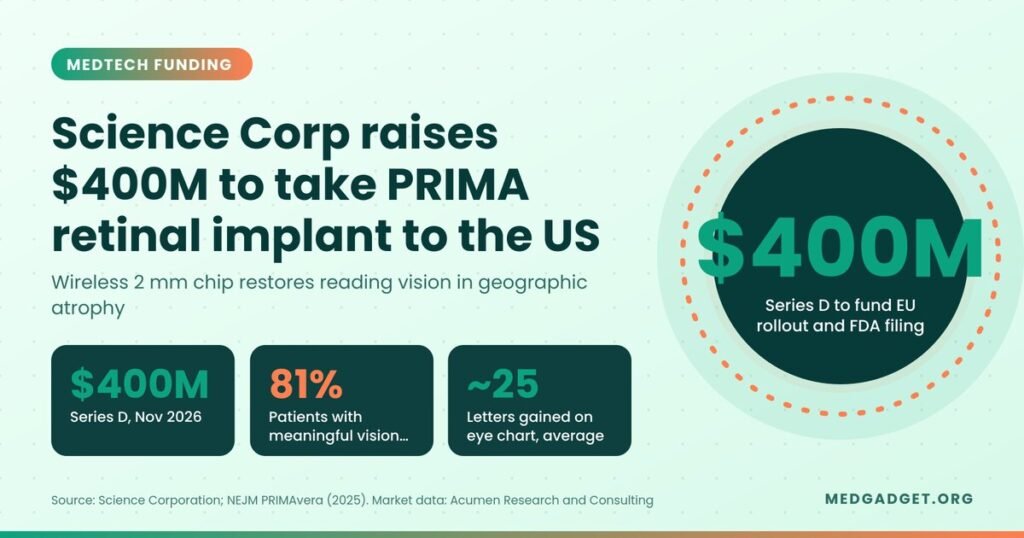

The PRIMA retinal implant just got the funding to chase a US launch: Science Corporation, the brain-computer interface company founded by Neuralink co-founder Max Hodak, announced a $400 million Series D on 17 November 2026. The money will widen access to PRIMA across Europe, where it carries a CE mark, and push it through the FDA’s Humanitarian Device Exemption pathway, with Hodak telling Bloomberg he hopes American patients can get it early in 2027.
PRIMA is a wireless chip about 2 mm square that sits under the retina and, paired with camera glasses, has helped people blinded in the centre of their vision by advanced dry age-related macular degeneration (AMD) read letters and words again. For the millions of older adults living with geographic atrophy, that is why this funding round matters more than a typical venture headline.
Key takeaways on the PRIMA retinal implant
- Science Corporation raised $400 million in a Series D announced on 17 November 2026, taking its total funding past $900 million since 2021.
- Investors named in coverage include Khosla Ventures, Ackman Oxman Institute, Tenet Healthcare, 885 Capital, Y Combinator and PLC Neurotech. Reports put the valuation at $3.5 billion, a figure the company has not confirmed.
- PRIMA received a CE mark in July 2026, opening sales in 30 European countries, with Germany first.
- In the PRIMAvera trial published in the New England Journal of Medicine, 26 of 32 patients (81%) followed for a year had a clinically meaningful gain in visual acuity, averaging about 25 letters on an eye chart.
- In the US, PRIMA holds Humanitarian Use Device designations for advanced geographic atrophy in both eyes and for Stargardt disease. It is not FDA approved yet.
What Science Corporation announced
Science disclosed the round in a company blog post on 17 November. Trade and tech outlets including MedTech Dive and SiliconANGLE reported that the cash will fund three things: commercial rollout of PRIMA in more European markets, a US regulatory filing and launch preparation, and heavier investment in manufacturing, operations and research.
Coverage is not fully consistent on who led the round. One report credits Khosla Ventures as lead, while another says Science named no lead investor. The $3.5 billion valuation also comes from people familiar with the deal rather than the company. Readers should treat both details as reported, not confirmed.
Science raised a $230 million Series C in March 2026, reportedly at about a $1.5 billion valuation. If the new figure is right, that is a 2.3x increase in about eight months (by our calculation).
How the PRIMA system restores sight
Geographic atrophy destroys the light-sensing photoreceptor cells in the macula, the part of the retina used for reading and recognising faces. The cells behind them, which pass signals on to the brain, often survive. PRIMA is designed to use those surviving cells.
The system has two parts:
- The implant. A thin photovoltaic chip, about 2 x 2 mm, placed under the retina in the damaged area. Coverage describes it as having 378 pixels, each with its own tiny electrode, and no wires or battery.
- The glasses. A forward-facing camera captures the scene, a processor adjusts it, and the glasses project it onto the chip as near-infrared light. Each lit pixel turns that light into a small electrical pulse that stimulates the remaining retinal cells, which send the signal to the brain.
Because the light is near-infrared, it does not interfere with the patient’s remaining natural side vision. Science describes PRIMA as the first CE-marked brain-computer interface that restores “form vision”, meaning the ability to make out letters, numbers and words, rather than only light and shapes.
What the PRIMAvera trial showed
The pivotal European study, PRIMAvera, was published in the New England Journal of Medicine in October 2025. It ran at 17 sites in France, Germany, Italy, the Netherlands and the UK and enrolled 38 people aged 60 and over with geographic atrophy.
| Measure (12 months) | Result |
|---|---|
| Participants with 12-month follow-up | 32 |
| Clinically meaningful improvement in visual acuity | 26 of 32 (81%) |
| Average gain on eye chart | About 25 letters (5 lines) |
| Largest single gain reported | 59 letters (12 lines) |
| Used PRIMA at home to read letters, numbers or words | 27 of 32 (84%) |
| Long-term follow-up reported by Science | Gains maintained through 36 months |
Two cautions apply. The trial was single-arm, so there was no randomised control group, and the reading gains depend on the glasses and zoom functions, not on natural vision returning. Investigators reported that procedure-related side effects, which can follow any subretinal surgery, had settled by one year, but patients still face surgical risks such as retinal detachment or bleeding that a surgeon would need to discuss.
Where PRIMA is available and when it could reach the US
| Region | Status (November 2026) |
|---|---|
| European Union | CE mark since July 2026; first commercial implants expected in Germany |
| Italy, France, UK | Launches expected in the coming months; reimbursement applications in progress |
| United Kingdom (private) | Science is seeking a self-pay option at Moorfields Private Eye Hospital; price not disclosed |
| United States | Under FDA review via Humanitarian Device Exemption; target availability early 2027 (company hope, not a confirmed date) |
The HDE route covers devices for small patient populations and requires evidence of safety and probable benefit rather than the full effectiveness standard of a premarket approval. It is faster, but can limit how widely a device is used and marketed.
Market context
The retinal implants market report from Acumen Research and Consulting valued the global market at USD 49.1 million in 2022 and projects it to reach USD 132.8 million by 2032, a compound annual growth rate of 10.6%. Acumen found that implantable miniature telescopes held the largest share in 2022 and that Asia-Pacific was the fastest-growing region. Science’s single funding round is about eight times that entire 2022 market (by our calculation), a sign that investors expect PRIMA to expand the category rather than compete for a small one.
The wider field is larger. Acumen’s brain-computer interface market analysis puts global BCI revenue at USD 1.9 billion in 2022, rising to USD 8.9 billion by 2032 at a 16.8% CAGR, with non-invasive systems holding the largest share. Both Acumen reports were last updated in 2023, so their forecasts predate PRIMA’s European approval and should be read as indicative.
Beyond PRIMA
Science is also testing PRIMA in Stargardt disease and is developing a “biohybrid” brain interface that pairs lab-grown neurons with silicon, so far tested only in animals, with first human trials hoped for within about 16 months. For more on new approaches to eye disease, see our report on the Nucelion and Pandorum exosome eye therapy partnership.
What to watch next
- FDA decision timing. Science has not published a target action date. An early-2027 US launch depends on the agency completing its HDE review.
- Price and reimbursement. No price has been disclosed in Europe or the US. Coverage decisions in Germany, France and Italy will shape how many patients can access it.
- Who qualifies. PRIMA was tested in people with advanced geographic atrophy and very poor central vision. It is not a treatment for earlier AMD or for wet AMD.
Frequently asked questions
What is the PRIMA retinal implant?
PRIMA is a 2 mm wireless photovoltaic chip implanted under the retina, used with camera glasses that beam near-infrared images onto it. It stimulates surviving retinal cells to restore some central “form vision” in people with geographic atrophy from dry AMD.
Is the PRIMA implant FDA approved?
No. As of November 2026, PRIMA is under FDA review through the Humanitarian Device Exemption pathway. Science Corporation hopes US patients can access it in early 2027, but no approval has been announced.
How well does PRIMA work?
In the PRIMAvera trial, 81% of the 32 patients followed for 12 months had a clinically meaningful improvement in visual acuity, with an average gain of about 25 letters on an eye chart, and 84% used it at home for reading.
How much did Science Corporation raise and who invested?
Science Corporation raised $400 million in a Series D announced on 17 November 2026. Named investors include Khosla Ventures, Ackman Oxman Institute, Tenet Healthcare, 885 Capital, Y Combinator and PLC Neurotech. A $3.5 billion valuation has been reported but not confirmed by the company.
Sources: Science Corporation Series D announcement (17 Nov 2026) as reported by MedTech Dive, SiliconANGLE and The Next Web; New England Journal of Medicine PRIMAvera publication (Oct 2025) and University of Pittsburgh release. Market data: Acumen Research and Consulting. This article is for information only and is not medical or investment advice. Last updated 20 November 2026.
More medical device news: Medical Device